Showing posts with label wisconsin synod. Show all posts

18 March 2025

Schöpfer dieser ganzen Welt

The next new translation from Lochner’s Passion-book, Devotion 13 (“Christ’s Further Discourses after Judas’ Departure”) is “Schöpfer dieser ganzen Welt” (B. Schmolck, d. 1737), from which the 2nd-article creedal stanzas 5 and 7 are quoted. This hymn ought to have been translated when I was “filling in the gaps” in the Evangelisch-Lutherisches Gesangbuch (Milwaukee, 1872), where it appears as #143 in a cento of 4 stanzas (i.e., 2nd article, to be sung on Christmas) beginning “Gottes und Marien Sohn.” However, it was originally published in 12 stanzas in the Schmolck’s Freuden-Öl (1711), p. 197 ff., with title “LXX. Holy sighs while meditating on the three articles of the Creed,” in which form I give it here.

Mel.: Jesus, meine Zuversicht


(1st article)
MAKER of the world’s domains,
Earth and heaven, Thy creation
Which Thy Word made and sustains,
Of Thy pow’r give attestation;
All these things Thy potency
Out of nothing made to be.

2 All Thy creatures, God, are good:
Grant that I may not abuse them,
But curb sinful flesh and blood,
Not excessively to use them.
All Thy works in unity
Mighty Maker, point to Thee.

3 I too am Thy handiwork:
Soul and mind and every member;
Grant that I this well may mark,
And with grateful heart remember;
In Thy might let me confide,
And on Thee till death abide.

4 Do I live alone in Thee?
Let me live, then, to Thy glory;
Thou wilt all supply to me
That I need to live before Thee.
I resign myself to Thee;
Care both here and there for me.

(2nd article)
5 Son of God and Mary sweet,
Prophet, Priest, and King forever;
Mediator, Mercy-seat,
Crucified and living Savior:
Let my faith Thee know and claim,
And Thee my dear Jesus name!

6 Thou, my Jesus, wast made Man,
For me born and crucifìed.
What was lost in Adam’s ban
Is by Thee again supplièd.
Give me strength that I may be
Thine alone eternally.

7 All salvation’s in Thy hand,
Savior all sinners lowly!
In Thy death life’s door doth stand,
Who hast death deafeated wholly.
Let Thy suffering and death
Be my merit and my faith.

8 By Thee, Mighty Victor crowned,
Death and hell have lost their power;
By this vict’ry I have found
Rest within the grave’s brief hour-.
By Thee I shall rise complete
And the Judge unfearing meet.

(3rd article)
9 Light of Father and of Son,
Lighten me with rays availing,
Strengthen me before God’s throne
When my feeble faith is failing.
Prompt me with the Abba-cry,
And in me, good Spirit, sigh.

10 Thy true member make Thou me,

In the church of Christ connected,
Lest my heart should stolen be,
Or the temple be dissected,
Which Thou hast, O worthy Guest
Built to be Thy dwelling blest.

11 Comfort me in my remorse
By forgiving my transgression;
Help me in my groanings hoarse,
To find grace, not vindication;
Prove, when comforts melts away,
That I am Thy child for aye!

12 Let me after this brief hour
Hope assured in life hereafter,
Till faith’s boldness lose its pow’r
To the sight of joy and laughter,
And what here my creed doth show,
There as pure Amen shall glow!

Translation © 2023, 2024 Matthew Carver.

GERMAN

Schöpfer dieser ganzen Welt,
Erd und Himmel, deine Werke,
die dein Wort schuf, und erhält,
zeigen gnugsam deine Stärke;
alles diß hat deine Macht
nur aus nichts hervorgebracht.

2 Alle Kreatur ist gut;
gib, daß ich den Misbrauch meide,
und mein sündlich Fleisch und Blut
nicht zu sehr an ihnen weide.
Das Geschöpfe weiset mich,
großer Schöpfer, nur auf dich.

3 Ich bin auch dein Händewerk,
Leib und Seel ist dein Geschenke.
Gib, daß ich es fleißig merk,
und mit Danken dran gedenke;
daß ich deiner Macht vertrau,
und noch ferner auf dich bau.

4 Web und leb ich nur in dir?
Laß mich dir zu Ehren leben;
du wirst auch noch ferner mir
meines Lebens Nothdurft geben.
Ich verlasse mich auf dich,
sorge hier und dort für mich.

5 Gottes und Marien Sohn,
Priester König und Prophete,
Mittler und Genadenthron [Mittler, Bürge…]
der am Kreuze sich erhöhte!
Gib, daß dich mein Glaube kenn[t]
und dich meinen Jesum nenn[t].

6 Du, mein süßer Jesus, bist
mir geboren, mir gestorben.
Was in Adam ich vermißt, [Was zerstört in Adam ist,]
hast du wiederum erworben.
Gib mir Kraft, daß ich dorthin [Gibe, daß ich in wahrer Treu]
auch dein Eigenthum stets bin […sei.]

7 Alles Heil kommt nur von dir,
Heiland aller armen Sünder!
Dein Tod war die Lebensthür
und des Todes Überwinder.
Laß auch deines Leidens Pein
mein Verdienst und Glaube sein.

8 Tod und Hölle sind durch dich,
großer Sieger, überwunden,
und durch diesen Sieg hab ich
Ruh im Tod und Grabe funden; […Grab gefunden]
durch dich werd ich auferstehn
und getrost zum Richter gehn.

9 Licht vom Vater und dem Sohn,
leuchte mir mit deinem Scheine;
Stärke mich vor Gottes Thron,
wenn mein schwacher Glaube kleine.
Sprich mir selbst das Abba für;
seufze, guter Geist, in mir.

10 Gib, daß ich ein wahres Glied
in der Kirche Christi heiße,
daß niemand mein Herz bezieht,
noch den Tempel hier zerreiße,
welchen du, o werther Gast,
dir allein gebauet hast.

11 Tröste mich bei meiner Reu
mit Vergebung meiner Sünde;
stehe mir mit Seufzen bei,
daß für Recht ich Gnade finde.
Wenn mir aller Trost zerrinnt,
zeuge, daß ich Gottes Kind.

12 Lasse mich nach dieser Zeit
auf ein ander Leben hoffen,
bis des Glaubens Freudigkeit
auch im Schauen eingetroffen.
Und was hier mein credo weist,
dorten lauter Amen heißt.


04 May 2023

O Sündenmensch, bedenk dein Tod

Here is my translation of the Eternity hymn “O Sündenmensch, bedenk dein Tod” (Georg Philipp Harsdörfer, d. 1658), Ev.-luth. Gsb #692, originally published in the author’s Hertzbewegliche Sontags-Andachten nach den Evangelien (Nuremberg, 1649). The appointed melody is “Herr Jesu Christ, wahr Mensch und Gott.”


O MAN of sin, think on thy death,
Thy last distress, thy final breath;
By true repentance ready thee
To live for all eternity.

2 Though ye possess the whole wide world,
With highest honor and all gold,
A little time it gladdens thee,
And serves not for eternity.

3 Oh, dost thou not the echoes hear:
“Ye dead, for judgment now appear”?
The Last Day is not far from thee.
Then cometh dread eternity.

4 That God’s good grace may be enjoyed,
The heavy guilt of sin avoid,
That fights thy soul most angrily;
Free art thou in eternity.

5 Unnumbered are the starry host
And grains of sand upon the coast,
Yet they have measure and degree;
Not so is God’s eternity.

6 Oh, think and ponder undeterred:
Eternity! O thundrous word!
Time of no eons setteth free
The pure, untamed Eternity!

Translation © 2023 Matthew Carver.

GERMAN
O Sündenmensch, bedenk den Tod,
der letzten Stunde Angst und Noth!
Mach dich mit wahrer Buß bereit,
zu leben in der Ewigkeit.

2 Besitzet du die ganze Welt
mit höchster Ehr und allem Geld:
erfreut es dich ein kleine Zeit,
und dienet nicht zur Ewigkeit.

3 Erschallt in deinen Ohren nicht:
Ihr Todten kommet vor Gericht?
Ist doch der jüngste tag nicht weit,
dem folgen wird die Ewigkeit.

4 Wenn du begehrest Gottes Huld,
so meid der Sünden schwere Schuld,
die wider deine Seele streit:
so bist du frei in Ewigkeit.

5 Unzählig ist der Sterne Heer,
die Tropfen und der Sand am Meer:
doch haben sie Maaß, Ziel and Zeit,
ind gleichen nicht der Ewigkeit.

6 Besinn und denke fort und fort,
was Ewig! für ein Donnerwort.
Ach keiner Zeiten Zeit befreit
die Ewig-Ewig-Ewigkeit!

03 May 2023

Ewig, ewig! heißt das Wort

Here is my translation of the Eternity hymn, “Ewig, ewig! heißt das Wort” (Benjamin Schmolck, d. 1737), in Ev.-luth. Gsb. #691, first in the author’s collection, Bochim und Elim (1731). The appointed melody is “Meinen Jesum laß ich nicht.” The older melody fits well here.


EVER! Word both dread and fair!
Word that we do well to ponder:
Here for time and ever there—
At this truth all men must wonder;
When life’s little day shall flee,
Long eternity shall be.

2 Time at last shall have an end,
By eternity be swallowed;
Sorrows ’twill increase or mend,
As we here the cure have followed;
As we here in time have done,
So eternity will run.

3 Ever thrives the heritage
Of the saints in Christ believing,
Faithful ones of every age,
Loving e’er without deceiving;
Them that here in sorrows drown
Shall eternity then crown.

4 Ever shall he be accursed
Who hath here his life-day squandered
And for shame his wealth dispersed
And in search of pleasures wandered.
Him eternity shall cast
Into endless woe at last.

5 Here in time, my God, let me
On eternity well ponder,
Nor by self-security
From the heav’nly purpose wander,
Lest, ere time runs out, I be
Taken by eternity.

6 Ever! sound of sweet delight
To the man in faith who liveth;
Ever! echo full of fright
If against his God he striveth!
Help me, God, in grace and love
That this word may blissful prove.

Translation © 2023 Matthew Carver.

GERMAN
Ewig, ewig! heißt das Wort,
das wir wohl bedenken müssen;
zeitlich hier und ewig dort,
das ist, was wir alle wissen;
denn nach dieser kurzen Zeit
folgt die lange Ewigkeit.

2 Es wird endlich alle Zeit
von der Ewigkeit verschlungen;
diese bringet Freud und Leid.
Wie man hier darnach gerungen,
was wir in der Zeit gethan,
schreibt die Ewigkeit uns an.

3 Ewig wird das Erbe sein
derer, die an Christum gläuben,
und ohn allen Heuchelschein
treu in seiner Liebe bleiben.
Für das Leiden dieser Zeit
krönet sie die Ewigkeit.

4 Ewig aber ist verflucht,
wer die Zeit in seinem Leben
zu verschenden hat gesucht
und sich eitler Lust ergeben.
Diesem bringt die Ewigkeit
endlich ein unendlich Leid.

5 Mein Gott, laß mich in der Zeit
an die Ewigkeit gedenken,
und durch keine Sicherheit
mir das rechte Ziel verschränken,
daß mich, eh die Zeit verläuft,
nicht die Ewigkeit ergreift.

6 Ewig, ewig! süßer Schall,
wenn man hier hat from gelebet!
Ewig, ewig! Schreckenshall,
wenn man Gott hat widerstrebet!
Steh mir, Gott, in Gnaden bei,
daß das Wort mir Jubel sei.

02 May 2023

Es mag dies Haus das aus Erden

Here is my translation of the Heaven/Eternity hymn, “Es mag dies Haus das aus Erden” (Jacob Baumgarten d. 1722), Ev.-luth. Gsb #690, first appearing in Freylinghausen 1714 set to “Wachet auf ruft uns die Stimme,” though as Fischer notes, the German is a syllable short in lines 1 and 4. Fischer says The hymn is the second half of the hymn “Gott wohnt in seiner Himmelshöhe” to which he refers the reader.


THOUGH this house, of earth so humble,
Grows ever older and must crumble,
Another house for us is built;
God Himself doth build it for thee,
Adorns it with His heav’nly glory,
Eternal, ne’er to fall nor tilt.
All earthly things depart!
My spirit and my heart
Hence are fleeing,
Grasping this word,
E’en now transferred
To heav’nly joy before my Lord.

2 Here there is no veil to sever,
The holy place is open ever:
O blest contentment waits for thee!
Here for our delight is given
The One who made the earth and heaven,
The blessed Holy Trinity.
The angels’ beauty here
Is made our beauty dear;
All as brethren
In love’s embrace
Live in this place;
O heart and soul, rejoice a space!

3 Here is naught but joy and lightness,
Our robes are silk of whitest brightness,
And ours, eternal holiness;
Crowns of gold we here are wearing,
And thrones of gold with God are sharing,
Nor do time’s changes here oppress;
Cease, mind, to worry so!
Now whither wilt thou go?
Softly, softly
Draw near the throne
Where God alone
Is All in all, and e’er thine own.

Translation © 2023 Matthew Carver.

GERMAN
Es mag dies Haus, das aus Erden,
nur immerhin zerbrochen werden;
ein andres Haus wird uns erbaut.
Gott selbst will den Bau vollführen,
mit ewger Himmelsklarheit zieren,
dran man nichts Unvollkommnes schaut.
Hinweg, was irdisch heißt!
Mein Herz und ganzer Geist
fleucht von hinnen,
ergreift dies Wort, und ist schon dort
an jenem selgen Freudenort.

2 Kein Vorhang wird angetroffen,
das Allerheiligste steht offen:
o seligste Zufriedenheit!
Hier giebt sich innig zu küssen,
mit süßer Wonne zu genießen
die heiligste Dreieinigkeit.
Es schenkt sich uns allhier
der Engel schöne Zier;
alle Frommen
unfassen sich recht brüderlich:
o Herz und Seele freue dich!

3 Hier ist lauter Licht und Freude:
hier kleidet uns nur weise Seide
der allerreinsten Heiligkeit;
wir trag'n lauter güldne Kronen,
wir sitzen hier auf güldnen thronen;
hier wechselt sich gar keine Zeit.
Hör auf mein blöder Sinn,
wo willst du endlich hin?
Stille stille!
Geh ruhig ein, wo Gott allein
wird alles und in Allem sein.


01 May 2023

Wer sind die vor Gottes Throne

Here is my supplemental translation for Cox’s translation of the Eternity / Heaven hymn, “Wer sind die vor Gottes Throne” (Heinrich Theobald Schenk, d. 1727), in Ev.-luth. Gsb #689, first appearing in the Hessia-Darmstadt Gsb 1733 with the name of the author. Fischer specifies 18 stanzas rather than 20. The Wisconsin hymnal cento  has 11 stanzas consisting of stanzas 1–3, 6–9, 14–15, 17, and 20 of the original. Cox’s translation consists of stanzas 1–3, 6–11, 14–17, and 20. Other translations are offered by Winkworth and Tozer, though not of different stanzas. Accordingly I supply stanzas 4-5, 12–13, and 18–19 below, to be sung with Cox’s other stanzas: 4–5, being narrative and contextual and relatively void, were almost universally omitted in later hymnals. I also provide a variant stanza 16. The appointed melody is “Gott des Himmels und der Erden,” though “Unser Herrscher, unser König” is also designated in other hymnals.


WHO are these like stars appearing,
These before God's throne who stand?
Each a golden crown is wearing;
Who are all this glorious band?
Alleluia! hark, they sing,
Praising loud their heav’nly King.

2 Who are these, who palms are clasping,
Like a conqu’ror, in their hand,
When he sees his foeman grasping,
Stretched before him in the sand?
What the combat, who the foes,
Whence this victory arose?

3 Who are these, in dazzling brightness,
Clothed in God’s own righteousness,
These, whose robes of purest whiteness,
Shall their lustre still possess,
Still untouched by time's rude hand?
Whence come all this glorious band?

*4 So of Christ’s esteemed attendant
John, an elder did inquire.
Him did God by pow’r resplendant,
With a vision rare inspire,
Giving him a wondrous sight
Of th’ elected host in light.

*5 Humbly to the elder holy
John did answer: “Sir, thou know’st.”
Mark the man of God, here lowly,
Honoring his elder host,
Who instructed John aright
In that rare and wondrous sight:

6 “These are they who have contended
For their Savior's honor long,
Wrestling on till life was ended,
Following not the sinful throng;
These, who well the fight sustained,
Triumph through the Lamb have gained.

7 These are they whose hearts were riven,
Sore with woe and anguish tried,
Who in prayer full oft have striven
With the God they glorified;
Now, their painful conflict o'er,
God has bid them weep no more.

8 Branches of that stock that saved them,
Where both grace and health unite,
In the Lamb’s pure blood they laved them,
Washed their robes and made them white:
Now adorned with holiness,
Shine they in their festal dress.

9 These th’ Almighty contemplating
Did as priests before Him stand,
Soul and body always waiting,
Day and night at His command:
Now in God's most holy place
Blest they stand before His face.

10 As the hart at noontide panteth
For the brooks of water clear,
For the life-spring Jesus granteth
These have groaned with many_a tear:
Now their thirst is satisfied,
For they are by Jesus’ side.

11 Lo, the Lamb Himself now feeds them
On Mount Zion's pastures fair;
From His central throne He leads them
By the living fountains there;
Lamb and Shepherd, Good supreme,
Free He gives the cooling stream.

*12 These are they once sore oppressèd
By dread tribulation’s heat,
Now removed to mountains blessed
Where the Lord hath made His seat,
Where God’s habitation stands
Free from foes and evil hands.

*13 These are they whose cheeks were bitten
By a flood without relief,
And whose hearts by fear were smitten,
And their bones consumed by grief.
Now are they refreshed in God,
Who hath wiped the tears that flowed.

14 Heav’nward now my hands extending,
Jesus, Lord, to Thee I pray;
Now in pray’r my knees I’m bending,
Since on earth I still must stay,
In Thy church still wage my war—
Drive, good Lord! my foes afar.

15 In the strife the vict’ry lend me
Over hell, the world, and sin;
With Thy grace, O Lord, defend me,
When temptation’s storms begin:
All my dangers bear me through,
Lord, my Rock, my Savior true!

16 Oh, that, Lord, with Thee connected
Like a living branch I grew!
Make me one of Thine elected,
Let me here be born anew;
Keep from stain my garments free,
Guard me from hypocrisy.

[16 v.: Let new birth to be me granted,
In Thee let me ever grow
As a branch upon Thee planted,
By Thy blood washed white as snow,
Let me keep my garments clean,
Shunning every guiling sheen.]

17 With the just, who Thee resemble,
Let, O Lord, my lot be cast;
Far from all that makes me tremble,
Let Thy faithful child at last
Make Thy pledged reward his own,
Ever dwelling near Thy throne.

*18 Ready for Thy service make me,
Let me as Thy priest divine
Boldly e’er to pray’r betake me,
And address Thee: “Father mine!”
Let Thy tabernacle be
From the heat my shel’tring lee.

*19 To Thy Zion-mead receive me,
There my thirst and hunger still;
Let Thy countenance relieve me
And my heart’s desire fulfill.
Wipe my tears, my soul restore
By Thy Spirit, I implore!

20 With that holy throng uniting,
Then what rapture shall be mine!
In the sun’s bright beams delighting,
I too like the stars shall shine:
Amen! glory be to Thee,
Thanks and praise eternally!

Translation, sts.  1–3, 6–11, 14–17, and 20, Frances E. Cox, 1841.
Translation sts. 4–5, 12–13, 16v, 18–19 © 2023 Matthew Carver.


GERMAN
1 Wer sind die vor Gottes Throne
was ist das für eine Schaar?
Träget jeder eine krone,
glänzet gleich den Sternen klar:
Hallelujah singen all,
loben Gott mit hohem Schall.

2 Wer sind die, die Palmen tragen,
wie ein Sieger in der Hand,
wenn er seinen Feind geschlagen
und geleget in den Sand?
Weicher Streit und welcher Krieg
hat zezeuget diesen Sieg?

3 Wer sind die in reiner Seide,
welche ist Gerechtigkeit,
angethan mit weißem Kleide,
das zerreibet keine Zeit
und veraltet nimmer mehr?
Wo sind diese kommen her?

*4 Fragte einer von den alten,
Christi hoch-erleuchten Knecht,
den der Herr sehr werth gehalten,
hat ihm dies gezeiget recht,
daß er sahe, im Gesicht
dir erwählte Schaar im Licht.

*5 Herr du weißt es sprach Johannes,
zu dem alten mit Bescheid:
Merkt des theuren Gottesmannes
Demuth und Bescheidenheit.
Drauf der alte im Gesicht
gab ihm weitern Unterricht.

6 Es sind die, die wohl gekämpfet
für des großen Gottes Ehr,
haben Fleisch und Blut gedämpfet,
nicht gefolgt des Satans Heer;
die erlanget auf den Krieg
durch des Lammes Blut den Sieg.

7 Es sind die, die viel erlitten,
Trübsal, Schmerzen, Angst und Roth,
im Gebet auch oft gestritten
mit dem hoch gelobten Gott;
nun hat dieser Kampf ein End,
Gott hat all ihr Leid gewendt.

8 Es sind Zeugen eines Namens, […zweigen eines Stammes]
der uns Huld und Heil gebracht;
haben in dem Blut des Lammes
ihre Kleider hell gemacht;
sind geschmückt mit Heiligkeit,
prangen nun im Ehrenkleid.

9 Es sind die, so stets erschienen
hier als Priester vor dem Herrn.
Tag und Nacht bereit zu dienen,
Leib und Seel geopfert gern;
nunmehr stehn sie all herum
vor dem Stuhl im Heiligthum.

*10 Welche wie ein Hirsch gelechzet
nach dem Strom, der frisch und hell,
also ihre Seel geächzet
nach der rechten Lebensquell.
Nun ihr Durst gestillet ist,
da sind sie bei Jesu Christ.

*11 Auf dem Zionsberg sie weidet
Gottes Lamm, die Lebenssonn,
mitten in dem Stuhl sie leitet
zu dem rechten Lebensbrunn.
Hirt und Lamm, das ewig Gut,
lieblich sie erquicken thut.

*12 Es sind die, die hart gedrücket
manche schwere Trübsalhitz.
Nun sind die hinweg gerücket,
dahin, wo des Herren Sitz:
wo die Hütte Gottes ist,
wo kein Feind, kein Argelist.

*13 Es sind die, von deren Wangen
Thränen sind geflossen stark,
deren Herz die Angst umfangen,
und das Leid verzehrt ihr Mark.
Nun Gott ihre Seel erfrischt,
und die Thränen abgewischt.

14 Ach, Herr Jesu, meine Hände
ich zu dir nun strecke aus;
im Gebet mich zu dir wende,
der ich noch in deinem Haus
hier auf Erden steh im Streit:
jag, o Herr, die Feinde weit.

15 Hilf mir Fleisch und Blut besiegen,
Teufel, Sünde, Höll und Welt;
laß mich nicht darnieder liegen,
wenn ein Sturm mich überfällt.
Führe mich aus aller Noth,
Herr, mein Fels, mein treuer Gott.

*16 Gib daß ich sei neu geboren
an dir, als ein grünes Reis,
wachse, und sei auserkoren,
durch dein Blut gewaschen weiß,
meine Kleider halte rein,
meide allen falschen Schein.

17 Daß mein Theil sei bei den Frommen,
deinem Bild die ähnlich sind,
und aus großer Trübsal kommen;
hilf, daß ich auch überwind
alle Trübsal, Noth und Tod,
bis ich komm zu meinem Gott.
Wer sind die vor Gottes Throne

*18 Hilf, daß ich dir willig diene [Mache mich bereit zu dienen,]
als ein Priester Gottes hier, [daß ich, als ein Priester dein,]
Daß ich mich im Flehn erkühne, [im Gebet mich darf erkühnen]
Dich zu nenne meine Zier; […Vater mein.]
Deine Hütte decke mich
Für dem heißen Sonnenstich.

*19 Wenn willst du mein Flehn erfüllen; [Meinen Durst und Hunger stille]
Komm mein Heil, daß ich dich schau; [auf der fetten Zions-au.]
Eile meinen Durst zu stillen; [Mein Verlangen auch erfülle]
Führe mich auf Zions-au: [Deines Angesichtes schau.]
Wische meine Thränen ab; [Meine Thränen wische…]
Wohl mir, wenn ich dich nur hab. [Meine Seel dein Geiste lab.]

20 O wie groß wird sein die Wonne,
wenn wir werden allermeist
schauen auf dem hohen Throne
Vater,Sohn und heilgen Geist!
Amen. Lob sei dir bereit,
Dank und Preis in Ewigkeit!


30 April 2023

Jesu, wirst du bald erscheinen

Here is my translation of the Last Things hymn, “Jesu, wirst du bald erscheinen” (Erdmann Neumeister, d. 1756), Ev.-luth. Gsb #686, first appearing in the author’s Evangelischer Nachklang (Hamburg, 1718), p. 618, for Trinity XXVI. The appointed melody is “O du Liebe meiner Liebe.”


JESUS, wilt Thou soon be coming?
Oh, when shall that Morning break?
When Thy chosen cease their roaming
And in glorious light awake?
Ah, we wait with heartfelt pining
For that rest from labor spared—
Wait to bear the crown bright-shining
Which for us Thou hast prepared!

2 Blessed souls in God believing,
True abide in faith sincere!
Though the Day be slow arriving,
Yet it daily draws more near.
Flee security and slumber,
Shun the world, its lust dispel,
Nor let sins your soul encumber,
Lest ye find the pangs of hell.

3 Walk ye in the light of heaven,
Flee the way of darkness drear;
For the judgment hour is given,
Though to you it be not clear.
Jesus certainly is coming;
Yea, but when? God hath not shared
What great hour He hath determined;
Therefore watch and be prepared.
 
Translation © 2023 Matthew Carver.

GERMAN
Jesu, wirst du bald erscheinen?
Ach, wann bricht der Tag herein,
da die auserwählten Deinen
in dein Licht verkläret sein?
Ach, wir warten mit Verlangen
auf die Ruh nach aller last,
und die Krone zu empfangen,
die du uns bereitet Hast.

2 O ihr Seelen, die ihr gläubet,
seid ihm nur im glauben treu.
Ob der Tag schon außen bleiben,
naht er täglich doch herbei.
Flieht die Sicherheit indessen,
und, was Welt und Sünden sein,
sollt ihr meiden und vergessen,
zu entfliehn der Höllenpein.

3 Wandelt, wandelt doch im Lichte.
Flieht den Weg der Finsterniß;
denn die Stunde zum Gerichte
ist gewiß und ungewiß.
Jesus wird gewißlich kommen;
aber wann? da hat die Zeit
keine Kreatur vernommen.
Darum wacht und seid bereit!

28 April 2023

Im Fried bin ich dahin gefahrn

Here is my translation of the epitaph, “Im Friend bin ich dahin gefahrn” (Luther, 1542), Ev.-luth. Gsb #680, from the author’s book of epitaphs and funeral music, Christliche Geseng Lateinisch und Deudsch, zum Begrebnis (Wittenberg, 1542) (a translation of the whole booklet is found here), in which he calls for the use of such epitaphs on Christian graves. As Fischer notes under entry “In meim Elend war dies mein Trost,” this and other epitaphs suggested here by Luthere were later set to music in certain hymnals, such as Nuremberg 1561. The Wisconsin hymnal appoints the melody “Vater unser.”


I HAVE gone forth in peace serene,
For these my eyes have truly seen
Thy Savior, Lord, prepared by Thee,
The light of Christians all to be.
Meanwhile I here at rest remain
Until my Lord shall come again.

Translation © 2023 Matthew Carver.

GERMAN
Im Fried bin ich dahin gefahrn,
denn meine Augen gesehn habn
dein Heiland, Herr, von dir bereit
zum Licht der ganzen Christenheit.
Indes ruh ich in dieser Gruft
bis auf mein's Herren Wiederkunft.

27 April 2023

O treu(st)er Jesu, der du bist

Here is my translation of the death and burial hymn, “O treu(st)er Jesu, der du bist” (Johann Scheffler, d. 1677), Ev.-luth. Gsb #676, appearing first in the author’s Heilige Seelen-Lust (Breslau, 1657) with title: “The 61st. It Implores Him for a Blessed End.” The appointed melody is “Was Gott thut das ist wohlgethan.”


O FAITHFUL Jesus, Shepherd true,
My Life and Comfort solely,
My Friend, with favors ever new!
Thine own I count me wholly.
I ask of Thee
Most fervently,
Let me not perish ever;
In death be Thou my Savior!

2 Lord, at the end abide with me!
To overcome assist me;
From all my debts, oh, set me free,
And from my sins release me;
When I must die,
Let me espy
Within Thy death and sadness
A glimpse of greater gladness.

3 Appear to me that very hour
With all Thy wounds deep-riven,
By which Thou didst in love devour
My death, and win me heaven;
Thy precious blood
Be for my good,
My soul make fresh and cheery
Within its cavern weary.

4 And when I can no longer speak
Nor move my mouth, to utter,
Receive what sighs, though faint and weak,
Within my heart may flutter;
And in my frame
Let Jesus’ name
Resound with echoes sweetly
If hearing fades completely.

5 This too, O faithful God, I pray,
That Thou wouldst then embrace me
And in that last distressing day
Not from Thy arms displace me;
Oh, would that I,
When I must die,
Receive the gracious favor,
Not from Thy lap to waver!

6 Come to Thy Lamb, O Shepherd mine,
My Life and Comfort solely,
My Friend, my Bridegroom Thou divine!
Thine own I count me wholly.
Come soon to me,
Take me with Thee
Out of this sea of sadness
To realms of ceaseless gladness!

Translation © 2023 Matthew Carver.

GERMAN
O treuster Jesu, der du bist
mein Hirte, Trost und leben,
mein bester Freund zu jeder Frist,
dem ich mich ganz ergeben:
ich bitte dich
ganz inniglich,
laß mich doch nicht verderben,
wenn kommt die Zeit zum Sterben.

2 Steh mir am letzten Ende bei,
und hilf mir überwinden;
mach mich von meinen Schulden frei,
und sprich mich los von Sünden;
in aller Noth
sei mir dein Tod
und unverschuldtes Leiden
ein Anblick großer Freuden.

3 Erscheine mir zur selben Zeit
mit deinen offnen Wunden,
die du, daß ich soll sein befreit,
aus lauter Lieb empfunden;
dein theures blut
komm mir zu gut,
und labe meine Seele
in ihrer matten Höhle.

4 Und wenn ich nicht mehr sprechen kann,
noch meinen Mund bewegen,
so nimm die schwachen Seufzer an,
die sich im Herzen regen.
Laß für und für
gar süß in mir
den Namen Jesus schallen,
wenn mir's Gehör entfallen.

5 Daneben bitt ich, treuer Gott,
du wollst mich gan umfassen,
und ja nicht in derselben Noth
aus deinen Armen lassen.
Ach möcht ich doch
auch heute noch
die theure Gunst ererben,
in deinem Schooß zu sterben!

6 Ei nun, so komm zu deinem Lamm,
mein Hirte, Trost und Leben,
mein bester Freund und Bräutigam,
dem ich mich ganz ergeben;
komm bald zu mir,
nimm mich mit dir,
aus diesem See der Leiden
ins Reich der ewgen Freuden.

26 April 2023

Nun bringen wir den Leib zur Ruh (supplement)

Here is my supplemental translation of the Burial hymn, “Nun bringen wir den Leib zur Ruh” (Ehrenfried Liebich, d. 1780), Ev.-luth. Gsb #674, originally appearing in the author’s Geistliche Lieder zur Erbauung (Liegnitz, 1774), beginning “So bringen . . .” with 12 stanzas. The later 10-stanza form, in which stanza 7 is omitted and stanzas 9 and 10 are spliced together, is more generally disseminated, but the Wisconsin hymnal has 9 stanzas with a further omission of original stanza 5 (“So währen Reichthum…”). In English, six stanzas are translated by Harbaugh in The Guardian, 1863, and 4 (including orig. st. 5) by Zuchtmann from 1867, published in The Choral Book (1889), though with lesser skill and exactness; I include his st. 5 slightly altered. I also add to Harbaugh’s generally faithful translation the remaining stanzas, altering his 2nd stanza to ensure inclusion of the doctrine of the final reunion of soul and body. The appointed melody is “Nun laßt uns den Leib begraben.”


THIS body, weary and distressed,
Finds here at last its kindly rest,
By God’s decree, most wise and just,
It moulders to its mother dust.

2 It shall not ever dust remain,
Not ever shall corruption reign;
It shall, when Christ appears again,
Rejoin its soul, all free from stain.

3 Here learn, O man, thy mortal state
Here learn how vain are small and great;
When cares and fears and pains are past,
Death ends the weary scene at last.

4 Our lives, how speedily they fly!
Death and eternity draw nigh;
Then shall the Lord rewards bestow,
According to our deeds below.

5 Thus riches, fame, and glory great—
Like these our bodies soon abate;
But so distress and pain and woe
Like our own life must end and go.

6 O self-sure man, consider here,
Death, grave, and Judge will soon appear;
In all thou thinkest and thou dost
Remember well, that die thou must.

7 O blest is he who watch doth keep
Whom morning shall not find asleep,
Whose heart the blood of Jesus dyes:
At death will heav’n before him rise!

8 Here as we stand beside these graves,
Let each one call on Him who saves:
O God, in Jesus' name we pray,
Prepare us for our dying day!

9 Let us our sins bemourn and rue,
And fear our God like children true.
Let us our heart to Christ commend;
Let us be faithful to the end.

10 Let us not to our own self live
Let each himself to battle give;
We hardly here our life keep whole;
Let all keep watch upon their soul.

11 When we have run our mortal race,
Be near us, Savior, by Thy grace;
Let death our gain forever be,
And sweetly draw our souls to Thee.

12 And when, O Prince of Life, some day
Thou shalt lay bare the buried clay,
Then let us upward joyful soar
And see Thy face forevermore.

Translation sts 1–4, 8, 11 Harbaugh, 1863, alt.
Translation st. 5 Friedrich Zuchtmann, 1867, alt.
Translation sts. 6–7, 9b–10a © 2023 Matthew Carver.


ZUCHTMANN 1889:

1 This body now we lay to rest,
And cover solemnly with dust,
For clay to clay and dust to dust
Is law for all, obey we must.

3 O man, here learn what life is worth.
Since hither camest by thy birth;
To care, and joy, and woe, and weal
Grim death succeeds, without appeal.

5 Thus riches, fame, and power great,
Like these, our bodies soon abate,
But so distress and pain and woe
Like our own life must end and go.

12 And when at last life’s glorious Prince
The graves to open wide begins,
Then we shall rise to higher life,
Devoid of woe or pain or strife.


HARBAUGH 1863:
1 This body, weary and distressed,
Finds here at last its kindly rest,
By God’s decree, most wise and just,
It moulders to its mother dust.

2 It shall not ever dust remain,
Not ever shall corruption reign;
When Christ in glory shall appear,
He’ll raise the body slumb’ring here.

3 Here learn, O man, thy mortal state
Here learn how vain are small and great;
When scores, and fears, and pains are past,
Death ends the weary scene at last.

4 Our lives, how speedily they fly,
Death and eternity draw nigh;
Then shall the Lord rewards bestow,
According to our deeds below.

8 Here as we stand beside these graves,
Let each one call on Him who saves:
O God, in Jesus' name we pray,
Prepare us for our dying day!

11 When we have run our mortal race,
Be near us, Saviour, by Thy grace;
Let death our gain for ever be,
And sweetly draw our souls to Thee.


GERMAN
1 Nun bringen wir den Leib zur Ruh
und decken ihn mit Erde zu,
den Leib, der nach des Schöpfers Schluß
zu Staub und Erde werden muß.

2 Er bleibt nicht immer Asch und Staub,
nicht immer der Verwesung Raub; [Er bleibt nicht…]
er wird, wenn Christus einst erscheint,
mit seiner Seele new vereint.

3 Hier Mensch, hier lerne, was du bist. [Lern, sterblicher! hier…]
schau hier, was unser Leben ist: [Wie elend…]
nach Sorge Furcht und mancher Noth […vieler Noth]
kommt endlich noch zuletzt der Tod.

4 Schnell schwindet unsre Lebenszeit, [So… .]
auf Sterben folgt die Ewigkeit. [Aufs…]
Wie wir die Zeit hier angewandt,
so folgt der Lohn aus Gottes Hand.

[5 So währen Reichthum, Ehr und Glück,
wie wir selbst, einen Augenblick;
so währt auch Kereutz und Traurigkeit,
wie unser Leben, kurze Zeit.]

6 O sichrer Mensch, besinne dich! [Mensch! Tod und Richter nahen sich]
Tod, Grab und Richter nahen sich. [Es schallet hier die Stimm an dich]
In Allem, was du denkst und thust,
bedenke, daß du sterben mußt.

[7 Wohl dem, der alle Stunden wacht,
und sich zum Aufbruch fertig macht!
Der, mit des Heilands Blut geschmückt,
den Himmel bei dem Tod erblickt!]

8 Hier wo wir bei den Gräbern stehn, [Laßt uns, da wir bei…]
soll jeder zu dem Vater flehn: [mit diesem Flehn zum Vater gehn:]
Ich bitt, o Gott, durch christi Blut, [mein Gott! ich bitt…]
machs einst mit meinem Ende gut.

9 Laßt alle Sünden uns bereun,
vor unserm Gott uns kindlich scheun. [laßt vor des Vaters Aug uns…]
Wir sind hier immer in Gefahr, [Laßt unser HErz uns Christo weihn,]
nehm jeder seine Seele wahr. [Laßt uns treu bis ans Ende sein!]

[10 Es lebe keiner von uns sich;
ein jeder kämpfe ritterlich;
ein jeder, wir sind in Gefahr,
nehm seiner Seele sorgsam wahr!]

11 Wenn unser Lauf vollendet ist,
so sei uns nah, Herr Jesu Christ.
Mach uns das Sterben zum Gewinn,
zeuch unsre Seelen zu dir hin.

12 Und wenn du einst, du Lebensfürst,
die Gräber mächtig öffnen wirst,
dann laß uns fröhlich auferstehn
und dort dein Antlitz ewig sehn.

25 April 2023

Liebster Gott, wann werd ich sterben

Here is my translation of the Death & Burial hymn, “Liebster Gott, wann werd ich sterben” (Caspar Neumann, d. 1715), Ev.-luth. Gsb #668, first appearing, as Fischer notes, in the Breslau hymnal Vollständige Kirchen- und Haus-Music, 8th ed. (ca. 1690) with title “Thoughts of Death” “. . . The hymn was held in great respect. In 1730, Gabriel Wimmer published edifying meditations based on it. Yet on stanza 3, Zinzendorf, in his Jeremias, part 4, ch. VIII, makes a sharp observation . . . Here, Zinzendorf thinks, the soul is mentioned only en passant and for the rest, the sequence of topics corresponds to the salvation-order of most of our hearers: What will we eat? What will we drink? With what shall we be clothed and—finally, be saved? It does not happen without God, he says finally, that the animorum sensa are also manifested on such occasions. This harsh reproach may have caused Freylinghausen to avoid including it.” Thus far Fischer. The melody is “Freu dich sehr, o meine Seele.”


WHEN, dear God, shall I be dying?
Here my time will soon be done,
And the heirs of Adam sighing,
Of whom also I am one,
As their father’s portion have
That, before the cooling grave,
Grief must here be briefly suffered,
Then to earth their bodies offered.

2 Yet I will not go despairing
Nor resist when it must be.
In my members I am bearing
Seeds of my mortality;
Daily life around us shows,
Mortal after mortal goes,
Many now the worms are feeding
Whom I knew in days preceding.

3 What, O God, shall I be thinking
When blinks out life’s little coal?
Where will then these limbs be sinking?
What will happen with my soul?
Oh, what sorrows I foresee!
Whose shall my provisions be?
Whither shall my friends belovèd,
When they die, be hence removèd?

4 Yet what need for care or sorrow?
Shall I not to Jesus go?
Rather this day than tomorrow!
Flesh shall rise again, I know.
Readily the world I leave,
Bid it all these things receive,
And bequeath to my descendants
God, who quickens His dependants.

5 Lord of life and death, I pray Thee,
Let me well my spirit yield,
Boldly at Thy call obey Thee,
Let my end by Thee be sealed;
Let my grave be well arrayed,
Godly Christians round me laid,
Let me then, by earth surrounded,
Never after be confounded.

Translation © 2023 Matthew Carver.

GERMAN
Lieber Gott, wann wird ich sterben?
Meine Zeit läuft immer hin,
und des alten Adams Erben,
unter denen ich auch bin,
haben das zum Vatertheil,
daß sie eine kleine Weil
arm und elend sind auf Erden,
und dann selber Erde werden.

2 Ich zwar will mich auch nicht widern,
zu beschließen meine Zeit;
trag ich doch in allen Gliedern
Saamen von der Sterblichkeit;
geht doch immer da und dort,
einer nach dem andern fort,
und schon mancher liegt im Grabe,
den ich wohl gekennet habe.

3 Aber, Gott, was werd ich denken,
wenn es wird auf Sterben gehn?
Wo wird man den Leib versenken?
Wie wirds um die Seele stehn?
Ach was Kummer fällt mir ein!
Wessen wird mein Vorrath sein?
Und wo werden meine Lieben
nach einander hin verstieben?

4 Doch was darf es dieser Sorgen?
Soll ich nicht zu Jesu gehn?
Lieber heute noch als morgen;
denn mein Fleisch wird auferstehn.
Ich verzeih es gern der Welt,
daß sie Alles hier behält,
und bescheide meinen Erben
einen Gott, der nicht kann sterben.

5 Herrscher über Tod und Leben,
mach einmal mein Ende gut;
lehre mich den Geist aufgeben
mit recht wohl gefaßtem Muth;
hilf daß ich ein ehrlich Grab
neben frommen Christen hab,
und auch endlich in der Erde
nimmermehr zu Schanden werde.

24 April 2023

Treuer Gott, in deine Hände

 Here is my translation of the death hymn “Treuer Gott, in deine Hände” (Christian Weise, d. 1708), Ev.-luth. Gsb #666, originally from the hymn-appendix to the author’s Eines christlichen Hertzens gottergebene Gedanken . . . (Dresden, 1703) with the title “On the words of Psalm 31:5.” The appointed melody in the Wisconsin hymnal is “Jesu, deine tiefen Wunden” though it was usually sung to “Zion klagt” or “Freu dich sehr,” and certainly either melody might thereby be indicated.


FAITHFUL God, let be commended
My poor spirit to Thy hands!
For in death Thy comfort splendid
Braces as two iron bands:
Thou dost love me heartily,
And hast pledged Thy Son to me;
With this balm of Thy bestowing,
I know whither I am going.

2 Though my pow’rs have me forsaken
Thy salvation shineth clear;
By the cords of death I’m taken,
Yet Thy hand Thou reachest near,
And my name upon Thy hand
Evermore doth graven stand;
Thus I stand assured forever
That I have Thy grace and favor.

3 Jesus will not let them perish
Who by His dear blood are bought.
Dying still this hope I cherish,
Though in limbs with frailty fraught;
Yet Thy Spirit doth impart
Proofs that Thou my Father art,
By whose gifts of grace redemption
Shall provide me my exemption.

4 Since Thy Son is my Deliv’rer,
Thou, my God, wilt faithful be;
Of all blessing He’s the Giver,
And His blessing dwells in me
Surely as the cov’nant stands
Made at Baptism by God’s hands,
Surely as all my transgression
By His blood receives remission.

5 Only help me hold my Savior,
Till at last He blesses me;
And when hence I leave forever,
Leave Thou not my family!
Let them not invite Thy wrath,
Keep them on Thy righteous path,
Let them in their tears and sadness
Yearn to see Thy heav’nly gladness.

6 God be praised, I sense the ending,
After which my heart has pressed!
To Thy hands myself commending,
Wherein lies the fairest rest,
I escape all agony,
For Thou faithful art to me!
Therefore save me, I implore Thee
In the name of Christ, my Glory!

Translation © 2023 Matthew Carver

GERMAN
Treuer Gott! in deine Hände
soll mein Geist befohlen sein:
denn der Trost am letzten Ende
stellt sich nun gedoppelt ein,
daß du mich von Herzen liebst,
deinen Sohn zum Pfande giebst.
Weil ich nun dies wohl bewahre;
weiß ich schon, wohin ich fahre.

2 Meine Kräfte sind verschwunden,
doch dein Heil ist mir bekannt.
Noth und Tod hat mich gebunden:
doch du reichst mir deine Hand,
in der ich jetzt und forthin
gnädig eingezeichnet bin,
und worin ich mein Geschenke
ewig zu behalten denke.

3 Jesus läßt den nicht verderben,
den sein Blut erlöset hat;
also bin ich indem Sterben
nur am Leibe schwach und matt:
in dem Herzen zeugt der Geist,
daß Gott selbst mein Vater heißt;
und durch dessen Gnadengaben
werd ich die Erlösung haben.

4 Christi des Erlösers wegen
bleibst du mir, mein Gott! getreu;
und sein hochverdienter Segen
wohnet mir wahrhaftig bei:
so gewiß der Bund besteht,
der in meiner Tauf angeht,
und so wahr ich für die Sünde
durch sein Blut Vergebung finde.

5 Hilf nur, daß ich Jesum fasse,
bis er mir den Segen spricht;
und wenn ich die Welt verlasse,
so verlaß die meinen nicht:
nimm sie wohl und gnädig an,
führe sie auf rechter Bahn,
und laß sie bei allen Thränen
sich nach deiner Wonne sehnen.

6 Nun, Gott Lob! hier ist das Ende,
wohin Herz und Geist gezielt,
welcher sich in deine Hände
zu der besten Ruh befiehlt.
So entgeh ich aller Noth;
denn du bist mein treuer Gott,
und auf Jesu theuren Namen […diesen theuren Namen]
sprich du selbst ein gnädig Amen. [spricht mein Jesus selber:…]

23 April 2023

O wie fröhlich, o wie selig

Here is my supplemental translation of the heavenly-longing hymn, “O wie fröhlich, o wie selig”  (Benjamin Schmolck, d. 1737), in Ev.-luth. Gsb #662, first in the author’s Mara und Manna (1726), later reworked by Diterich as “O wie unaussprechlich selig” (1842); to be distinguished also from “O wie fröhlich o wie selig / ist das Himmel Leben” by Johann Arnschwanger. Arthur Tozer Russell’s translation of stanzas 1, 5, and 8 are here given in a lightly altered form (to conform to the personal, future aspect of the German) and supplemented with my translation of the remaining stanzas. I also include below his original text and Reid’s heterometrical translation. The appointed melody in the Wisconsin hymnal is “Jesu, der du meine Seele.”


OH, how joyous! Oh, how blessèd
Shall our life be there in heav’n!
Joy that cannot be expressèd,
Shall be for our harvest giv’n.
There the Sun shall cheer our reaping,
Who on earth go forth with weeping:
There no night shall follow day;
There we’ll smile all tears away.

2 What but grief and aggravation
Is this life and its concern,
Filled with hardship, tribulation,
And distress at every turn?
Resting not from morn to even,
Through the tides of life we’re driven,
And the tears on which we’re fed
We must call our daily bread.

3 Who longs not to make that sally
From this life to Zion high,
And to quit this tear-filled valley
For the place of every joy,
Where to palms are turned our crosses,
And to gains our earthly losses,
And our sad laments to song,
Which the fore’er prolong.

4 There our eyes shall gaze forever
On what beauty no man knows;
There our mouth all bliss shall savor,
Which from God’s own heart outflows.
There our ear shall hear that solely
Which increases plesaure holy;
There our heart at last shall gain
Pure refreshment free from pain.

5 Oh, what light shall then be beaming
On us from God’s glorious throne!
Floods of praise around us streaming,—
Angel-choirs of sweetest tone!
Oh, how shall our crowns be shining—
Many wreaths of vict’ry twining:
And our garments be so bright
That the sun must veil his light.

6 Manna shall delight us yonder,
God Himself the table deck,
Feasters, ever growing fonder,
Find of poison not a speck.
Joy shall be like rivers flowing,
And our feet unwearied going
On the thornless roses red
With which Eden’s paths are spread.

7 Oh, when shall I then be gifted
To behold God’s count’nance there?
Will I not soon be uplifted
To the heav’nly city fair,
That on precious stones reclineth,
And by far the sun outshineth,
And the splendors of her fame
Put the purest gold to shame?

8 Jesu! Prince of life! my spirit
Longs for that eternal rest:
Oh, may I that world inherit
Where I may in Thee be blest!
Grant me, whilst on earth remaining,
Heav’nly hope, my soul sustaining,
Till a fairer lot be mine
In that home of joy divine!

Translation sts 1, 5, 8, A. T. Russel, 1851, alt.
Translation sts 2–4, 6, 7 © 2023 Matthew Carver.


AT RUSSELL (1851)
1 OH how joyous, oh how blessèd
   Is our life, our rest in heaven!
Joy that cannot be expressèd,
There is for our harvest given.
There the Sun shall cheer our reaping,
Who on earth go forth with weeping:
  There no night shall follow day;
  There we smile-all tears away.

5 Oh what light on all is beaming
  From the glorious Godhead's throne!
Floods of praise around are streaming,—
  Angel-choirs of sweetest tone!
There are crowns of victory shining—
Many rays their light combining:
   All are clad in robes so bright
  That the sun must veil his light.

8 Jesu! Prince of life! my spirit
  Longs for that eternal rest:
Oh may I that world inherit
  Where I may in Thee be blest.
Grant me, whilst on earth remaining,
Heavenly hope my soul sustaining,
   Till a fairer lot be mine
  In that home of joy divine!

REV. WILLIAM REID (1872)
1 Oh, how blest, beyond our telling !
  Shall we be, in heaven above,
Jesus ! in Thy presence dwelling,
  Knowing all Thy boundless love!

2–3 Distanced all our griefs for ever,
  There in glory we shall stand !
Gladness ours that fadeth never,
  Jesus, Lord, at Thy right hand.

4 Every eye, Thy beauty knowing,
   Then shall see Thee as Thou art;
Where, with fervent love o'erflowing,
  Worships each adoring heart.

5–8 There Thy saints Thy praises singing,
  One in heart and soul shall be,
Evermore thanksgivings bringing,
Jesus, worthy One, to Thee!


GERMAN
O wie fröhlich, o wie selig
werden wir im Himmel sein!
Droben ernten wir unzählig
unsre Freudengarben ein.
Sehen wir hier bin und weinen,
dorten wird die Sonne scheinen;
dort ist Tag und keine Nacht,
dort wo man nach Thränen lacht.

2 Es ist doch um dieses Leben
nur ein jämmerliches thun,
und die Noth, die uns umgeben,
lässet uns gar selten ruhn.
Von dem Abend bis zum Morgen
kämpfen wir mit lauter sorgen,
und die überhäufte Noth
heißet unser täglich Brod.

3 Ach, wer wollte sich nicht sehnen,
dort in Zion bald zu stehn,
und aus diesem thal der Thränen
an den Freudenort zu gehn,
wo das Kreuze sich in Palmen,
unser Klagelied in Psalmen,
unsre Last im Lust verkehrt
und das Jauchzen ewig währt!

4 Da wird unser Aug erblicken,
was ganz unvergleichlich ist;
da wird unsern Mund erquicken,
was aus Gottes herzen fließt;
da wird unser Ohr nur hören,
was die Freude kann vermehren;
da empfindet unser herz
lauter Labsal ohne Schmerz.

5 O wie werden wir so schöne
bie der Klarheit Gottes sein!
Wie wird uns das Lobgetöne
seiner Engelschaarn erfreun!
Wie wird unsre Krone glänzen
bei so vielen Siegeskränzen!
wie wird unser Kleid so rein,
heller, als die Sonne sein!

6 Manna wird uns dorten thauen,
wo Gott selbst den Tisch gedeckt,
auf den immer grünen Auen,
die kein Gifthauch mehr befleckt.
Wonne wird wie Ströme fließen,
und wir werden mit den Füßen
nur auf lauter Rosen gehn,
die in Edens Garten stehn.

7 Ach, wann werd ich dahin kommen,
daß ich Gottes Antlitz schau!
Werd ich nicht bald aufgenommen
in den schönen Himmelsbau,
dessen Grund den perlen gleichet,
dessen Glanz die Sonne weichet,
dessen wundervolle Pracht
alles gold beschämet macht?

8 Nun, so stille mein Verlangen,
o du großer Lebensfürst!
Laß mich bald dahin gelangen,
wo du mich recht rösten wirst.
Unterdessen laß auf Erden
schon mein Herze himmlisch werden,
bis mien Loose in jener Welt
auf das Allerschönste fällt.

22 April 2023

Leb ich, so leb ich meinem Gott

Here is my translation of the death hymn, “Leb ich, so leb ich meinem Gott” (Anon., 16th c.?), in Ev.-luth. Gsb #661, based on Romans 14:8. Fischer has no entry for it. It is in fact originally a rhymed prayer for the dying found especially in early “art of dying” books and hymnals as a single stanza. I find it first in the Nuremberg Gsb 1590 (525 Geistliche Lieder…), and funeral orders, such as Seb. Wresovic’s Gloriae Christi sacrum (1594) and Johann Juglerus’ funeral sermon for Otto Henry, Elector Palatine (1604). Its early appearance in Nuremberg points to a possible connection with a Bohemian source. Later it appears in other art-of-dying manuals and hymnals, e.g., of Bernhard Albrecht (1666); Daniel Tanner (Regensburg, 1646), etc. It is especially reminiscent of lines by Johannes Leon, e.g., in “Ich hab mein Sach Gott heimgestellt,” and “Leb ich, O mein Herr Jesu Christ, so leb ich dir, mein Heyland bist” (Wackernagel IV, p. 512) and probably dates from his time, being included also in his posthumous Ejaculationes, das sind, Kurtze Hertzerweichende Klag (cf. ed. 1620). The appointed melody in the Wisconsin hymnal is “Herr Jesu Christ, wahr Mensch und Gott.”


NOW, if I live, I live to God,
And if I die, I fear no rod,
For I in Jesus Christ confide,
And trust that for my sins He died.

2 He that believes in Him, dies not
Nor shall dread judgment be his lot.
Therefore I die with willing heart;
In peace and joy I shall depart.

3 When at the Last Day God shall sound
His mighty trump, I’ll leave the ground
And joy in Christ eternally:
So grant it, Holy Trinity!

Translation © 2023 Matthew Carver.

GERMAN
Leb ich, so leb ich meinem Gott;
sterb ich, so hört auf all mein Noth;
ich glaub, das mein Herr Jesus Christ
für all meine Sünd gestorben ist.

2 Wer an ihn glaubt, der stirbet nicht,
und kommt auch nimmer ins Gericht.
Drum ich zu sterben willig bin,
absterben ist meine bester G'winn.

3 Wenn Gottes Posaun wird angehn
am jüngsten Tag, will ich aufstehn,
bei Christo sein in ewger Freud,
das helf die wahr Dreienigkeit!

Amen.


GERMAN VARIANTS
sterb ich, so hört auf all mein Noth.
Ich glaub, daß mein Herr Jesus Christ
für all mein Sünd gestorben ist.
Wer an ihn glaubet stirbet nicht, […glaubt, der stirbet nicht]
viel wenigr wird derselb gericht, [viel wenger…]
drum ich zum Sterben willig bin,
mit Fried und Freud ich fahr dahin. {or, Absterben ist vor mein Gewinn. Amen.}
Wann Gottes Posaun wird angehn,
am Jüngsten Tag will ich aufstehn,
[mein lieben Gott von Angesicht
ewig schauen, dran zweifl ich nicht,]
in aller Freud und Herrlichkeit,
das helf mir die Dreifaltigkeit. Amen.

19 April 2023

Ach, wann werd ich dahin kommen

Here is my translation of the hymn on heavenly longing (also, Communion, death & burial), “Ach, wann werd ich dahin kommen” (Johann Christoph Kohlhans, d. 1677), from the Ev.-luth. Gsb #655, from the author’s Parodiæ Scheinianæ oder Abschiedslieder, so nach etlichen Melodien Hermann Scheins gemacht sind (Coburg, 1642) and based on Psalm 42. Indeed, the first line is the same as the 2nd stanza of Kohlhans-contemporary Paul Gerhard’s psalm paraphrase “Wie der Hirsch im großen Dürsten.” This hymn is also to be distinguished from the similarly beginning, “A. w. w. i. d. k., / daß ich meinen Jesum seh,” by Ämilia Juliana Countess of Schwarzburg-Rudolstadt. The appointed melody is “Ringe recht wenn Gottes Gnade.”


OH, when shall I come before Thee,
And behold, O God, Thy face?
When with gladness see Thy glory
Where Thou hast prepared a place?

2 As when brooks of water seeking,
Runs the hart most fervently,
So in thirst beyond all speaking
Do I pant, Lord God, for Thee.

3 Here my soul doth weary totter,
Seeking but to quench its thirst
From the fount where living water
Evermore doth freely burst.

4 Yea, it longs to see its Savior,
Jesus Christ would fain be shown,
And would enter bliss forever—
Is its longing, this alone.

5 Therefore let me come before Thee,
And behold, O God, Thy face,
And with gladness see Thy glory
Where Thou hast prepared a place!

6 Till that time I’ll find amending
In His body and His blood
And refreshed, my sighs be sending
God, to Thee, my highest Good.

7 Shall the jaws of hell alarm me?
To no danger am I prone:
Sin hath little pow’r to harm me,
Since I am Christ Jesus’ own.

8 Though in death’s dark vale I suffer
Some affliction, I’ll not fall.
Christ His sturdy staff will proffer,
Till I reach the heav’nly hall.

9 Then from strife at last resigning
For the heav’nly victory,
Like the sun I shall be shining,
And with Christ forever be.

Translation © 2023 Matthew Carver.


GERMAN
Ach, wann werd ich dahin kommen,
daß ich Gottes Angesicht
schau, und was er hat den Frommen
in dem Himmel zugericht?

2 Wie nach einem Wasserbrunnen
ein Hirsch schreiet mit Begier:
also auch mit meiner Jungen […für Angst zerrunnen]
lechz ich, o Herr Gott, zu dir.

3 Ihren Durst begehrt zu stillen […gestillet]
meine matte Seel allhier
aus dem Brunnen der thut quillen […da quillet]
Lebenswasser für und für.

4 Ja sie wünschet bald zu sehen
ihren Heiland Jesum Christ;
bald in Himmel einzugehen,
einzig ihr Verlangen ist.

5 Drum, Gott, laß mich dahin kommen,
daß ich bald dein Angesicht
schau, und was du hast den Frommen
in dem Himmel zugericht.

6 Ich will mich so lang erquicken
hier mit Christi Leib und Blut,
und voran die Seufzer schicken,
Gott zu dir, mein Höchstes Gut.

7 Klagt mich an der Höllen Rachen: [Klafft…]
ohne Schaden geh ich hin;
wenig kann die Sünde machen,
weil ich Christi eigen bin.

8 Muß ich auch mit Schmerzen wallen
durch das finstre Todesthal:
Christus läßt mich doch nicht fallen,
bis hin in den Himmelsaal. [bis ich komm ins…]

9 Also hab ich denn gewonnen,
in den Himmel geh ich ein;
leuchten werd ich gleich der Sonnen
und bei Christo ewig sein.


17 April 2023

Allenthalben wo ich gehe

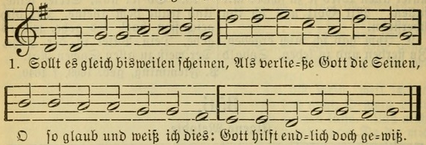
Here is my translation of the Jesus hymn “Allenthalben wo ich gehe” (Anon., asc. Ahasuerus Fritsch, d. 1701), from Ev.-luth. Gsb #652, which names Angelus Silesius as author. Fischer says: “The hymn is mostly ascribed to Ahasuerus Fritzsch. It is certainly found in his collection Neue Himmelische Jesus-Lieder (Jena, 1668) . . . Only according to the preface, the hymns are ‘partly newly composed, partly collected as lovely heart-strengthening rosies from various paradise-gardens.’ Fritzsch’s authorship thus remains unsure; yet it is probable, since it hymn also included in his work Himmels Lust und Welt-Unlust (Leipzig, 1670).” While a proper melody exists, the Wisconsin hymnal appoints the more familar “Sollt es gleich bisweilen scheinen.”


WHEREsoever I am going,
Whatsoever I am doing,
Jesus is my hope and pride,
Who for me was crucified.

2 I am ready to be leaving
Cross and world so oft aggrieving,
That my evils all may cease
When it shall my Maker please.

3 When I come to share His dwelling,
Reigning there in joy excelling,
Oh, how blessed shall I be,
With the angels’ company!

4 Deep will be my jubilation
When He gives rejuvenation,
And to heaven bringeth me,
Beautiful with Him to be.

5 Tongue and heart will then be sounding,
Singing Jesus’ praise resounding,
Voice conjoined eternally
With the angels’ company.

6 I will find a life far better,
Free from death and sinful fetter.
Oh, how blessed shall I be
With the angels’ company!

Translation © 2023 Matthew Carver.

GERMAN
Allenthalben wo ich gehe,
sitze, liege, oder stehe,
sehn ich mich nach Jesu Christ,
der für mich gestorben ist.

2 Von der bösen Welt zu scheiden
nach so vielem Kreuz und Leiden,
wenn es ihm gefällig ist,
bin ich fertig und gerüst't.

3 Wenn ich werde mit ihm leben,
herrschen und in Freuden schweben,
o wie selig werd ich sein
bei den lieben Engelein!

4 Herzlich werd ich mich erfreuen,
wenn mich Christus wird verneuen,
und in Himmel führen ein
prächtig, stets bei ihm zu sein.

5 Zung und Herze wird da klingen,
und dem Herren Jesu singen;
ewig werd ich stimmen ein
mit den lieben Engelein.

6 Besser Leben werd ich finden
ohne Tod und ohne Sünden.
O wie selig werd ich sein
bei den lieben Engelein!

16 April 2023

Auf meinen Jesum will ich sterben

Here is my translation of the death hymn, “Auf meinen Jesum will ich sterben” (Salomo Franck, d. 1725), from Evang.-Lutherisches Gsb #650, originally published in the author’s Geist- und Weltlicher Poesien Zweiter Theil (Jena, 1716) with the title: “The Christian Dying upon Christ.” The appointed melody is “Wer nur den lieben Gott läßt walten.”


IN Christ I meet my death impending,
Assured with peace and fearlessness.
His blood will be the color lending
For my most beauteous wedding dress.
On Christ alone my hope I keep:
On Him I live, and so I’ll sleep.

2 On Christ I meet my death impending,
’Tis well within His wounds to die.
In Him this shall not be the ending;
Deep in His blood I safely lie;
On Christ alone my hope I keep:
On Him I live, and so I’ll sleep.

3 On Christ I meet my death impending,
Within His side myself I cast,
So I’m an heir of life unending.
Then break my heart, oh, break at last!
On Christ alone my hope I keep:
On Him I live, and so I’ll sleep.

4 On Christ I meet my death impending;
He doth abide when all forsake;
Among His blood-won troops attending,
Beside His flag, my post I take;
On Christ alone my hope I keep:
On Him I live, and so I’ll sleep.

5 On Christ I meet my death impending;
Lord Jesus, take my soul to Thee!
My Savior grants a blessed ending,
And everything is gain for me;
On Christ alone my hope I keep:
On Him I live, and so I’ll sleep.

6 On Christ I meet my death impending
When death shall my last vision take,
When color from my lips is wending,
And when my heart at last shall break,
On Christ alone my hope I keep:
On Him I live, and so I’ll sleep.

7 On Christ I meet my death impending;
By Thee are body and soul possessed;
Lord Jesus, grant a blessed ending!
Oh, take me to eternal rest!
On Christ alone my hope I keep:
On Him I live, and so I’ll sleep.

8 On Christ I meet my death impending;
Oh, help me in the last distress!
The better portion to me sending,
Make sweet for me death’s bitterness!
On Christ alone my hope I keep:
On Him I live, and so I’ll sleep.

Translation © 2023 Matthew Carver.

GERMAN
Auf meinen Jesum will ich sterben,
getrost mit Fried und Freudigkeit.
In seinem Blute will ich färben
mein allerschönstes Hochzeitskleid.
Mein Jesus ist mien Trost allein,
auf Jesum leb und schlaf ich ein.

2 Auf meinem Jesum will ich sterben,
in seinen Wunden stirbt sich's gut.
Er läßt mich nimmermehr verderben;
ich senke mich tief in sein Blut.
Mein Jesus ist mien Trost allein,
auf Jesum leb und schlaf ich ein.

3 Auf meinen Jesum will ich sterben,
in seine Seite schließ ich mich;
so kann ich doch den Himmel erben.
Brich immerhin, meine Herze, brich.
Mein Jesus ist mien Trost allein,
auf Jesum leb und schlaf ich ein.

4 Auf meinen Jesum will ich sterben,
er bleibt, wenn Alles mich verläßt;
der durch sein Blut mich wollen werben,
bei dessen Fahne steh ich fest.
Mein Jesus ist mien Trost allein,
auf Jesum leb und schlaf ich ein.

5 Auf meinen Jesum will ich sterben.
Herr Jesu, nimm die Seele hin,
mein Heiland läßt mich nicht verderben,
so hab ich Alles zum Gewinn.
Mein Jesus ist mein Trost allein,
auf Jesum leb und schlaf ich ein.

6 Auf meinen Jesum will ich sterben,
wenn mir vergeht der Augen Licht.
Wenn Mund und Lippen sich entfärben,
und wenn mir auch meine Herze bricht.
Mein Jesus ist mien Trost allein,
auf Jesum leb und schlaf ich ein.

7 Auf meinen Jesum will ich sterben,
mit Leib und Seele bin ich dein.
Herr Jesu, laß mich nicht verderben,
ach laß mich ewig selig sein.
Mein Jesus ist mien Trost allein,
auf Jesum leb und schlaf ich ein.

8 Auf meine Jesum will ich sterben,
ach Jesu,hilf in letzter Noth!
Laß mich das beste Theil ererben,
versüße mir den bittern Tod.
Du bist mine höchster Trost allein,
dir leb und schlaf ich selig ein.

15 April 2023

Wie froh wird meine Seele sein

Here is my translation of the hymn on the joy of the Lord, “Wie froh wird meine Seele sein” (Johann Jänichen, d. 1731), from Ev.-luth. Gsb #645, originally appearing in the Halle Gsb 1713. The melody appointed in the Wisconsin hymnal is “Herr Jesus Christ, du höchstes Gut.”


HOW glad my soul will be indeed
At Jesus’ declaration:
“Come, O ye blest, from troubles freed,
And enter your possession!
Come and receive the kingdom true
Which God the Father wrought for you
Before the world’s creation.”

2 I’ll enter in with great delight
To be with my dear Savior!
There will I stand upon His right,
Nor foes to harm me ever;
The Lamb of God will there appear,
My fairest One, my Bridegroom dear,
Will to the wedding bring me.

3 Here in the realm of grace below,
A foretaste I am given,
But evermore I’ll taste and know
the Bread of Life in heaven;
The founts of life there issue free
O’er soul and body constantly
From out of His abundance.

4 I’m blest and hallowed by His blood,
That pure and precious river,
Which turneth every ill to good,
For all His subjects ever;
All guilt and debt it hath erased,
And I am in God’s love embraced,
Which richly I encounter.

5 God is my Father, I His heir,
Therefore I cannot perish.
What goods I shall inherit there,
Which here in hope I cherish!
The glorious robe of Christ is mine,
The priceless blessedness divine,
Which here no eye perceiveth.

6 God from the world’s beginning hath
Prepared for me this treasure;
Gold often paves the hellward path,
But this is without measure.
This legacy remains my bliss:
As long as God eternal is,
So long shall I enjoy it.

7 Therefore, my heart, do not despair
When cross and woe betide thee;
Christ is Thy Light and Comfort e’er;
From Him can naught divide thee.
The fleeting grief that now doth press
Compares not to that gloriousness
In thee to be revealèd.

8 There shalt thou see God face to face,
Upon His gaze attending;
How well ’twill be in His embrace,
And in His light unending!
Delivered then from every pain,
Blest in the Lord thou shalt remain
And filled with joy forever.

Translation © 2023 Matthew Carver.

GERMAN
Wie froh wird meine Seele sein,
wenn Jesus einst wird sagen:
Kommt, ihr Gesegnete herein,
befreit von allen Plagen;
kommt, erbet meines Vaters Reich,
das er bereitet hat für euch,
eh er die Welt erschaffen.

2 Mit was für Freuden werd ich gehn
zum Freunde meiner Seelen!
ich werde ihm zur Rechten stehn,
mich wird kein Feind mehr quälen;
das auserwählte Gotteslamm,
mein Schönster und mein Bräutigam,
wird mich zu Hochzeit führen.

3 Der Vorschmack muß mich schon allhier
im Gnadenreiche laben,
im Himmel soll ich für und für
das Brod des Lebens haben;
die Lebensbrünnlein sollen dort
auf Leib und Seele fort und fort
aus seiner Fülle fließen.

4 Gesegnet bin ich durch sein Blut,
das er für mich vergossen;
dies Blut macht allen Schaden gut
bei seinen Reichsgenossen;
es hat getilget alle Schuld,
darum läßt Gott mir seine Huld
so reichlich widerfahren.

5 Gott ist mein Vater, ich sein Kind,
drum kann ich nicht verderben.
Die Güter, die erworben sind,
soll ich im Himmel erben.
Ich erbe Christi Ehrenkleid,
die unschätzbare Seligkeit,
die hier kein Auge siehet.

6 Gott hat von Anbeginn der Welt
dies Erbtheil mir bereitet;
ihm gleichet weder Gold noch Geld,
das oft zur Hölle leitet;
dies Erbtheil bleibet ewig mien;
so lange Gott wird ewig sein,
so lange soll ich's haben.

7 Darum, mein Herz, verzage nicht
in deinem Kreuz und leiden;
dein Jesus ist dein Trost und Licht,
nichts kann von ihm dich scheiden;
das kurze leid, das dich beschwert,
ist jener Herrlichkeit nicht werth,
zu welcher du sollst kommen.

8 Da wirst du Gott von Angesicht
zu Angesichte sehen;
wie wohl wird dir bei diesem Licht
in Ewigkeit geschehen.
Du wirst befreit von aller Pein,
gesegnet in dem Herren sein
und ewiglich dich freuen.

13 April 2023

Ich hab von ferne

Here is my translation of the “heaven” hymn, “Ich hab von ferne” (Johann Timotheus Hermes, d. 1821), Ev.-luth. Gsb #636, first apearing in the author’s Sophiens Reise von Memel nach Sachsen (1770) titled “Foretaste of heaven.” A melody is provided by J. A. Hiller in Lieder und Arien aus Sophiens Reise (1779). J. P. Lange calls the hymn “remarkable in its simplicity, brevity, and depth of lyrical tone.” It is certainly of its time. The melody generally appointed now is that which first gave the meter, “Nun preiset alle.” Another translation evidently exists, beginning “Though from a distance,” but seems to be generally unavailable.


SINCE I’ve glimpsed faintly,
Maker, Thy palace fair,
With longing saintly
I would my heart prepare,
And with desire to Thee surrender
This weary life, mighty Lord of splendor. (x2)

2 Splendid those towers
Here in the Spirit seen!
Thou hast all powers;
Beauteous Thy radiant sheen.
Oh, that upon these thrones bright-shining,
I were today and fore’er reclining! (x2)

3 Sinful I own me,
To earth yet bending low—
Well was this shown me
By Thy good Spirit’s glow.
Not yet am I made pure and lighted,
Not yet entirely with Thee united. (x2)

4 Yet my heart’s steady,
No ban can shake my bliss;
I’m blest already,
Since I’ve discovered this!
Still I will count my woes as training,
And love Thee well all my days remaining. (x2)

5 Yet it is cheering,
I’ve spied that City High;
And, never wearying,
I would draw ever nigh,
And to that end my heart embolden,
Till I shall wander those pathways golden. (x2)

Translation © 2023 Matthew Carver.

GERMAN

Ich hab von ferne,
Herr, deine Thron erblickt
und hätte gerne
mein Herz vorausgeschickt,
und hätte gern mein müdes Leben,
Schöpfer der Geister, dir hingegeben.

2 Das war so prächtig,
was ich im Geist gesehn!
du bist allmächtig;
drum ist dein Licht so schön.
Könnt ich an diesen Hellen Thronen
doch schon von heute an ewig wohnen!

3 Nur ich bin sündig,
der Erde noch geneigt;
das hat mir bündig
dein heilger Geist gezeigt.
Ich bin noch nicht genug gereinigt,
noch nicht ganz innig mit dir vereinigt.

4 Doch bin ich fröhlich,
daß mich kein Bann erschreckt;
ich bin schon selig,
seitdem ich das entdeckt.
Ich will mich noch im Leiden üben
und dich zeitlebens inbrünstig lieben.

5 Ich bin zufrieden,
daß ich die Stadt gesehn,
und ohn Ermüden
will ich ihr näher gehn
und ihre hellen goldnen Gassen
lebenslang nicht aus den Augen lassen.