Showing posts with label Cox. Show all posts

01 May 2023

Wer sind die vor Gottes Throne

Here is my supplemental translation for Cox’s translation of the Eternity / Heaven hymn, “Wer sind die vor Gottes Throne” (Heinrich Theobald Schenk, d. 1727), in Ev.-luth. Gsb #689, first appearing in the Hessia-Darmstadt Gsb 1733 with the name of the author. Fischer specifies 18 stanzas rather than 20. The Wisconsin hymnal cento  has 11 stanzas consisting of stanzas 1–3, 6–9, 14–15, 17, and 20 of the original. Cox’s translation consists of stanzas 1–3, 6–11, 14–17, and 20. Other translations are offered by Winkworth and Tozer, though not of different stanzas. Accordingly I supply stanzas 4-5, 12–13, and 18–19 below, to be sung with Cox’s other stanzas: 4–5, being narrative and contextual and relatively void, were almost universally omitted in later hymnals. I also provide a variant stanza 16. The appointed melody is “Gott des Himmels und der Erden,” though “Unser Herrscher, unser König” is also designated in other hymnals.


WHO are these like stars appearing,
These before God's throne who stand?
Each a golden crown is wearing;
Who are all this glorious band?
Alleluia! hark, they sing,
Praising loud their heav’nly King.

2 Who are these, who palms are clasping,
Like a conqu’ror, in their hand,
When he sees his foeman grasping,
Stretched before him in the sand?
What the combat, who the foes,
Whence this victory arose?

3 Who are these, in dazzling brightness,
Clothed in God’s own righteousness,
These, whose robes of purest whiteness,
Shall their lustre still possess,
Still untouched by time's rude hand?
Whence come all this glorious band?

*4 So of Christ’s esteemed attendant
John, an elder did inquire.
Him did God by pow’r resplendant,
With a vision rare inspire,
Giving him a wondrous sight
Of th’ elected host in light.

*5 Humbly to the elder holy
John did answer: “Sir, thou know’st.”
Mark the man of God, here lowly,
Honoring his elder host,
Who instructed John aright
In that rare and wondrous sight:

6 “These are they who have contended
For their Savior's honor long,
Wrestling on till life was ended,
Following not the sinful throng;
These, who well the fight sustained,
Triumph through the Lamb have gained.

7 These are they whose hearts were riven,
Sore with woe and anguish tried,
Who in prayer full oft have striven
With the God they glorified;
Now, their painful conflict o'er,
God has bid them weep no more.

8 Branches of that stock that saved them,
Where both grace and health unite,
In the Lamb’s pure blood they laved them,
Washed their robes and made them white:
Now adorned with holiness,
Shine they in their festal dress.

9 These th’ Almighty contemplating
Did as priests before Him stand,
Soul and body always waiting,
Day and night at His command:
Now in God's most holy place
Blest they stand before His face.

10 As the hart at noontide panteth
For the brooks of water clear,
For the life-spring Jesus granteth
These have groaned with many_a tear:
Now their thirst is satisfied,
For they are by Jesus’ side.

11 Lo, the Lamb Himself now feeds them
On Mount Zion's pastures fair;
From His central throne He leads them
By the living fountains there;
Lamb and Shepherd, Good supreme,
Free He gives the cooling stream.

*12 These are they once sore oppressèd
By dread tribulation’s heat,
Now removed to mountains blessed
Where the Lord hath made His seat,
Where God’s habitation stands
Free from foes and evil hands.

*13 These are they whose cheeks were bitten
By a flood without relief,
And whose hearts by fear were smitten,
And their bones consumed by grief.
Now are they refreshed in God,
Who hath wiped the tears that flowed.

14 Heav’nward now my hands extending,
Jesus, Lord, to Thee I pray;
Now in pray’r my knees I’m bending,
Since on earth I still must stay,
In Thy church still wage my war—
Drive, good Lord! my foes afar.

15 In the strife the vict’ry lend me
Over hell, the world, and sin;
With Thy grace, O Lord, defend me,
When temptation’s storms begin:
All my dangers bear me through,
Lord, my Rock, my Savior true!

16 Oh, that, Lord, with Thee connected
Like a living branch I grew!
Make me one of Thine elected,
Let me here be born anew;
Keep from stain my garments free,
Guard me from hypocrisy.

[16 v.: Let new birth to be me granted,
In Thee let me ever grow
As a branch upon Thee planted,
By Thy blood washed white as snow,
Let me keep my garments clean,
Shunning every guiling sheen.]

17 With the just, who Thee resemble,
Let, O Lord, my lot be cast;
Far from all that makes me tremble,
Let Thy faithful child at last
Make Thy pledged reward his own,
Ever dwelling near Thy throne.

*18 Ready for Thy service make me,
Let me as Thy priest divine
Boldly e’er to pray’r betake me,
And address Thee: “Father mine!”
Let Thy tabernacle be
From the heat my shel’tring lee.

*19 To Thy Zion-mead receive me,
There my thirst and hunger still;
Let Thy countenance relieve me
And my heart’s desire fulfill.
Wipe my tears, my soul restore
By Thy Spirit, I implore!

20 With that holy throng uniting,
Then what rapture shall be mine!
In the sun’s bright beams delighting,
I too like the stars shall shine:
Amen! glory be to Thee,
Thanks and praise eternally!

Translation, sts.  1–3, 6–11, 14–17, and 20, Frances E. Cox, 1841.
Translation sts. 4–5, 12–13, 16v, 18–19 © 2023 Matthew Carver.


GERMAN
1 Wer sind die vor Gottes Throne
was ist das für eine Schaar?
Träget jeder eine krone,
glänzet gleich den Sternen klar:
Hallelujah singen all,
loben Gott mit hohem Schall.

2 Wer sind die, die Palmen tragen,
wie ein Sieger in der Hand,
wenn er seinen Feind geschlagen
und geleget in den Sand?
Weicher Streit und welcher Krieg
hat zezeuget diesen Sieg?

3 Wer sind die in reiner Seide,
welche ist Gerechtigkeit,
angethan mit weißem Kleide,
das zerreibet keine Zeit
und veraltet nimmer mehr?
Wo sind diese kommen her?

*4 Fragte einer von den alten,
Christi hoch-erleuchten Knecht,
den der Herr sehr werth gehalten,
hat ihm dies gezeiget recht,
daß er sahe, im Gesicht
dir erwählte Schaar im Licht.

*5 Herr du weißt es sprach Johannes,
zu dem alten mit Bescheid:
Merkt des theuren Gottesmannes
Demuth und Bescheidenheit.
Drauf der alte im Gesicht
gab ihm weitern Unterricht.

6 Es sind die, die wohl gekämpfet
für des großen Gottes Ehr,
haben Fleisch und Blut gedämpfet,
nicht gefolgt des Satans Heer;
die erlanget auf den Krieg
durch des Lammes Blut den Sieg.

7 Es sind die, die viel erlitten,
Trübsal, Schmerzen, Angst und Roth,
im Gebet auch oft gestritten
mit dem hoch gelobten Gott;
nun hat dieser Kampf ein End,
Gott hat all ihr Leid gewendt.

8 Es sind Zeugen eines Namens, […zweigen eines Stammes]
der uns Huld und Heil gebracht;
haben in dem Blut des Lammes
ihre Kleider hell gemacht;
sind geschmückt mit Heiligkeit,
prangen nun im Ehrenkleid.

9 Es sind die, so stets erschienen
hier als Priester vor dem Herrn.
Tag und Nacht bereit zu dienen,
Leib und Seel geopfert gern;
nunmehr stehn sie all herum
vor dem Stuhl im Heiligthum.

*10 Welche wie ein Hirsch gelechzet
nach dem Strom, der frisch und hell,
also ihre Seel geächzet
nach der rechten Lebensquell.
Nun ihr Durst gestillet ist,
da sind sie bei Jesu Christ.

*11 Auf dem Zionsberg sie weidet
Gottes Lamm, die Lebenssonn,
mitten in dem Stuhl sie leitet
zu dem rechten Lebensbrunn.
Hirt und Lamm, das ewig Gut,
lieblich sie erquicken thut.

*12 Es sind die, die hart gedrücket
manche schwere Trübsalhitz.
Nun sind die hinweg gerücket,
dahin, wo des Herren Sitz:
wo die Hütte Gottes ist,
wo kein Feind, kein Argelist.

*13 Es sind die, von deren Wangen
Thränen sind geflossen stark,
deren Herz die Angst umfangen,
und das Leid verzehrt ihr Mark.
Nun Gott ihre Seel erfrischt,
und die Thränen abgewischt.

14 Ach, Herr Jesu, meine Hände
ich zu dir nun strecke aus;
im Gebet mich zu dir wende,
der ich noch in deinem Haus
hier auf Erden steh im Streit:
jag, o Herr, die Feinde weit.

15 Hilf mir Fleisch und Blut besiegen,
Teufel, Sünde, Höll und Welt;
laß mich nicht darnieder liegen,
wenn ein Sturm mich überfällt.
Führe mich aus aller Noth,
Herr, mein Fels, mein treuer Gott.

*16 Gib daß ich sei neu geboren
an dir, als ein grünes Reis,
wachse, und sei auserkoren,
durch dein Blut gewaschen weiß,
meine Kleider halte rein,
meide allen falschen Schein.

17 Daß mein Theil sei bei den Frommen,
deinem Bild die ähnlich sind,
und aus großer Trübsal kommen;
hilf, daß ich auch überwind
alle Trübsal, Noth und Tod,
bis ich komm zu meinem Gott.
Wer sind die vor Gottes Throne

*18 Hilf, daß ich dir willig diene [Mache mich bereit zu dienen,]
als ein Priester Gottes hier, [daß ich, als ein Priester dein,]
Daß ich mich im Flehn erkühne, [im Gebet mich darf erkühnen]
Dich zu nenne meine Zier; […Vater mein.]
Deine Hütte decke mich
Für dem heißen Sonnenstich.

*19 Wenn willst du mein Flehn erfüllen; [Meinen Durst und Hunger stille]
Komm mein Heil, daß ich dich schau; [auf der fetten Zions-au.]
Eile meinen Durst zu stillen; [Mein Verlangen auch erfülle]
Führe mich auf Zions-au: [Deines Angesichtes schau.]
Wische meine Thränen ab; [Meine Thränen wische…]
Wohl mir, wenn ich dich nur hab. [Meine Seel dein Geiste lab.]

20 O wie groß wird sein die Wonne,
wenn wir werden allermeist
schauen auf dem hohen Throne
Vater,Sohn und heilgen Geist!
Amen. Lob sei dir bereit,
Dank und Preis in Ewigkeit!


30 January 2023

Sieh wie lieblich und wie fein (suppl.)

Here is my supplemental translation of the hymn “Sieh wie lieblich und wie fein” (Michael Müller, d. 1704 / Johann Christian Nehring, d. 1736), a hymn on brotherly love appearing in Ev.-Luth. Gsb #484 in 12 stanzas, of which 4 stanzas are already translated by Frances Cox and found (in a much-altered form of the hymn from Bunsen’s hymnal, which also adds new stanzas) in Evangelical Lutheran Hymnary (1913) #397 for Trinity II. The present text goes further back to a less-abbreviated 12-stanza form popular in Moravian hymnals such as that of Zinzendorf (omitting sts. 2–3), ultimately derived from the 14-stanza Müller-Nehring hybrid from Freylinghausen 1704, the first four stanzas from Müller’s paraphrase of Psalm 133 in his Die Psalmen Davids . . .(Stuttgart, 1700); the remaining stanzas by Nehring, expanding on brotherly love, from a “Manuscript of spiritual poems,” as Wetzel attests. The appointed melody is “Nun komm der Heiden Heiland.”


GOOD and pleasant 'tis to see
Brethren dwell in unity,
When the law which Jesus taught,
Rules each word, and deed, and thought.

2 Like rich balm this love flows down,
Spilling from the head and crown,
Till its pow’r and grace revered
Fills the whole of Aaron’s beard.

3 Down upon His garment flows
Balm that joy and bliss bestows,
As the dew on Hermon white
And on Zion’s sacred height. 

4 God has promised, as we know,
This rich blessing to bestow,
Life on earth, with all its store,
Life in heav’n for evermore.

5 Oh, how is that love grown cold,
Not a spark may man behold,
On the earth, nor flame detect,
Such as may the heart affect.

6 Every man lives selfishly
With no sense of charity,
With no thought but for his own;
Whither is love’s duty gone?

7 O Lord Christ, the Father’s Son!
Look at last from heaven’s throne,
And the scattered flock attend,
Which no man has pow’r to mend.

8 Heav’nly Shepherd! to Thy way
Bring back all that go astray;
’Neath Thy favor and Thy light,
All Thy pasture-sheep unite.

9 Let Thy mighty unction spill,
Hearts of men with life to fill,
Pour it deep within our heart,
There Thy gladd’ning ray impart.

10 Bind together heart with heart,
Let no strife the union part;
With thine own Almighty hand
Knit the sacred brother-band.

11 Father, Son, and Spirit, we
Own one God in Persons Three;
Who His flock as one doth bind,
In His perfect love combined.

12 Oh, what joy and what delight
Can we lack in yonder light?
All that we desire in heav’n
To that host by God is giv’n.

13 All those hurt in former days
As with single mouth of praise
Shall God’s pow’r of love revere
When He makes them one fore’er.

14 Honor, praise, and majesty
To the Highest ever be,
Me He grant us unity,
Who is ever One in Three!

Sts. 1, 4, 8 tr. F. Cox, alt.
Sts. 2–3, 5–7, 9–14 Translation © 2023 Matthew Carver.


GERMAN

Sieh, wie lieblich und wie fein
ists wenn Brüder friedlich sein,
wenn ihr Thun einträchtig ist,
ohne Falschheit, Trug und List!

[2 Wie der edle Balsam fleußt,
und sich von dem Haupt ergeußt,
weil er von sehr guter Art,
in des Aarons ganzen Bart;

[3 Der herab fleußt in sein Kleid,
und erreget Lust und Freud,
wie befällt der Thau Hermon,
auch die Berge zu Zion.]

4 Diesen ja verheißt der Herr, [Denn daselbst…]
reichen Segen nach Begehr,
und das Leben in der Zeit,
und auch dort in Ewigkeit.

5 Aber ach, wie ist die Lieb
so erloschen, daß kein Trieb
mehr auf Erden wird gespürt,
der des Andern herze rührt!

6 Jedermann lebt für sich hin
in der Welt nach seinem Sinn,
denkt an keinen andern nicht,
wo bleibt da die Liebespflicht.

7 O Herr Jesu, Gottes Sohn,
schaue doch von deinem Thron,
schaue die Zerstreuung an,
die kein Mensche bessern kann!

8 Sammle, großer Menschenhirt,
Alles, was sich hat verirrt:
laß in deinem Gnadenschein
Alles ganz vereinigt sein.

9 Gieß den Balsam deiner Kraft,
der dem Herzen Leben schaft,
tief in unser Herz hinein,
strahl in uns den Freudenschein.

10 Bind zusammen Herz und Herz,
laß uns trennen keinen Schmerz,
knüpfe selbst durch deine Hand
das geheilgte Brüderband.

11 So, wie Vater, Sohn und Geist
drei und doch nur Eines heißt,
wird vereingt ganz und gar
deine ganze Liebesschaar.

12 Was für Freude, was für Lust
wird uns da nicht seyn bewußt!
Was sie wünschet und begehrt,
wird von Gott ihr selbst gewährt.

13 Alles, was bisher verwundt,
wird mit Lob aus Einem Mund
preisen Gottes Liebesmacht,
wenn er All's in Eins gebracht.

14 Kraft, Lob, Ehr und Herrlichkeit
sei dem Höchsten allezeit,
der wie er ist drei in Ein,
uns in ihm läßt Eines sein!

24 January 2023

Himmelan geht unsre Bahn (supplement)

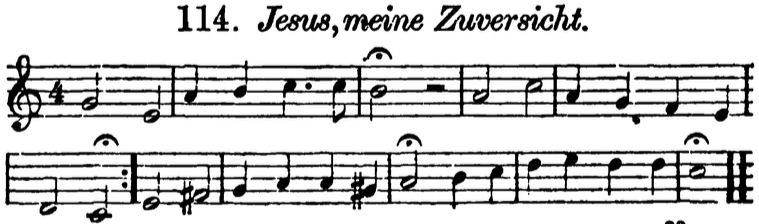
Here is my supplemental translation of the Christian life (Christian mind, conduct) / Ascension hymn “Himmelan geht unsre Bahn” (Benjamin Schmolck, d. 1737), Ev.-Luth. Gsb #473 in a cento of 8 stanzas, originally published in the author’s Bochim und Elim . . . (1731) with title: “Sweet meditation on heaven.” Stier calls it “a biblical hymn on seeking the goal and the prize which is above, likewise, to be sung on the feast of Ascension.” Translations by Cox/Ramsey and Winkworth (perhaps using the same source) omit stanzas 3, 4, and 7, and Winkworth omits stanza 8 in her improved version (I have altered the first few lines to fit the meter). The Cox/Ramsey translation is widespread, e.g., in Common Service Book and Wartburg Hymnal, but Winkworth’s in ELH (Ohio) and seems stronger in a couple parts, so I have used this framework for my supplemental translation of the aforesaid stanzas. The Wisc. hymnal omits stanzas 7 and 9 and appoints the melody “Jesus, meine Zuversicht.”


HEAV’NWARD doth our journey tend,
Here on earth we are but strangers,
Towards our promised land we wend,
Through a wilderness of dangers;
Here we roam a pilgrim band,
Yonder is our native land.

2 Heav’nward stretch, my soul, thy wings,
Thou canst claim a heavenly nature;
Cleave not to these earthly things,
Thou canst rest not in the creature.
Every soul that God inspires,
Back to Him, its Source, aspires.

3 Heav’nward! Only borrowed dust
Can the world to thee be giving;
Thy desire for heaven must
Be for higher treasure striving,
For the treasure that will stay
When the world must pass away.

4 Heav’nward I must have my heart
Also with my truest Treasure,
Who doth quickening impart
Far beyond all earthly measure;
For e’en now in heav’n I am,
If I only think on Him.

5 Heav’nward! doth His Spirit cry,
Oft as in His word I hear Him;
Pointing to the rest on high
Where I shall be ever near Him.
When His Word fills all my thought,
Oft to heaven my soul is caught.

6 Heav’nward still I long to haste,
When Thy Supper, Lord, is given;
Heavenly strength on earth I taste,
Feeding on the Bread of Heaven;
Such is e'en on earth our fare,
Who Thy marriage feast will share.

[7 Heav’nward by that magnet sped
Which within the cross is hidden,
Here my foot on thorns may tread,
Yet I know that, when I’m bidden,
I’ll walk heaven’s rosy path
Which no step of sorrow hath.]

8 Heav’nward! Far beyond the skies
Faith the fairest lot is spying,
And my heart would swiftly rise,
Sun and moon and stars o’erflying,
To that Light behind the veil,
Where all earthly splendors pale.

[9 Heav’nward! To that blessed home
Death at last will surely lead me;
All my trials overcome,
Christ with life and joy will feed me;
Who Himself hath gone before
That we too might heav’nward soar.]

10 Heav’nward! This shall be my cry
While a pilgrim here I wander,
Passing earth's allurements by
For the love of what is yonder;
Heavenward all my being tends,
Till in Heaven my journey ends.

Translation sts 1–2, 5–6, 8–10 C. Winkworth, 1855, alt.
Translation sts 3–4, 7 © 2023 Matthew Carver.


F. Cox / A. Ramsey:

Heav'nward still our pathway tends;
Here on earth we are but strangers,
Till our road in Canaan ends,
Safely passed this wild of dangers;
Here we but as pilgrims rove,
For our home is there above.

2 Heav'nward still, my soul, ascend!
Thou art one of heaven's creations;
Earth can ne'er give aim or end
Fit to fill thy aspirations;
And a heaven-enlightened mind
Ever turns, its source to find.

5 Heav'nward still! God calls to me
In His Word, so loudly speaking;
Glimpses in that Word I see
Of the home I'm ever seeking:
While my heart that call attends,
Still to heaven my path ascends.

6 Heav'nward! this I always think
When He spreads for me His table,
And I taste the meat and drink
That with heavenly strength enable;
After earth's oft bitter bread
There His marriage feast is spread.

8 Heav'nward! far beyond the skies
Faith my portion's joys is counting
Till my heart doth upward rise
Sun and moon and stars surmounting.
All their light cannot compare
With the splendent glory there.

9 Heav'nward still when life shall close,
Death to my true home shall guide me:
Then, triumphant to my woes,
Lasting bliss shall God provide me:
Christ Himself the way has led;
Joyful in His steps I tread.

10 Heav'nward! Heav'nward! this my song.
This my watchword oft repeated.
Here for heaven I fondly long,
Vain delusions all defeated.
Heav'nward all my thoughts ascend
Till in heaven my path shall end.

Catherine Winkworth:
Heavenward doth our journey tend,
Here on earth we are but strangers,
Towards our promised Land we wend,
Thro' a wilderness of dangers;
Here we roam a pilgrim band,
Yonder is our native land.

2 Heavenward stretch, my soul, thy wings,
Thou canst claim a heavenly nature;
Cleave not to these earthly things,
Thou canst rest not in the creature.
Every soul that God inspires,
Back to Him, its Source, aspires.

5 Heavenward! doth His Spirit cry,
Oft as in His word I hear Him;
Pointing to the rest on high
Where I shall be ever near Him.
When His Word fills all my thought,
Oft to heaven my soul is caught.

6 Heavenward still I long to haste,
When Thy Supper, Lord, is given;
Heavenly strength on earth I taste,
Feeding on the Bread of Heaven;
Such is e'en on earth our fare,
Who Thy marriage feast will share.

8 Heavenward! Faith discerns the prize
That is waiting us afar,
And my heart would swiftly rise,
High o'er sun and moon and star,
To that Light behind the veil
Where all earthly splendours pale. (earlier version)

9 Heavenward! To that blessed home
Death at last will surely lead me;
All my trials overcome,
Christ with life and joy will feed me;
Who Himself hath gone before
That we too might heavenward soar.

10 Heavenward! This shall be my cry
While a pilgrim here I wander,
Passing earth's allurements by
For the love of what is yonder;
Heavenward all my being tends,
Till in Heaven my journey ends.


GERMAN
Himmelan geht unsre Bahn,
wir sind Gäste nur auf Erden,
bis wir dort in Canaan durch
die Wüste kommen werden,
Hier ist unser Pilgrimsstand,
droben unser Vaterland.

2 Himmelan schwing dich, mein Geist;
denn du bist ein himmlisch Wesen,
und kannst das, was irdisch heißt,
nicht zu deinem Zweck erlesen.
Ein von Gott erleuchter Sinn
kehrt in seinen Ursprung hin.

3 Himmelan! die Welt kann dir
nur geborgte Güter geben.
Deine himmlische Begier
muß nach solchen Schätzen streben,
die uns bleiben, wenn die Welt
in ihr erstes Nichts zerfällt.

4 Himmelan! ich muß mein Herz
auch bei meinem Schatze haben,
denn es kann mich anderwärts
kein so großer Reichtum laben,
weil ich schon im Himmel bin,
wenn ich nur gedenk an ihn.

5 Himmelan! ruft er mir zu,
wenn ich ihn im Worte höre;
das weist mir den Ort der Ruh,
wo ich einmal hingehöre.
Wenn mich dieses Wort verwahrt,
halt ich eine Himmelfahrt.

6 Himmelan denk ich allzeit,
wenn er mir die Tafel decket,
und mein Geist hier allbereit
eine Kraft des Himmels schmecket.
Nach der Kost im Jammerthal
folgt des Lammes Hochzeitsmahl.

*7 Himmelan! zieht der Magnet,
der im Kreuz verborgen lieget,
wann mein Fuß auf Dornen geht,
und die Hoffnung mich vergnüget,
daß des Himmels Rosenpfad
Keinen sauren Tritt mehr hat.

8 Himmelan! mein Glaube zeigt
mir das schönste Loos von ferne,
daß mein Herz schon aufwärts steigt
über Sonne, Mond und Sterne;
denn ihr Licht ist viel zu klein
gegen jenen Glanz und Schein.

*9 Himmelan! wird mich der Tod
in das rechte Heimat führen,
da ich über alle Noth
ewig werde triumphieren.
Jesus geht mir selbst voran,
daß ich freudig folgen kann.

10 Himmelan, ach himmelan!
das soll meine Losung bleiben.
Ich will allen eitlen Bahn
durch die Himmelslust vertreiben.
Himmelan steht nur mein Sinn,
bis ich in dem Himmel bin.


01 August 2015

Du weinest vor Jerusalem

Here is my translation of the repentance hymn “Du weinest vor Jerusalem” (J. Heermann, 1630), which takes for its theme the Gospel on the X. Sunday after Trinity. It was previously and well translated by Elizabeth Cox as “With Tears o’er Lost Jerusalem.” The melody is “Allein zu Dir, Herr Jesu Christ.”


LORD JESUS, how Thy tears did burn
When Thou beheldest Salem,
Assuring that, when sinners turn,
Thy mercy will not fail them!
When I remorseful come to Thee
And mourn my gross iniquity,
Thou wilt by grace blot out again
The sins which stain
And hitherto have brought me pain.

2 When for my sins Thy Father’s wrath
Like as a fire is wakened,
Then in Thy tears I find the bath
By which my heart is quickened;
Thy tears by God are held so high,
That whoso daubs his sins thereby,
God gives to him a tender glance
At ev’ry chance,
And cheers his troubled countenance.

3 This is the house of bitter woes
Where oft I must lie wailing
And bear the world’s repeated blows.
They plague me without failing:
On ev’ry side they seek my life
And draw me into deadly strife,
Yet this doth comfort e’er impart:
Lord Christ, Thy heart
Was also stung by many_a dart.

4 Thou keepest count of all my tears,
Though none can tell their number,
Yet each before Thy sight appears,
Each doth Thy heart encumber,
When they but fall, they cause Thee grief
And move Thy heart to my relief,
With mercy in which I may boast:
My cross Thou know’st
And eagerly Thy help bestow’st.

5 Who here his tears of seed hath sowed
His soul in patience keeping,
Will joy, O God in Thine abode,
Abundant gladness reaping,
Where there is joy none can express,
And everlasting blessedness:
What cross and sorrow here I bear
Will swiftly there
Be turned to bliss without compare.

6 For these Thy tears I thank Thee, Lord,
For by these marks of sadness
Thou hast my crown of joy procured
With Thee in realms of gladness;
When Thou wilt pluck me by Thy hand
To join Thy blest and chosen band,
Eternal praise to Thee I’ll sing,
O fairest King,
For all Thy tears and suffering.

Translation © 2015 Matthew Carver.


GERMAN

1 Du weinest für Jerusalem,
Herr Jesu, heisse Zähren;
Bezeugst, es sei dir angenehm,
Wenn Sünder sich bekehren:
Wenn ich vor dir mit Buss erschein
Und über meine Sünden wein;
So tilgest du aus lauter Gnad
Die Missethat,
So mich bisher gequälet hat.

2 Wenn deines Vaters Zorn entbrennt,
Von wegen meiner Sünde,
Zu deinen Thränen ich mich wend,
Da ich Erquickung finde:
Vor Gott sind sie so hoch geschätzt,
Wer damit seine Sünde netzt,
Den blickt Gott an mit Gütigkeit
Zu jeder Zeit,
Und sein betrübtes Herz erfreut.

3 Hier muss ich auch im Thränenhaus
Vor grosser Angst oft weinen,
Der Welt aushalten manchen Strauss,
Sie martert stets die Deinen;
Auf allen Seiten, wo sie kann,
Fängt sie mit mir zu hadern an:
Diess tröstet mich zu aller Frist,
Herr Jesu Christ,
In Noth du auch gewesen bist.

4 Du zählest alle Thränen mein,
Ich weiss, sie sind gezählet,
Und ob sie nicht zu zählen sein,
Dennoch ihr keine fehlet:
So oft vor dir sie regen sich,
So oft sie auch bewegen dich,
Dass du dich mein erbarmen musst,
Wie dir bewusst,
Denn du mir allzeit Hülfe thust.

5 Wer jetzund säet Thränen aus,
Hält in Geduld Gott stille,
Wird fröhlich sein in deinem Haus,
Da Freude ist die Fülle:
Ja, solche Freude, die kein Mann
Mit seiner Zung aussprechen kann,
Und die da bleibt in Ewigkeit:
Mein Kreuz und Leid
Wird werden dort zu lauter Freud.
 6 Für diese Thränen dank ich dir,
Dass du die Freudenkrone,
Herr Christ, dadurch erworben mir,
Bei dir im Himmelsthrone:
Wenn du mich holen wirst hinauf
Zu deinem auserwählten Hauf,
Dann will ich recht lobsingen dir,
O höchste Zier,
Für deine Thränen für und für.

19 December 2011

Warum sollen dich so schmerzen* (Alt.)

Here is my suggested emendation and modernization of J. Kelly’s translation of Paul Gerhardt’s hymn on the Circumcsion suitable for use on the Feast of the Circumcision on January 1. I Include below his original version, as well as Miss Cox' two-stanza version, which I believe is on the whole poorer than Kelly's.


WHY SHOULD they such torment give You?
Why so pain You, dearest Christ?
Why by such a rite so grieve You,
With their hearts uncircumcised?
Jesus! Oh, but You are free
From the Law’s severity,
For, although man's nature wearing,
You are free of sin and erring,

2. For Yourself You do not bear it,
Of the Cov’nant You are Head;
’Tis our debts that make You share it,
That, like grievous loads of lead,
Lie upon us, and Your heart
Pierce unto the inmost part;
These You suffer to deliver
Those who could have paid them never.

3. Let your hearts be glad, O debtors!
Let the world rejoice today!
For God’s Son now breaks our fetters,
Here our price begins to pay.
Now the Law has been fulfilled
Now God’s anger has been stilled.
Now are we, to death once given
Made by Christ the heirs of heaven.

4. Who can tell the grace and favor,
Or of thanks repay Your due!
Heart and mouth shall own You ever,
As our Savior honor You!
We shall praise with all our pow’r
All Your goodness, You adore,
While in weakness here we wander,
And Your praises echo yonder!

J. Kelly, 1867, alt. Matthew Carver, 2011.

J. KELLY, 1867:
1. Why should they such pain e’er give Thee,

Why inflict such cruel smart?

Jesus, why should they so grieve Thee,

Who’re uncircumcis’d in heart,

By this rite? Though Thou art free

From the law’s yoke utterly,

Yet man’s nature art Thou wearing,

But no sin its beauty marring.

2. For Thyself Thou dost not bear it,

Of the Cov’nant Thou art Head;

’Tis our debts that make Thee share it,

That like grievous load of lead

Lie upon us, and Thy heart

Pierce e’en to the inmost part;

These Thou bearest to deliver

Us, who could have paid them never.

3. Let your hearts be glad, ye debtors!

Let the world rejoice to-day,

For the Son of God our fetters

Breaks, the price begins to pay.

This day is the Law fulfill’d,

This day is God’s anger still’d,

Whom to death law did deliver,

God’s Son makes God’s heirs for ever.

4. We this grace enough can never

Own, nor for it grateful be;

Heart and mouth, O Saviour! ever

Shall exalt and honour Thee!

We shall praise with all our pow’r

All Thy goodness, Thee adore,

While in weakness here we wander,

And Thy praise re-echo yonder!
Paul Gerhardt's Spiritual Songs, 1867


F. E. COX, 1841 (sts. 3-4 only):
3. Mortals, who have God offended,

Sinners all, rejoice to-day!

Gods own Son, from heaven descended,

Now your ransom 'gins to pay:
See the law this day fulfill'd,

God's just wrath and vengeance still'd;

He for sin who would have slain us,

Now for sons and heirs hath ta'en us.

4. Well may we this grace and favour

Evermore with blessings tell !

Well may heart and mouth for ever

Hail Thee our Immanuel !

Here in weakness while we stay,

Lord, we praise Thee as we may;

Earthly bonds our tongues here fetter,

But in heaven we'll praise Thee better.


GERMAN
1. Warum machet solche Schmerzen,
Warum machet solche Pein,
Der von unbeschnittnem Herzen,
Dir, herzliebstes Jesulein,
Mit Beschneidung, da du doch
Frei von des Gesetzes Joch.
Weil du, einem Menschenkinde
Zwar gleich, doch ganz ohne Sünde?

2. Für dich darfst du dies nicht dulden,
Du bist ja des Bundes Herr,
Unsre, unsre große Schulden,
Die so grausam, die so schwer
Auf uns liegen, daß es dich
Jammert herz- und inniglich,
Die trägst du ab, uns zu retten,
Die sonst nichts zu zahlen hätten.

3. Freut, ihr Schuldner, euch deswegen,
Ja, sei fröhlich alle Welt,
Weil heut anhebt zu erlegen
Gottes Sohn das Lösegeld;
Das Gesetz wird heut erfüllt,
Heut wird Gottes Zorn gestillt.
Heut macht uns, so sollten sterben,
Gottes Blut zu Gottes Erben.

4. Wer mag recht die Gnad erkennen?
Wer kann dafür dankbar sein?
Herz und Mund soll stets dich nennen
Unsern Heiland, Jesulein!
[30] Deine Güte wollen wir
Nach Vermögen preisen hier,
Weil wir in der Schwachheit wallen;
Dort soll baß dein Lob erschallen.