Showing posts with label NEGB. Show all posts

31 December 2023

Lobet und preiset den Schöpfer des Himmels und Erden

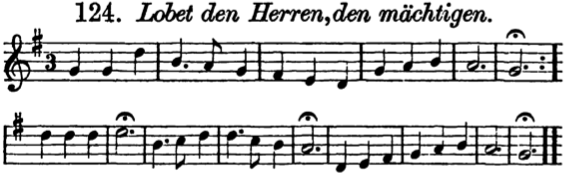
Here is my translation of the seasonal praise hymn, “Lobet und preiset den Schöpfer des Himmels und Erden” (? Paul Henkel, d. 1825), in NEGB #245 with melody assignment “Lobe den Herren, den mächtigen König der Ehren” and title “On the seasons of the year.” Despite the title, only summer is expounded on, from which we may surmise that several other stanzas, omitted or unwritten, would have treated the other seasons. This is the final hymn of NEGB’s first edition. The 2nd adds in an appendix a few more common hymns, already translated. The hymn is marked with the cipher of a colon (:.) and period which may be taken as the typographer’s erstatz double-dagger and period (‡.) otherwise employed to signify the works of Paul Henkel, especially since the German text exhibits characteristics of his style (if I may say so) and appears nowhere else to my knowledge.


PRAISE and adore ye the Maker of earth and of heaven,
Who summer, winter, and all the year’s seasons hath given!
Come, glorify
Him praised by angels on high,
By love and thankfulness driven.

2 Lo, the fair summer with bounties so fruitfully raining,
By our kind heavenly Father’s most gracious ordaining!
Praise and adore
Him who doth bid you implore,
For so He gives, all sustaining.

3 Lo, the green field and the pasture and meadow-land glorious!
More glorious yet are the sights that confront the victorious:
Beauteous and fair
Shall be the holy ones’ share
When we behold Him before us.

4 God’s loving care for all creatures in summer suffices,
Since He hath fashioned all things, and His will so devises
Them to sustain,
So doth He gen’rously reign;
Therefore my praise to Him rises!

5 God, who sustainest my body, Thy bounties bestowing,
Oh, grant all that I receive may this lesson be showing:
From Thee alone
Comes every good I have known:
Praise to Thee only is owing.

Translation © 2023 Matthew Carver.

GERMAN

Lobet und preiset den Schöpfer des Himmels und Erden,
der Winter, Sommer und alle Jahrs-Zeiten läßt werden.
Bringet ihm Ehr,
lobet und preiset ihn sehr,
gleichwie die himmlischen Heerden.

2 Sehet den Sommer mit allen den Früchten und Gaben,
die euch der gnädige himmlische Vater läßt haben.
Lobet und preist
ihn, der euch dieses selbst heißt,
er gibts, daß ihr euch sollt laben.

3 Die grünende Felder, Wiesen und herrlichen Auen, [Die Wiesen, grünende Felder und…]
noch herrlicher wenn ihr sie dort im Himmel werdt schauen.
Prächtig und schön,
wo alle Heiligen stehn,
und Gott alleine vertrauen.

4 Gott gibt im Sommer, Menschen und Vieh, Früchten die Fülle,
dieweil er alles erschaffen, so war es sein Wille;
zu erhalten,
sie mit Reichthum verwalten,
drum preis ich ihn in der Stille.

5 Gott, der meinen Leib mit zeitlichen Güter ernähret,
o gib mir die Gnade, daß alles dieses mich lehret,
von dir allein
alle Gaben kommen sein,
und dir allein Preis gehöret.
.
..

30 December 2023

Nun die Reise ist vollendet (Nun hab ich, Gott Lob, vollendet)

Here is my translation of the post-travel hymn, “Nun die Reise ist vollendet” (Johann Christoph Beer, d. 1712), in NEGB #244 with melody assignment “Werde munter, mein Gemüthe.” Bachmann gives its origin as Nürnberg 1676.  — The earliest instance I find is Nuremberg 1677 (Saubert) with ascription to Beer, an earlier 4-stanza form of our hymn with the title “Nun hab ich, Gott Lob, vollendet / meine vorgehabte Reis” and fitting the meter of the assigned melody “Jesu, der du meine Seele.” The same occurs again in Ermunternde Geistliche Seelen-Lust (1686) and later in Altdorffische neu-eingerichtete Lieder-Tafel (1734). —  Already in Sohr’s & Crüger’s Musicalischer Vorschmack (1693) we find an early 3-stanza version set to and fitting “Werde munter,” thus during the author’s lifetime, and perhaps by his pen or at least assent, though this transitional form, omitting stanza 2 and rearranging the last 4 lines of each stanza, is a little awkward and paves the way for the further alterations. —— This later form reappears in the Vermehrtes Hannoverisches Kirchen-Gsb (1745), no. 1019 (the very last hymn); likewise in the ed. 1759, both without ascription. It appears later in Electoral Palatinate (Ref.) hymnals as well. The ascription is also found (with reference to both titles) more explicitly in Heerwagen’s Literaturgeschichte I (1797), 164.


NOW have I my journey ended!
I am done, praise be to God,
With the travel I intended!
Blessing, glory, thanks and laud,
Jesus Christ, to Thee are fitting,
Who hast led me, oft unwitting,
Yonder, hither, with Thy hand,
Through so many a town and land!

2 That I have been unmolested
Cometh only from Thy pow’r;
That no foe my way arrested
I must thank Thee, Lord, my Tow’r;
That no sickness me attended,
Lord, Thou graciouly hast fended.
Briefly, Jesus, He Thou art,
Whom I thank with all my heart.

3 Jesus, Thou, Thy vigil keeping,
Hast escorting angels sent,
So that now my heart is leaping
And its joy is evident.
I must sing and praises pay Thee,
Jesus, for all things obey Thee,
Who art reigning, and my road
Hast arrayed with many a good.

4 Yet, oh, show me, I implore Thee,
One more grace, that I may gain
Everlasting life in glory,
And to yonder goal attain,
Whither here my soul aspireth,
Which eternal bliss desireth!
Bring me thus from misery
To Thy glad eternity.

Translation © 2023 Matthew Carver.

Newer Form:


NOW the journey meets its ending,
I have reached the goal, O Lord!
Unto Thee, my way attending,
I my hymn of thanks afford,
Since I know Thy gracious hand
Kept me safe by sea and land
And, upon returning, brought me,
So that no distresses caught me.

2 Thou, my God, hast me protected,
Thine angelic watchers round,
Every evil have deflected,
So that, mind and body sound,
I have safely reached my goal;
Take me as an off’ring whole
For Thy grace renewed each morrow
And defended me from sorrow!

3 Now I pray Thee, Father, never
Leave me till I shall arrive
By Thy wisdom, help, and favor
Whither yet my soul would strive.
Lead me from this misery
To that glad eternity.
Hear, O Lord, my supplication:
Ever be Thou my salvation!

Translation © 2023 Matthew Carver.

GERMAN (1745 Form)

Nun die Reise ist vollendet,
Herr, die zu vollenden war:
Dir, durch den ich sie geendet
bring ich nun mein Danklied dar.
Weil mich deine Gnadenhand
wohl und sicher durch das Land
wieder bis hieher geführet,
daß mich keine Noth berühret.

2 Du, mein Gott, hast mich bewachet,
deiner Engel Schirm und Hut
schützte mich und hat gemachet,
daß ich frisch und Wohlgemuth
hier nun angelanget bin.
Nimm mich selbst zum Opfer hin
für die Gnade, die mich deckte,
daß mch kein Betrüben schreckte.

3 Nun ich bitte, Vater, weiche
Nicht von mir mit Rath und That,
bis ich jenes Ziel erreiche,
das mein Geist noch vor sich hat:
führ mich aus der Jammerzeit
dort zur frohen Ewigkeit.
Ich verlange von der Erden;
laß mich ewig selig werden.


GERMAN (1677 FORM) [Sohr’s 1693 alt.]
Nun hab ich, Gott Lob! vollendet
meine vorgehabte Reis;
nun ist solche ganz geendet,
Lob und Ruhm und Dank und Preis, [darum viel Lob, Ehr und Preis,]
Jesu Christe! dir gebühret, [weil mich deine Gnaden-Hand]
weil du mich hast selbst geführet [hat so sicher durch das Land]
hin und her mit deiner Hand, [wieder bis hieher geführet]
durch so manche Stadt und Land. [jetzt, o mein Gott, dir gebühret.]

2 Daß ich unversehrt geblieben, [stanza omitted in 1693]
kommet einig her von dir,
daß kein Feind mich aufgerieben,
schreib ich dir zu meine Zier,
daß mich Krankheit nicht verzehret,
hast du gnädig abgewehret.
Kurz: du, Jesu, bists allein,
dem ich hier muß dankbar sein.

3 Jesu, du hast mich bewachet [Du, mein Gott,…]
mit der Engel Schutz-Geleit, [durch…]
so daß mein Herz jetzund lachet [mich so glücklich auch gemachet,]
und ist voller Lust und Freud. [daß ich jetzt mit…]
Ich muß preisen, ich muß loben, [hier bin wieder kommen an]
Jesu, dich, der du dort oben [und mir so viel Guts gethan]
herrschest, und auf dieser Bahn [daß ich dich muß herzlich preisen]
so viel Guts an mir gethan. [und dir ewig Dank erweisen].

4 Ach! ich bitte dich, erzeige
mir noch ferner deine Gnad,
endlich gib, daß ich erreiche,
wornach stets Verlangen hat [so mein Geist noch für sich hat!]
meine Seele hier auf Erden, [Führe mich aus diesem Leid]
laß mich ewig selig werden; [hin in deine Ewigkeit!]
führe mich aus diesem Leid [Ich verlange von der Erden,]
hin zur Freuden-Ewigkeit. [laß mich ewig selig werden.]

29 December 2023

O Gott, im Namen Jesu Christ (In deinem Namen, o Herr Christ)

Here is my translation of the travel hymn, “O Gott, im Namen Jesu Christ” (Justus Gesenius, d. 1673), in NEGB #243 in slightly altered form, “In deinem Namen, o Herr Christ” with melody assignment “Nun freut euch, lieben Christen gmein” and omitting stanzas 4, 8, and 9; first appearing in the Hanover Gsb 1648 (New Ordentlich Gsb). Below I provide this later German form, and after that, the earlier form by Gesenius. Hymns of similar content include “Jetzt reis ich aus in Jesu Nam” and “In deinem Nam auf dein Geheiß.”


IN Jesus’ name I now depart,
My journey undertaking;
Thou, who my Shepherd Keeper art,
Shalt not be me forsaking;
My soul and body I commend
To Thee! Do Thou all things attend
And all Thou hast provided.

2 I know that I, till life shall cease,
By dangers am surrounded,
And never shall have perfect peace
Till heaven’s trump is sounded.
I am a pilgrim, and must aye
With staff and sandal make my way
And here have no abiding.

3 Yet Thou dost help me ever still
To overcome distresses,
Till yonder rest my soul shall fill
When it Thy peace possesses.
There, my true homeland, knows no grief,
There is my home of pure relief,
Where restlessness is ended.

4 I dream of that tranquility
As pilgrim-like I wander,
And pray Thee, Lord, so govern me,
That I may reach Thee yonder;
Oh, lead me on the even way,
And on my labors day by day
Thy blessings pour from heaven!

5 To Thee, O Lord, is clearly known
What here my work entaileth,
What must by land or sea be done,
And what my soul availeth.
Oh, keep me ever sound and whole
Till I have reached my final goal,
And then returned in safety.

6 Avert all evils, while I roam,
From those I love most dearly
Whom I have left behind at home,
Defend them late and early;
Watch o’er them with Thy strength divine,
And let me find all who are mine
Alive in good condition.

7 Yet grant this favor too, I pray,
That I may walk with caution,
And circumspectly make my way,
Proceeding with devotion;
Grant by Thy Holy Spirit’s grace
Good wisdom, counsel, time, and place
For all that I endeavor.

8 Thine angel send me, to prepare
A blessed way before me,
From Satan to defend me e’er,
To shield me and watch o’er me.
Lord, be my great defense and tow’r,
Lest all their cunning wiles and pow’r
Should ever hurt or harm me.

9 O Father, keep me in Thy hand,
Surround me with Thy graces,
Preserve and guide me in this land
And in all foreign places,
And let me soon, as pleases Thee,
This restless world depart and flee,
And rest with Thee forever.

Translation © 2023 Matthew Carver.

GERMAN
In deinem Namen, o Herr Christ,
will ich zur Reise gehen;
du, der mein Hirt und Hüter [b]ist,
wirst mir zur Seite stehen.
Mein Leib und Seel befehl ich dir,
nebst Ehr und Gut, und was du mir
auf dieser Welt bescheret.

2 Ich weiß, ich bin in dieser Zeit
mit viel Gefahr umfangen;
ich werd in dieser Sterblichkeit
auch niemals Ruh erlangen;
ich bin ein Pilgrim, der so Fuß
als Stab stets weiter setzen muß,
und hier kein Bleiben findet.

3 Doch hilfst du, daß ich immerzu
die Noth auch überwinde,
bis daß ich dort die wahre Ruh
auch rechte Heimat finde;
da ist denn Müh und Sorgen aus,
da bin ich eigentlich zu Haus;
die Unruh hat ein Ende.

*4 An dieser Ruhstatt denk ich nun
anjetzt bei meinem Wallen.
Herr! hilf und lehre mich hier thun
nach deinem Wohlgefallen.
Leit mich allzeit auf rechter Bahn;
und fang ich etwas Gutes an,
so führ es wohl zu Ende.

5 Dir ist, o Gott! mein Amt bekannt,
und was dies mit sich führet;
du weißt, daß mir in meinem Stand
den Weg zu thun gebühret;
bring mich gesund, wohin ich soll,
lenk meine Werke segensvoll,
führ mich gesund zurücke.

6 Wend unterdessen Noth und Pein
von meinen Anverwandten,
von allen die zu Hause sein,
von Freunden und Bekannten;
laß sie dir, Gott, befohlen sein;
hilf, daß ich sie, und was nur mein,
im guten Stande finde.

7 Ich bitte dich, mein Gott! verleih,
daß ich behutsam wandle,
und immerdar voll Vorsicht sei
in allem was ich handle.
Durch deines Geistes Gütigkeit
gib Rath, Verstand und rechte Zeit
zu meinem Thun und Lassen.

*8 Schick deinen Engel vor mir her,
den Weg mir zubereiten.
Befiehl, daß er dem Satan wehr,
und allen bösen Leuten.
Nimm mich, o Herr, in deinem Schutz,
daß ihre List, Gewalt und Trutz
mir nimmer schaden könne.

*9 Nun, Vater! dir ergeb ich mich;
du kannst mir Hilfe senden.
Bewahr und führ mich gnädiglich
hier und an allen Enden;
und laß mich dann, wann dirs gefällt,
nach aller Unruh dieser Welt,
bei dir dort Ruh erlangen.


EARLIER FORM (?)

O Gott, im namen Jesu Christ
Reis ich nun meine strassen;
Mein hüter und mein hirt du bist,
Du wirst mich nicht verlassen:
Mein leib und seel befehl ich dir
Mein ehr und gut, und was du mir
Auf dieser welt bescheret.

2 Ich weiß daß ich allhoer auf erd
Bin mit gefahr umfangen;
Zu keiner zeit auch völlig werd
Die ruh daselbst erlangen:
Ich bin ein pilgrim, der stets muß
Fortsetzen seinen stab und fuß,
Der nirgend hat sein bleiben.

3 Doch hilfst du, daß ich immerzu
Die noth noch überwinde,
Bist daß ich dort die wahre ruh
Und rechte heimath finde;
Da ist denn müh und sorge aus,
Da bin ich eigentlich zu haus,
Die unruh hat ein ende.

4 An solche ruhstatt denk ich hier
Jetzund bey meinem wallen:
Ich hier, o Herr! mich so regier,
Daß ich dir mög gefallen.
Leit mich allzeit auf rechter bahn,
Und alles, was ich fange an,
Das segne du von oben.

5 Du weißt, o Herr, daß es mein stand
Erfordert auszureisen:
Drum wollest du mit deiner hand
Die wege selbst mir weisen:
Bring mich gesund, dahin ich soll,
Mein werk las mich verrichten wohl,
Und glücklich wieder kommen.

6 Wend unterdeß das unehil ab
Von eminen anverwandten,
Dich ich zu haus gelassen hab,
Und auch von den bekanten:
Laß sie dir, Gott, befohlen seyn,
Hilf, daß ich sie, und all das mein,
In gutem zustand finde.

7 Daneben gib auch dis dabey,
Daß ich behutsam wandel;
Und immerdar vorsichtig sey
In allem, was ich handle:
Durch deines heilgen Geistes gnad
Gib rechte ziet, verstand und rath,
Zu meinem thun und lassen.

8 Schick her vor mir dein engelein,
Den weg mir zu bereiten;
Laß sie mir stets zur seiten seyn
Und immer mich begleiten.
Nim mich, o Herr, in deinen schutz,
Daß böser leute list und trutz
Mir nimmer können schaden.

9 Nun, Vater! dir ergeb ich mich,
Du kanst stets hülfe senden;
Bewahr und führ mich gnädenlich
Hier, und an allen enden.
Und laß mich bald, wo dirs gefällt,
Nach dieser unruh in der welt,
Bey dir dort ruh erlangen.

28 December 2023

Wir preisen heute Gottes Gnad

 Here is my translation of the harvest thanksgiving hymn, “Wir preisen heute Gottes Gnad” (Paul Henkel, d. 1825), in NEGB #238 with melody assignment “Es ist gewisslich an der Zeit.”


GOD’S grace today we glorify
With gladsome heart and spirit,
And celebrate our Lord Most High
Whose love, without our merit,
Hath blest us with all that we need,
And constantly doth aid and speed
What for our life is useful.

We have been spared by God, our Shield,
Who safety hath supplied us,
Preserved the fruit upon the field,
Which now again provide us
The sustenance for man and beast;
Our God forsaketh not the least,
Now to His name be glory!

3 God hath remembered us in love,
Therefore to us hath given
The joyous blessing from above
And graced this earth from heaven,
He gives us clothing, food, and drink,
Wherefore with thanks of Him we think
And for His love we thank Him.

4 Our handiwork the Lord hath blessed
And by His hand it groweth;
He gives us strength to do what’s best,
And once again bestoweth
What shall our life with gladness fill;
That is our God’s intention still;
We praise Him for His kindness.

5 Our Father’s heart on us is set;
He loves us and receives us
And gladly pardons all our debt
And His good Spirit gives us,
Who makes our understanding bright,
And shows us Christ, our Life and Light,
Our Way, and our Salvation.

6 With all our heart we thank our God
For His dear Word and teaching;
With heart and lips we praise and laud,
His glories loudly preaching
For all the good that He has shown;
He is our highest Good alone,
To Him be glory ever!

Translation © 2023 Matthew Carver.

GERMAN
Wir preisen heute Gottes Gnad
mit freudigem Gemüthe:
Preis dem, der uns gesegnet hat
aus lauter Treu und Güte
mit allem, was uns nützlich ist,
und schenkt uns auch zu jeder Frist
was unserm Leben dienet!

2 Er hat uns wiederum verspart,
gefristet unser Leben,
die Früchte auf dem Feld bewahrt,
die uns nun wieder geben
die Nahrung beid für Mensch und Vieh;
er, unser Gott, verläßt uns nie;
wir priesen seinen Namen.

3 Gott hat in Lieb an uns gedacht,
drum hat er uns gegeben
den Segen, der uns fröhlich macht,
auf Erden hier zu leben.
Er schenkt uns Kleider, Speis und Trank,
ein jeder sag ihm Lob und Dank
und danket seiner Liebe!

4 Er segnet unser Hände-Werk,
er läßts iuns wohl gedeihen,
er giebt zum Guten Kraft und Stärk
und schenket uns von neuen,
was unser Leben glücklich macht;
das ist von Gott uns zugedacht;
wir preisen seine Güte.

5 Er ist der Vater der uns liebt,
in Liebe an uns denket,
der uns gern alle Schuld vergibt
und seinen Geist uns schenket;
der uns erleuchtet den Verstand,
der uns macht Jesum Christ bekannt:
der Weg, das Heil und Leben.

6 Wir danken Gott von Herzensgrund
für dies sein Wort und Lehre;
wir preisen ihn mit Herz und Mund,
wir geben ihm die Ehre
für alles Gute daß er thut,
er ist ja unser höchstes Gut,
drum sei ihm ewig Ehre.
‡

27 December 2023

Ach, heiliger, gerechter Gott

Here is my translation of the general (national) distress hymn, “Ach, heiliger, gerechter Gott” (Paul Henkel, d. 1825), in NEGB #237 with melody assignment “Es ist das Heil uns kommen her.” An analogous hymn in the subsequent Church Hymn Book (Va., 1816ff.) was not immediately apparent.


ALAS, O holy, righteous God!
Should not we faint in spirit
Before the threat’ning of Thy rod,
And scourges which we merit?
For all our land is laid beneath
The peril of Thy fearsome wrath.
Oh, hear our lamentation!

2 How righteous were Thy judgment, Lord—
We never could deny it,
But must confess with one accord,
Our sins well justify it—
If every curse and threat should fall
On us, and doom us sinners all,
Which in Thy Word is written.

3 And if our land in blood be drowned,
A gruesome inundation,
And if within it naught be found
But death and devastation
As is the case in other lands,
Where everything in ruin stands,
We would be paid most justly.

4 The Lord hath called us many a day
To penance and amending,
But stubbornly we go our way,
Resisting and offending.
Before, He gave us peace and rest
And all our works and labors blessed,
And gave us all we needed.

5 His Word and Spirit He bestows,
The Word of folly rids us;
The Spirit strength and succor shows,
To do whate’er He bids us.
How oft we hear Him knock outside,
Desiring that we open wide
Our heart, to be His dwelling.

6 Yet vanity and fleshly lust
And worldly fondness hollow
On earth are common as the dust,
And we that impulse follow—
That wicked impulse found within,
Which only makes us fond of sin,
And from the truth distracts us.

7 Truth’s mockery receives its rod
At last, as men see clearly;
Thou art in truth the righteous God,
And sin rebukest dearly.
Thou visitest iniquity
With which men have offended Thee
And earned this heavy chast’ning.

8 Yes, Lord, we have, with sins defiled,
Deserved in grief to perish,
Yet Jesus hath us reconciled,—
Thy Son, whom Thou dost cherish.
Then judge us not, we beg of Thee,
Nor thrust us evermore from Thee,
Nor let us ever perish.

9 Forgive our trespasses, we pray,
For Christ the Mediator;
Thy Spirit send to be our stay
And help our fallen nature
To do what Thy commandments tell,
Then we will walk before Thee well,
And in Thy way continue.

Translation © 2023 Matthew Carver.

GERMAN
Ach heiliger, gerechter Gott,
ach sollten wir nicht zagen,
da uns nun drohet große Noth,
und wohlverdiente Plagen?
Est steht ja unser ganzes Land
in recht gefährlichem Zustand,
wie leider zu beklagen.

2 Ach wie gerecht wär dein Gericht!
wir müßtens ja gestehen,
wir konntens ewig leugnen nicht,
es wird uns recht geschehen:
wenn uns sollt treffen jeder Fluch,
den uns beschreibt das Bibel-Buch,
der allen Sünder drohet.

3 Und müßt auch unser ganzes Land
in seinem Blute baden,
und wäre es mit nichts bekannt
als Leibs und Seelen Schaden,
so wies in andern Ländern steht,
da alles ins Verderben geht,
so wär es recht belohnet.

4 Der Herr hat uns gerufen lang,
zur Buß und bessern Leben,
wir aber gehen unsern Gang,
ihm stets zu widerstreben;
bisher schenkt er uns Fried und Ruh,
die Nahrung reichlich noch darzu,
und was wir sonst bedarfen.

5 Er schenket uns sein Wort und Geist,
das Wort uns underweiset,
der Geist uns Kraft und Beistand leist
zu thun, was er uns heißet,
wie oftmals klopft er bei uns an,
er will, daß ihm werd aufgethan
das Herz, darinn zu wohnen.

6 Doch Eitelkeit und Fleisches-Lust,
Hoffart und der Weltliebe,
das bleibt am besten uns bewußt,
wir folgen nur dem Triebe;
dem Triebe, dem sehr bösen Trieb,
der uns nur macht die Sünde lieb,
und zieht uns von der Wahrheit.

7 Doch endlich trifft der Wahrheit Spott,
wie manche es empfinden;
du bist doch der gerechte Gott,
drum strafest du die Sünden;
du suchest heim die Missethat,
damit man dich beliedigt hat,
und deine Straf verdienet.

8 Wir habens, Herr, ja wohl verdient,
daß wir in Noth verderben,
doch warst du, Herr, mit uns versöhnt
durch deines Sohnes Sterben.
Ach geh nicht mit uns ins Gericht,
verstoß uns von dir ewig nicht,
laß uns nicht ewig sterben.

9 Vergieb uns alle Missethat
um unsers Mittlers Willen;
schenk deinen Geist, schenk Hilf und Rath,
so werden wir erfüllen
und thun, was fordert dein Gebot,
dann werden wir vor dir, o Gott,
in deinem Wege gehen.


26 December 2023

Meine Hoffnung läßt mich nicht

Here is my translation of the trust hymn, “Meine Hoffnung läßt mich nicht” (Benjamin Schmolck, d. 1737), in NEGB #235 with melody assignment “Meinen Jesum laß ich nicht,” originally appearing in the author’s Heilige Flammen (1704) with the title: “The pleasant hope.” It is an acrostic on the name MARIA JOHANNA ZEDLITZIN GEBOHRNE TSCHIRNHAUSIN. I have attempted to preserve the first names, “Maria Johanna,” at least, but when I came to stanza 3, faced with the dubious proposition of beginning a stanza with a z-word, I preferred to break off the attempt at reproducing the entire acrostic. “Zestful doubt the heart doth kill,” indeed. In brackets I provide alternate, slightly more natural wording for the first two stanzas. Even in the German, the acrostic accounts for some of the stranger imagery and contributes to a sense of disconnectedness.


MY hope never shall depart! [Never shall my hope depart]
All things else may well forsake me.
“Rest,” I tell my trusting heart, [Here I say with…]
“I will to my God betake me;
Ah, what balm and blessedness, [Comfort here…]
Jesus gives me to possess!” [Yea, my Savior…]

2 Oh, this world is vanity; [All…]
Here on spider-webs we slumber;
All who would with Jesus be— [He…]
No cares else their heart encumber; […his heart…]
Now their soul on sweetness feeds [On sheer honey-dew he…]
And knows not life’s bitter weeds.

3 Doubting doth the heart but kill;
Spirits must by hope be driven.
He who sends me grief and ill
Leaves me, too, an open heaven.
God remains my rock on high,
Much though men my hope defy.

4 Tears are seeds of sorrow born;
I must be with tears anointed.
Have no fear! The path of thorn
Heavenwards is ever pointed.
Hearts resigned in stillness dwell
Till the sun shall storms dispel.

5 Viper-tongues and vicious spite
Oft have innocence assaulted,
Yet integrity shines bright
Once the troubling storms are halted.
Consciences which know God bear
Virtue’s honor-trophy fair.

6 Hush, impatience in the race!
Futile cares are scourges ever;
If thou hast God’s loving grace,
Thou need never doubt nor waver.
Hope and rest in Him retain;
After grief shall come the gain.

7 Hope, thou solid ground and true!
I will not succumb to sinking.
When my lips with palid hue
Shall death’s bitter cup be drinking,
Hold thou forth in hope to me
Christ alone: my hope is He!

Translation © 2023 Matthew Carver.

GERMAN
Meine hoffnung läßt mich nicht,
Alles mag mich sonst verlassen,
Ruht mein herz in Gott, und spricht:
Ich will ihn getrost umfassen;
Ach so hab ich trost und heil,
Jesus ist der seelen theil.

2 O wie eitel ist die welt!
Hier schläft man auf spinnen-weben:
Aber wers mit Jesus hält,
Nur allein ihm denkt zu leben,
Nähret sich mit honigthau,
Auch in dieser wermuths au.

3 Zweifel tödtet nur das herz,
Edle geister müssen hoffen
Der mich sclägt mit angst und schwerz,
Läßt mir auch den himmel offen:
Ist Gott meine zuversicht,
Trotz dem, der mir widerspricht.

4 Zähren sind die jammersaat,
Ich muß mich mit thränen salben,
Nur getrost, der dornen pfad
Geht zum himmel allenthalben.
Ein gelaßnes herze schweigt,
Bis der sturm die sonne zeigt.

5 Ottergift und blasser neid,
Hat die unschuld oft verletzet,
Redlichkeit wird doch allzeit
Nach dem unglücksturm ergetzet:
Ein gewissen, das Gott weiß,
Trägt der tugend ehren-preis.

6 Schweige demnach ungeduld,
Eitle sorgen sind nur plagen,
Hast du deines Gottes huld,
Ey so darfst du nicth verzagen,
Ruhe nur, und hoff auf ihn,
Nach dem trauren folgt gewinn.

7 Hoffnung, o du fester grund!
Ach so laß mich nimmer sinken,
Und wenn mein erblaßter mund
Soll des todes wernmuth trinken,
Ey so stell in hoffnung mir
Nichts als meinen Jesum für.

25 December 2023

Ihr Waisen, weinet nicht

Here is my translation of the hymn for orphans, “Ihr Waisen, weinet nicht” (Johann Friedrich Starck, d. ), in NEGB #234 with melody assignment “O Gott du frommer Gott,” first appearing, according to Fischer, in the author’s Tägliches Hand-Buch (Frankfurt, 1727), 2nd ed. (1734) with title “Forsaken lament to God in their distress.”


DEAR orphans, do not weep!
Let not your grief o’ertake you;
Upon your God rely,
Who never shall forsake you:
Your parents here have died,
But lo, God liveth still,
And since God lives, ye need
Fear no distress nor ill.

2 God is and e’er remains
The orphan’s tender Father,
Who with the body’s needs
Provideth every other;
In Him but put your trust,
He will your cause attend;
He is your great Defense,
Your Advocate, and Friend.

3 God is a bounteous God,
He food and clothes provideth,
He knows your every need,
And nothing from Him hideth;
Although your stores be scant,
And little hope ye see,
He will for days to come
Your kind Provider be.

4 Take heart, be of good cheer!
God swears with resolution:
He will th’ abandoned save
Out of their destitution;
This promise is for you,
And ye shall see indeed
Its glad fulfilment come
To you in time of need.

5 Yes, in your God believe,
Walk as His Word declareth;
Awaiting patiently
The blessing He prepareth;
Turn not aside from God,
But trust Him constantly,
And ye will prosper here
And in eternity.

Translation © 2023 Matthew Carver.

GERMAN
Ihr Waisen, weinet nicht;
wie? könnt ihr euch nicht fassen?
verlasset euch auf Gott,
der wird euch nicht verlassen:
sind gleich die Eltern todt,
so lebet dennoch Gott;
dieweil Gott aber lebt,
so habt ihr keine Noth.

2 Gott ist und bleibet stets
ein Vater aller Waisen,
der will sie insgesamt
ernähren, kleiden, speisen;
demselben trauet nur,
er nimmt sich euer an;
seht der ist euer Schutz,
und euer Helfersmann.

3 Gott ist ein reicher Gott,
der wird euch wohl versorgen;
er weiß ja eure Noth,
die ist ihm nicht verborgen;
ob ihr schon wenig habt,
der Vorrath ist auch klein,
so will fürs künftige
Gott der Versorger sein.

4 Habt einen guten Muth,
Gott hat es ja verheißen:
Er woll verlassene
aus ihrer trübsal reißen;
das Wort geht euch auch an,
ihr werdet es schon sehn,
wie es an euch auch wird
in die Erfüllung gehn.

5 Ja! glaubet, bleibet fromm
und geht auf Gottes Wegen,
erwartet mit Geduld
den euch verheißnen Segen,
und weichet nicht von Gott,
vertraut ihm allezeit;
so werdt ihr glücklich sein
in Zeit und Ewigkeit.

24 December 2023

Arme Wittwe, weine nicht

Here is my translation of the hymn for widows, “Arme Wittwe, weine nicht” (Anon., 18th c.), in NEGB #233 with melody assignment “Schwing dich auf zu deinem Gott” and omitting stanzas 7–8. Based on words from Luke 7:13, yet applied to the widow’s estate generally, it appears earlier in Mühlenberg’s Erbauliche Lieder-Sammlung and numerous American German hymnals besides. In German publications, find it in Beck’s Neues Gesangbuch (Strassburg, 1732), Engelbach’s Girrendes Täublein (1736), and Quandt’s Neue Sammlung (1751), followed by its frequent counterpart hymn on orphans, “Ihr Waisen, weinet nicht,” which follows also in NEGB. No author is ascribed to it in any available instances. It is sometimes assigned the melody “Christus, der uns selig macht.”


DEAREST widow, weep not so!
Jesus comfort bringeth;
He who pledges help in woe,
When most sore it stingeth,
Also sees thy misery
And the tears outflowing.
Oh, how grieved He is to see
Hearts such sorrow knowing!

2 Dearest widow, weep not so!
Bid thy cares to leave thee
Though thy bread may scarcer grow
When hard times aggrieve thee,
Jesus gives thee flour in store
And thy cruse He filleth,
Wisely gives thee oil and more,
So in love He willeth.

3 Dearest widow, weep not so!
If all men forsake thee
He whose eye beholds thy woe
Surely cannot hate thee,
Who Himself thy Father calls
Knows what thou art lacking;
He who counts each tear that falls,
Knows thy pain and aching.

4 Dearest widow, weep not so
When there rise against thee
Enemy and evil foe;
God on high defends thee.
Jesus is thy Shield and Might,
And thy staff to hold thee;
Let it not thy soul affright,
Though hell cry so boldly.

5 Dearest widow, weep not so,
In thy lonely dwelling,
If the fiery cross of woe
Brings thy tears upwelling;
Widows’ tears like eagles fly,
To God’s heart ascending;
He will help thee by and by,
He is close attending.

6 Dearest widow, weep not so!
Jesus hears thy grieving.
He will give thee joy to know
Who thy crown is weaving.
Patiently thine anchor ground
In Thy wounded Savior;
There is utter comfort found,
There is Jesus’ favor.

7 Dearest widow, weep not so!
Why in grief be sinking?
Think of what true Christians owe;
God of thee is thinking.
It may even be today
That He will release thee,
And with roses strew thy way
Where thy crosses press thee.

8 Dearest widow, weep not so!
Leave the world its laughter.
Jesus, who in thee doth glow,
Thee will save hereafter.
He will open heav’n to thee,
And the crown will give thee.
Hasten, thy dear Lamb to see,
Who will there receive thee.

Translation © 2023 Matthew Carver.

GERMAN
Arme witwe, weine nicht!
Jesus will dich trösten.
Der dir hülf und trost vespricht,
Wenn die noth am grösten,
Der sieht auch dein elend an,
Und die thränen-fluthen.
O wie weh wird ihm gethan,
Wenn die herzen bluten.

2 Arme witwe, weine nicht!
Laß die forgen fahren:
Ob dir öfters brodt gebricht
In betrübten jahren.
Jesus giebt dir mehl ins cad,
Und dein öhl-krug quillet;
Dann durch Gottes weisen rath
Wird er bald gefüllet.

3 Arme witwe, weine nicht!
Wenn du bist verlassen:
Der sein aug auf dich gericht,
Kan dich ja nicht hassen,
Der sich deinen Vater nennt,
Weiß wohl, was dir fehlet,
Und der deine thränen kennt,
Hat sie auch gezehlet.

4 Arme witwe, weine nicht!
Wenn die feinde toben,
Und der satan dich ansicht,
Gott schützt dich von oben.
Jesus ist dein schirm und schild,
Ja, dein stab und stecken:
Ob die hölle noch so brültt,
Laß dich nicht erschrecken.

5 Arme witwe, weine nicht!
Wenn du einsam sitzest,
Und di creutzes-hitze sticht,
Daß du thränen schwitzest:
Witwen-thränen steigen hoch,
Bis zu Gottes herzen;
Hilft er nicht gleich, hilft er doch,
O er kennet die schmerzen!

6 Arme witwe, weine nicht!
Jesus hört dein schreien.
Er, der deine krone flicht,
Wird dich bald erfreuen.
Senk den anker mit geduld
Nur in seine wunden,
Da wird lauter Jesus-huld,
Lauter trost gefunden.

7 Arme witwe, weine nicht!
Was wilst du dich kränken?
Denk an deine christen-pflicht,
Gott wird an dich denken.
ei vielleicht ists heute noch,
Daß er dich befreiet
Von dem harten creutzesjoch,
Und dir rosen streuet.

8 Arme witwe, weine nicht!
Laß die welt nur lachen.
Jesus, deiner seelen licht,
Will dich selig machen.
Jesus schließt den himmel auf,
Jesus reicht die krone:
Eil! befördre deinen lauf
Zu des lammes throne.

23 December 2023

Ach Gott wie mancher Kummer macht

Here is my translation of the Cross & Comfort hymn, “Ach Gott wie mancher Kummer macht” (Erdmann Neumeister, d. 1735), in NEGB #232 with melody assignment “Es ist gewißlich an der Zeit” and title “Of Cross and Trial,” first appearing in the author’s Zugang zum Gnaden-Stuhl (1710ff.) with melody assignment “Herr Jesu Christ, du höchstes Gut” and title “Hymn of Comfort from 1 Peter 5:7.”


AH, God, how grievous is my plight!
How oft it steals my slumber!
When I through many a weary night
My thousand sorrows number,
My sighs and pray’rs arise to Thee,
Dear God, regard me graciously,
And soothe my heart and spirit!

2 Thought I must yet consume my bread
While tears of sorrow wet me,
Thou wilt not leave Thy child in dread,
Nor evermore forget me;
For Thou from childhood’s earliest day
Hast led me in a wondrous way
Through many thorns and roses.

3 My heart may worry day and night
How plans shall thrive or languish;
Yet once it has surveyed aright
Its every care in anguish,
It finds that naught is gained thereby,
Wherefore I trustingly rely
On Thee, and naught beside Thee.

4 To overcome all anxious care
Let me Thy patience borrow,
And ground the anchor of my pray’r
Upon Thy care and sorrow!
The spirit willing is, and yet
The flesh is weak and like to fret;
So be my Strength unfailing!

5 Have I but Thee, there is no place
For fear or sad repining;
Through life and death the Sun of grace
Must be forever shining,
And grief must wholly be resigned;
Then be at peace, unhappy mind!
For God is my contentment!

Translation © 2023 Matthew Carver.

GERMAN
Ach Gott! wie mancher Kummer macht,
daß ich mich herzlich kränke!
Wenn ich bei mancher trüben Nacht
an tausend Dinge denke,
so gehn die Seufzer zu dir auf.
Ach lieber Gott! ach merke drauf,
und tröste mein Gemüthe.

2 Solls sein, daß ich mein bißgen Brod
mit Thränen noch muß essen,
so wirst du doch in keiner Noth
mich, als dein Kind, vergessen;
dein Kind, das du von Kindheit an,
auf mancher Dorn- und Rosen-Bahn
recht wunderlich geführet.

3 Mein Herze sorgt zwar früh und spat,
wie dies und das wird kommen;
und wenns nun alle Sorgen hat
recht ängstlich durchgenommen,
so hat es doch nichts ausgericht:
drum will ich meine Zuversicht
auf dich, und sonst nichts, stellen.

4 Gib mir Geduld, damit ich stets
die Sorgen überwinde,
und sich der Anker des Gebets
auf deine Sorgen gründe.
Der Geist ist willg: aber doch
das Fleisch fühlt seine Schwachheit noch;
drum sei du meine Stärke.

5 Hab ich nur dich, so hats nicht Noth
mit mir und mit den Meinen;
so muß durch Leben und durch Tod
die Gnaden-Sonne scheinen;
so streicht der Kummer gänzlich hin.
Zufrieden, unvergnügter Sinn!
denn Gott bleibt mein Vergnügen.

22 December 2023

Unser Herrscher, unser König

 Here is my translation of the thanks and praise hymn, “Unser Herrscher, unser König” (Joachim Neander, d. 1680), in NEGB #229 with melody assignment “Herr, ich habe mißgehandelt,” first appearing in the author’s Glaub- und Liebes-Übung (1679) with title “The Glorious Jehovah. Psalm 8:2.” The original melody by Neander was later altered and used for other hymns, but I include the original form here from Zahn. The translation by William Reid from “The Praise Book” formed the basis of my translation, though eventually, by comparison with the German, the alteration became so great as to qualify as a new translation, perhaps excepting the first few lines. Reid’s translation, rich in poetic expression, is deficient chiefly in the last two lines of stanzas 2–5, which are a syllable short (while given and heaven may be comfortably sung as two syllables), which allows it be sung to the modern form of Neander’s melody. Curiously, Reid chose to rhyme the first and third lines, which are not rhymed in Neander’s German, whereas the tendency in English translation is, if anything, to drop rhymes in odd lines. Nevertheless, I have followed Reid in this respect.


LORD our Ruler, King victorious,
Thee our highest Good we own:
Thy great name is high and glorious,
For the wonders Thou hast done;
Near and far be praises given
From the earth to starry heaven!

2 Few are they who now, true-hearted,
Love and seek Thee longingly,
By whom praise might be imparted,
Therefore Thou preparest Thee
Praise from mouths of infants nursing,
Wide Thy pow’r in earth dispersing.

3 Oh, what cause for lamentation!
Yea, whose heart breaks not to see
Thousands cast away salvation
And forsake Thy majesty?
Oh, how sinners sleep securely!
Mighty is that wonder, surely!

4 Meanwhile, Lord, my great Defender,
I will love Thee faithfully;
For I know, O Father tender,
That Thou truly lovest me;
Lift me, that my heart may even
Be conformed to those in heaven.

5 Lord, whose name in every nation
Is extolled and widely known,
Where the rays of jubilation
Shine upon one land alone:
Praise Jehovah! heaven crieth,
And the earth in kind replieth.

6 Lord, my Ruler, great in glory
Is Thy name, and dear to me!
Therefore as I sing before Thee
I commend myself to Thee:
Grant in turn that I may wholly
Be inclined to serve Thee solely!

Translation © 2023 Matthew Carver, after W. Reid.

REID
Sovereign Ruler, King victorious!
Thee, our highest good, we own;
Thy great name is high and glorious,
Pow’r belongs to Thee alone.
Endless praise to Thee be given,
Praise on earth, and praise in heaven.

2 Few there are, who, loyal hearted,
Cleave to Thee in these our days;
Therefore has Thy love imparted
Power to babes to speak Thy praise.
Lisping infants praises bring,
Now Thy mighty name they sing.

3 How Thy love-claims here are slighted,
E’en by hearts that know Thy grace!
In the pathway Thou hast lighted,
Few the footprints that we trace.
Yet, while many are asleep,
Some remain the watch to keep.

4 Jesus, faithful, gracious Saviour!
Keep me ever loving Thee,
Make me true in my behaviour,
For I know Thou lovest me;
Borne from earth on eagles’ wings,
Set my mind on heavenly things.

5 Lord, Thy name, all names transcending,
Shall throughout the world be known,
When the nations, meekly bending,
Worship Thee on David's throne;
Earth and heaven shall spread the fame
Of Jehovah's mighty name.

6 Excellent beyond my telling
Is Thy name, O Lord, to me;
In this tower of safety dwelling,
Let Thy grace my portion be:
So shall praise to Thee be given,
Evermore, in earth and heaven.


GERMAN
Unser herrscher, unser könig,
Unser aller höchstes gut,
Herrlich ist dein grosser name,
Weil er wunder-thaten thut;
Löblich, nah und auch von fernen,
Von der erd bis an die sternen.

2 Wenig sind zu diesen zeiten,
Welche dich von herzensgund
Lieben, suchen und begehren;
Aus der säugelingen mund
Hast du dir ein lob bereitet
welches deine macht ausbreitet.

3 Es ist leider zu beklagen,
Ja, wem bricht das herze nicht?
Wenn mann siehet so viel tausend
Fallen an dem hellen licht.
Ach wie sicher schläft der sünder,
Ist es nicht ein grosses wunder?

4 Unterdessen, Herr, mein herrscher,
Will ich treulich lieben dich:
Denn ich weiß, du treuer Vater,
Daß du herzlich liebest mich:
Zieh mich kräftig von der erden,
Daß mein herz mag himmlisch werden.

5 Herr, dein nam ist hochgerühmet.
Und in aller welt bekannt,
Wo die warmen sonnenstrahlen
Nur erleuchten einig land,
Da ruft himmel, da ruft erde:
Hochgelobt Jehovah werde!

6 Herr, mein herrscher, o wie herrlich
ist dein name meiner seel!
drum ich auch für deinen augen
Singende mich dir befehl:
Gib daß deines kindes glieder
Sich du ganz ergeben wieder!

20 December 2023

Ach, abermal bin ich gefallen

Here is my translation of the repentance and sanctification hymn, “Ach, abermal bin ich gefallen” (Balthasar Münter, d. 1793), in NEGB #227 with melody assignment “Wer nur den lieben Gott läßt walten,” appearing in Münter’s Samml. geistl. Lieder (1774), vol. 2, p. 69ff., with title “Favorite Sin.”


ALAS, again, O Lord, I’ve fallen
With full awareness and consent;
How deeply, deeply I have fallen!
And shall I not at last repent?
Oh, what a sinful wretch am I,
In what a deep abyss I lie!

2 O fav’rite sin that pleases never,
O vile desire that will not rest,
The inclination, ling’ring ever,—
Oh, how they rage within my breast!
How boundless seems their mastery,
How dread their power over me!

3 My conscience long in faithful fashion
Had warned: “O man, fight not with God!
Swept on by wicked lust and passion,
Thou racest down perdition’s road!
Soon, soon, thy sin will steal from thee
Thy bliss for all eternity.”

4 Oft have I pledges undertaken;
Now would I from my passions flee,
Yea, henceforth having sin forsaken,
Walk without fault and blamelessly!
How oft, O God, I have appealed
To Thee for strength and to be healed!

5 But soon again that sin surprised me,
My weak resistance was ashamed,
Alas, it struck me and enticed me
And speedily the vict’ry claimed!
Then pleasure vanished like the dust
And left but loathing and disgust.

6 This time once more I was defeated!
Alas, my fall was ne’er so deep!
My resolution was unseated—
My conscience cried, my heart did leap;
I thought of Thee, O Judge, as well,
And still, oh, still in sin I fell!

7 I told myself, God shall avenge it!
And still, oh, still in sin I fell.
Is any fault like my transgression?
It frightens me like very hell;
At threats divine and judgment stern
I quailed, yet never once would learn.

8 O love of sin deep-set within me!
How shall I rid myself of thee?
How overcome thy charms to win me?
How stamp out sin and thee in me?
My gracious God, receive my sigh:
Help me sin’s forces to defy!

9 If I but loved Thee as were fitting,
Sin’s longing soon would flee away;
Though sin would not its war be quitting,
It would not over Thee hold sway.
The virtue of Thy perfect love
Would all the pow’r of sin remove.

10 Work in my soul, by grace inspiring
A love for Thee and longing true;
Let all my thinking and desiring
By action testify thereto!
To love Thee, God, of all things most,
Let be my work, my hope, my boast!

11 Then shall I overcome my passions
And so at last the mast’ry claim.
Then wilt Thou pardon my transgressions,
Though great in number and in shame.
For thanks, to Thee I here shall live,
And hymns of praise in heaven give.
 
Translation © 2023 Matthew Carver.

GERMAN
Ach! abermal bin ich gefallen
Mit überlegung und mit wahl!
Tief, o wie tief bin ich gefallen,
Vielleicht noch nicht zum letztenmal!
Elender sünder, der ich bin,
In welchen abgrund iel ich hin.

2 O die verhaßte lieblings-sünde,
O die gewohnheit böser lust;
Der hang, den ich zu ihr empfinde,
Wie wüten sie in meiner brust!
Wie unumschränkt, wie fürchterlich
Ist ihre herrschaft über mich!

3 Längst warnte schon mich mein gewissen:
Mensch, du empörst dich wider Gott!
Von böser lust dahin gerissen,
Verrogner, eilst du in den tod!
Dir raube die sünd in kurzer zeit
Dein glück in zeit und ewigkeit.

4 Wie oft hab ich mir vorgenommen:
Nun will ich meine sünde fliehn:
Nein und unsträflich und vollkommen
Zu wandeln, will ich mich bemüht!
Wie oft, o Gott! hat meine gebet
Um kraft dazu dich angesteht!

5 Bald reitzt aufs neue mich die sünde:
Wie schwach war gleich mein widerstand;
Ach! sie gefiel mir! und geschwinde
Ergriff sie mich und überwandt:
Die lust verschwand mir im genuß:
Nun folgten eckel und verdruß.

6 Auch dismal bin ich uuberwunden!
Ach! niemals sonst fiel ich so tief,
Mein versatz war noch nicht verschwunden:
Mein herz schlug, mein gewissen rief:
Gott! richter1 ich gedacht an dich,
Und dennoch, dennoch sündigt ich.

7 Ich sagte mir: Gott wird es rächen:
Und dennoch, dennoch sündigt ich.
Ist ein vergehn, wie mein verbrechen?
O wie erschreck ich über mich!
Vom drohen deines weltgerichts
Erhebt ich; doch es wirkte nichts.

8 O tief verborgne sünden-liebe,
Wie werd ich endlich frei von dir!
Wie überwind ich deine triebe,
Und dämpfe dich und sie in mit?
Gott, mein erbarmer, hör mein stehn,
Und lehre mich, ihr widerstehn!

9 Liebt ich dich nur so wie ich sollte,
So flöh die lust zur sünde mich;
Wenn sie mich auch versuchen wollte,
Gelung es ihr nicht wider dich:
Durch deiner wahren liebe kraft
Würd ihre macht hinweggeschaft.

10 O! pflanze du in meiner seele
Rechtschaffne lieb und lust zu dir.
Gott! was ich denke, was ich wählte,
Das zeuge durch die that von ihr!
Dich lieben als mein eigenthum,
Das sei mein werk, mein heil, mein ruhm.

11 Dann werd ich endlich überwinden,
Und herrscher meiner lüste sein.
Dann wirst du alle meine sünden,
Wie viel, wie groß sie find, verzeihn.
Mein leben hir, mein lobgesant
Im himmel, Vater! sei dein dank!

19 December 2023

Gott Lob, daß er uns Menschen liebt

Here is my translation of the Holy Word hymn, “Gott Lob, daß er uns Menschen liebt” (Paul Henkel, d. 1825), in NEGB #225 with melody assignment “O Jesu Christe, wahres Licht.” The Church Hymn Book (1816ff.) provides the English rendering “A precious gift on man bestowed,” probably the work of the same author, in five stanzas of Long Meter, somewhat altered as to content.


TO God be praise, who loves our race,
And to us gives His Word in grace;
It is our heritage most bright,
Shows us salvation, life, and light.

2 The Bible doth to us make plain
All that had else concealèd lain;
It shows that Jesus Christ, God’s Son,
Is man’s Redeemer—He alone.

3 The Bible is of greatest worth,
God’s doctrine doth it show the earth,
It is for aye the highest Good,
Makes glad the heart and hope supplies.

4 How blest are they that this believe!
They find what none can break or thieve;
Not e’en the foe with pow’r and plot
Can overpow’r a single jot.

5 He that the Bible’s truth will hold
Hath found the weapon bright and bold,
By which he shall in battle win
Against the devil, world, and sin.

6 Preserve, O Lord, to us Thy Word
And let it ever, undeterred,
Among and in us mighty be,
Thine be the praise eternally.

Translation © 2023 Matthew Carver.

CHURCH HYMN BOOK
A Precious gift on man bestow'd,
That is to have the word of God;
The sure infallible record
That shews the counsels of the Lord.

2 That book it has to man reveal'd,
That which was to the world conceal'd.
That book reveal'd the glorious plan
By which God sav'd the race of man.

3 Of all the treasures here on earth,
This book is of the greatest worth;
From age to age it handeth down,
As much as need to man be known.

4 The Bible is a light divine!
It makes a world of darkness shine;
And ev'ry chapter, line and page,
Can cast a light on ev'ry age.

5 Bless'd are the rays this light doth give,
And bless'd are they who do receive;
This blessed light, this blessed heat,
Can make our hopes and joys complete.


GERMAN
Gott Lob, daß er uns Menschen liebt
und uns die liebe Bibel gibt,
die Bibel unser bestes Theil
zeigt uns das Leben, Licht und Heil.

2 Die Bibel macht uns offenbar,
was allen sonst verborgen war,
sie zeiget uns daß Jesus Christ
der ganzen Welt Erlöser ist.

3 Die Bibel ist von großem Werth,
sie zeigt uns, was Gott selber lehrt,
sie ist und bleibt das höchste Gut,
erfreut das Herz, gibt Trost und Muth.

4 Wohl dem, der an die Bibel glaubt,
der findet was ihm niemand raubt;
der Satan selbst mit Macht und List
dazu auch nicht vermögend ist.

5 Wer sich nur hält zur Bibel-Lehr,
der findt daran die beste Wehr,
damit er endlich überwindt
den Teufel, Welt und alle Sünd.

6 Erhalt uns, Herr, dein heilig Wort,
und laß dasselbe immerfort
bei uns und in uns kräftig sein,
zu deiner Ehr und Preis allein.
‡

17 December 2023

Allen Christen und auch mir

Here is my translation of the hymn on brotherly love, “Allen Christen und auch mir” (Christian Felix Weiße (?), d. 1804), in NEGB #220 with melody assignment “Jesus meine Zuversicht” and omitting stanzas 2–3 and 8–9. It is absent in Fischer. I find its earliest instance in Zollikofer 1766 with substantial differences, on which hymnal Zollikofer collaborated with Weiße, the latter writing several new texts, including this one, according to Iphofen). Appearing in several of the “new” hymnals in the 1780s–90s, it has almost a different form in every distinct hymnal. I give Zollikofer’s text followed by the variants found in NEGB and Augsburg 1793 (which changes “thee” to “me”). Early on, a popular form also omits the first stanza and begins with an altered stanza 4, changing its emphasis and recasting it as an anthem against classism, presumably within the church, though one cannot exclude influence of egalitarian-republicanist movements at the time, in states largely coterminous with a sort of cultural Christianity.


TO all Christians, and to me,
Hath the Lord this rule imparted:
Love your neighbor, just as ye
Love yourselves, with love whole-hearted;
Hatred in the heart doth slay, [Here we all are brothers dear,]
And God hates the murd’rer’s way. [All one heaven hope for here.]

2 We are one world’s citizens,
Children of one Father: brothers;
He his fellow limbs resents
Who resents and scorns the others.
For one body are we all;
To one love God doth us call.

3 Mortal is each man that lives,
Brief his life, and frail and feeble;
But one hope our Maker gives
Equally to all His people:
But one punishment or bliss
Waiteth for us after this.

4 Honor, riches, rank, estate,
Gifts of body, mind, and spirit,
All that serves to make us great
Which we from God’s hand inherit—
None of this has set us free
From the bond of charity.

5 Our distinction as to gifts
All men’s hearts together tieth;
Thus one man the other lifts
When his gift he well employeth;
Justly by thy help is he
Nourished, who must nourish thee.

6 As the pledge bestowed on thee,
So the duties now thou owest;
Hath God blest thee bounteously,
Justly thou in turn bestowest
Wages due: for he that serves
With thee equal right deserves.

7 Thy Redeemer says to thee:
He that here the least attendeth,
Doth it also unto Me.
Who offends him, Me offendeth.
Many a man whom men despise
Doth the Maker highly prize.

8 Therefore, God, give me a heart
That with charity outfloweth,
and in trials and distress
Mercy to its neighbor showeth.
Nor in folly fails to see
That he is a man like me.

9 Grant, O Jesus, Friend of men,                                                                                                                           
That on earth I may be standing
’Gainst all spite and glory vain,
Humble after Thy commanding;
Joying in that hope that I
Shall be with Thee counted high.    

Translation © 2023 Matthew Carver.

GERMAN
Allen Christen und auch mir
hat der Herr dies vorgeschrieben:
Euern Nächsten sollet ihr
als euch selbst von Herzen lieben;
wer ihn hasset, schlägt ihn todt, [Brüder sind wir alle hier;][Christen! was Gott hier gebeut,]
und die Mörder hasset Gott. [einen Himmel hoffen wir.] [sei uns heilig allezeit!]

2 Wir sind Bürger éiner Welt,
Kinder éines Vaters, Brüder:
Wer sie schmäht und unwerth hält, [die er huldreich all erhält;]
wütet gegen seine Glieder; [alle éines Leibes…]
denn wir sind éin Leib; Gott schuf
uns zu einerlei Beruf.

3 Eine sterbliche Natur,
éin gebrechlichs kurzes Leben,
éine Hoffnung hat uns nur
Gott ohn Unterschied gegeben;
éine Straf und Seligkeit
wartet unser nach der Zeit.

4 Ehre, Reichthum, Würde, Stand, [Reichthum, Würde, Macht, Verstand]
Kraft der Seele, Leibesgaben, [sind des Höchsten freie Gaben,] [Leibeskräfte, Geistesgaben]
und was wir aus Gottes Hand [die wir nur aus seiner…]
sonst für einen Vorzug haben: [Brüder zu beglucken,…]
alles dies befreit uns nicht [Wohl uns! wenn zu dieser Pflicht]
von der Menschenliebe Pflicht. [Glaub und Lieb uns nicht gebricht.]

5 Nein, der Gaben Unterschied [Selbst…] [Unsrer…]
knüpft das große Band auf Erden: [dient zum allgemeinen Besten]
Jeder, wenn er sich bemüht, [wenn nur jeder…]
kann dem andern nutzlich werden; [von dem Kleinsten bis zum Größten]
den, der dir hier dienen muß, [Ja! kein Mensch wär dir zu klein;] [andern, und nicht sich allein,]
nährt mit Recht dein Überfluß. [lebest du mit ihm allein.] [nützlich, wo er kann, zu sein.]

6 Nach dem dir vertrauten Pfand [Nachdem mir]
messen sich auch deine Pflichten: [mißt der Vater deine…] [meine] [mißt der Richter meine…]
gab Gott viel in deine Hand, [meine]
so hast du viel zu entrichten. [hab ich] [hab ich viel ihm…]
Dies bestimmt den Lohn: dein Knecht [Wer nur thut so viel er kann] [im Gericht hat Fürst und Knecht] [Vorm Gericht hat Herr und Knecht]
hat dort mit dir gleiches Recht. [den sieht Gott in Gnaden an.] [nach dem Werth ein…]

7 Dein Erlöser sagt es dir: [Mein]
Wer hier der Geringsten einen
pflegt, der thut es selber mir.
Denn ihr alle seid die Meinen.
Mancher, den die Welt verschmäht, [Jener,…]
ist in Gottes Aug erhöht.

8 Darum, Gott, gib mir ein Herz, [O so gib mir, Gott,…]
das von Menschenlieb entbrennet; [voll von wahrer Menschenliebe]
auch in Niedrigkeit und Schmerz [das an andrer Freud und Schmerz] [auch in Armuth, Noth und Schmerz]
seinen Nächsten nicht verkennet, [Antheil nehm und gern das übe] [seinen Bruder…]
nie voll eiteln Wahns vergißt, [Ws der Liebe pflicht begehrt] [nie in stolzem Wahn…]
daß ein Mensch, wie ich, er ist. [wie sie uns dein Sohn erklärt.]

9 Ja, gib, großer Menschenfreund, [Diesem großen…]
Jesu! daß ich auf der Erde [laß uns alle ähnlich werden,]
allem Stolz und Neide feind, [daß wir hier mit ihm vereint,]
dir an Demuth ähnlich werde, [nach vollbrachtem Lauf auf Erden,]
um der Hoffnung mich zu freun, [einst auch ewig bei ihm sein,]
einstens groß vor dir zu sein. [seiner Liebe uns zu freun.]

16 December 2023

Wer sagt, Ich liebe meinen Gott

Here is my translation of the hymn on brotherly love, “Wer sagt, Ich liebe meinen Gott” (Christian Fürchtegott Gellert, d. 1769), in NEGB #218 with melody assignment “Mir nach, spricht Christus” (=“Machs mit mir Gott’) and abbreviated to include only stanzas 1–2, 4, and 9; originally appearing in 14 stanzas in the author’s Geistliche Oden (Leipzig, 1757). Henkel’s probable source, Erbauliche Lieder-Sammlung, already omits stanza 3; thus the inclusion of stanza 10 in NEGB is all the more noteworthy.


WHOEVER saith, I love my God,
But hateth his own brother,
Derides God’s truth, and with his fraud
The praise of God doth smother.
For God is love, and calleth me
To love my neighbor equally.

2 Whoever hath whate’er he needs,
And sees his brother suffer,
And never once the hungry feeds,
Nor doth the naked cover,
Hath on his foremost duty trod,
And harbors not the love of God.

3 He that besmears his neighbor’s name,
And hears it slandered gladly,
At foes’ demise doth glad exclaim,
Construeth all things badly,
Nor scolds the sland’rer as he ought,—
That man doth love his neighbor not.

4 He that his neighbor doth provide
With help and consolation,
Yet only out of haughty pride
Or mere self-preservation
Obeys not as in duty bound,
No neighbor-love in him is found.

5 He that demurs till one in need
Complaints upon him heapeth,
Nor doth the saint assist with speed
Who in the secret weepeth,
Nor graciously his need hath sought,
That man doth love his neighbor not.

6 Whoever, when he shelters men
With hate and spite torments them,
And, when his neighbors chance to sin,
Attacks them and resents them,
How doth, in such a fury grim,
The love of God remain in him?

7 He that ignores the poor’s distress
Nor cares for their salvation
Nor seeks those evils to address
Which bring their degredation,
But carelessly some off’ring gives,—
What love of God within him lives?

8 True, thou canst not continually
Show love in deed and truly,
Yet if thou in sincerity
Are set to serve men duly,
And seekest strength from God above
To do thy part, then dost thou love.

9 If such an impulse fails in thee,
Ask help from God in heaven;
Say often, “God is love, and He
Hath me His image given.”
Think often: “I belong to Thee;
Shall I not also gracious be?”

10 One God and Lord we all possess,
All joined to one another,
So serve and help with eagerness
Thy neighbor, yea, thy brother;
God made the world not just for me;
All are His children equally.

11 One hope is all our common good;
Shall I despise my brother,
For whom my Savior shed His blood,
As for all men together?
Do I than others merit more
That He my sin on Calv’ry bore?

12 How many debts Thou grantest me
Though daily more I gather!
Shall I not also patiently
Like Thee bear with my brother?
If Thou forgiv’st, shall I accuse?
Dost Thou love, and shall I refuse?

13 What to the least of these I do,
Who are His brothers holy,
He, my Redeemer, seeth too
As though to Him done solely.
Shall I, a man, forbear to please
My God within the least of these?.

14 A doom and judgment merciless
Shall on those souls be lying
Who have no mercy nor redress
The plaints of brothers crying.
O God, then by Thy Spirit move
My heart to honor Thee through love!

Translation © 2023 Matthew Carver.

GERMAN
1 So jemand spricht: Ich liebe Gott!
Und hasst doch seine Brüder,
Der treibt mit Gottes Wahrheit Spott,
Und reißt sie ganz darnieder.
Gott ist die Lieb, und will, dass ich
Den Nächsten liebe, gleich als mich.

2 Wer dieser Erden Güter hat,
Und sieht die Brüder leiden,
Und macht den Hungrigen nicht satt,
Lässt Nackende nicht kleiden;
Der ist ein Feind der ersten Pflicht,
Und hat die Liebe Gottes nicht.

3 Wer seines Nächsten Ehre schmäht,
Und gern sie schmähen höret;
Sich freut, wenn sich sein Feind vergeht,
Und nichts zum Besten kehret;
Nicht dem Verleumder widerspricht;
Der liebt auch seinen Bruder nicht.

4 Wer zwar mit Rat, mit Trost und Schutz
Den Nächsten unterstützet,
Doch nur aus Stolz, aus Eigennutz,
Aus Weichlichkeit ihm nützet;
Nicht aus Gehorsam, nicht aus Pflicht;
Der liebt auch seinen Nächsten nicht.

5 Wer harret, bis ihn anzuflehn,
Ein Dürftger erst erscheinet,
Nicht eilt, dem Frommen beizustehn,
Der im Verborgnen weinet;
Nicht gütig forscht, ob’s ihm gebricht;
Der liebt auch seinen Nächsten nicht.

6 Wer andre, wenn er sie beschirmt,
Mit Härt und Vorwurf quälet,
Und ohne Nachsicht straft und stürmt,
So bald sein Nächster fehlet;
Wie bleibt bei seinem Ungestüm
Die Liebe Gottes wohl in ihm?

7 Wer für der Armen Heil und Zucht
Mit Rat und Tat nicht wachet,
Dem Übel nicht zu wehren sucht,
Das oft sie dürftig machet;
Nur sorglos ihnen Gaben gibt;
Der hat sie wenig noch geliebt.

8 Wahr ist es, du vermagst es nicht,
Stets durch die Tat zu lieben.
Doch bist du nur geneigt, die Pflicht
Getreulich auszuüben,
Und wünschest dir die Kraft dazu,
Und sorgst dafür: so liebest du.

9 Ermattet dieser Trieb in dir:
So such ihn zu beleben.
Sprich oft: Gott ist die Lieb, und mir
Hat er sein Bild gegeben.
Denk oft: Gott, was ich bin, ist dein;
Sollt ich, gleich dir, nicht gütig sein?

10 Wir haben einen Gott und Herrn,
Sind eines Leibes Glieder;
Drum diene deinem Nächsten gern;
Denn wir sind alle Brüder.
Gott schuf die Welt nicht bloß für mich;
Mein Nächster ist sein Kind, wie ich.

11 Ein Heil ist unser aller Gut.
Ich sollte Brüder hassen,
Die Gott durch seines Sohnes Blut
So hoch erkaufen lassen?
Dass Gott mich schuf, und mich versühnt,
Hab ich dies mehr, als sie, verdient?

12 Du schenkst mir täglich so viel Schuld,
Du Herr von meinen Tagen!
Ich aber sollte nicht Geduld
Mit meinen Brüdern tragen?
Dem nicht verzeihn, dem du vergibst,
Und den nicht lieben, den du liebst?

13 Was ich den Frommen hier getan,
Dem Kleinsten auch von diesen,
Das sieht Er, mein Erlöser, an,
Als hätt ich’s ihm erwiesen.
Und ich, ich sollt ein Mensch noch sein,
Und Gott in Brüdern nicht erfreun?

14 Ein unbarmherziges Gericht
Wird über den ergehen,
Der nicht barmherzig ist, der nicht
Die rettet, die ihn flehen.
Drum gib mir, Gott! durch deinen Geist
Ein Herz, das dich durch Liebe preist.

15 December 2023

Komm betend oft und mit Vergnügen

Here is my translation of the prayer hymn, “Komm betend oft und mit Vergnügen” (Christian Fürchtegott Gellert, d. 1769), in NEGB #211 with melody assignment “Wer nur den lieben Gott läßt walten” and title “Of Prayer,” omitting stanzas 10–11. More an exhortation to prayer than a doctrinal overview, it reflects Gellert’s simple, “new” style. Fischer has no entry for it. It occurs in the “newer” hymnals especially, such as Zollikofer 1768, Mitau (Jelgava) 1769, Lavater’s and Schelhorn’s Sammlung (1772).


COME praying oft and with contentment,
O Christian soul, before God’s sight,
Let not thy sloth nor some resentment
Prevent thee from this duty right.
Pursue it to God’s glory e’er
And for thy good, with faithful care.

2 Pray oft in simpleness of spirit:
God sees the heart;—a Spirit, He.
Dost thou lack words? Oh, do not fear it,
Since by thy heart ’tis bidden thee.
Thy pray’r in faith on Jesus found—
’Tis faith He hears, not futile sound.

3 Whoever, praying, truly seeketh
What serves for peace, gives God the praise,
But he that brazen wishes speaketh
Which God detests, his shame displays;
He that forgets what he hath sworn
A moment past, puts God to scorn.

4 Pray oft to God and taste with gladness
How friendly He, thy Father, is.
Pray oft to God, who times of sadness
Can sweeten o’er and turn to bliss.
God hears, God helps, and strength imparts
And comforts weary, heavy hearts.

5 Pray oft and with a spirit cheerful,
Behold His wonders day to day,
Behold the manner kind and careful
In which He’s brought thee on thy way,
And borne with thee in patient love.
Thy thanks for His great favor prove!

6 Pray oft, with happy spirit hailing
The heartfelt mercies shown to thee,
By Him who with His blood availing
Freed all men from iniquity.
And for thy peace and holiness
His sacrifice as thine possess.

7 Pray oft, whatever thy location;
Thy God is there as everywhere.
Think: “Where I go with supplication,
His ears attend the faithful pray’r.”
Oh, let thine heart ascend aloft
Where’er thou be, to heaven oft.

8 Yet fail not in the congregation,
To call on God with common groan,
To lift His name in celebration
Among thy brethren and His own.
How zealously thy Savior too
This blessed duty deigned to do!

9 Pray oft to God, thy hopes declaring
For Christian brethen and for all,
For we are limbs, one body sharing,
As is the one thou foe dost call.
This pray’r, to which love thee doth move
Doth honor God, for God is love.

10 Pray oft, and thou shalt faith be keeping,
Thy self examine, evil shun,
Coals on thy love and ardor heaping,
Rich in good works to everyone.
For courage, strength, and inward peace,
To them that ask, God will increase.

11 Then let me come and fall before Thee
With praise and thanks and longing pray’r,
And if I err as I implore Thee
In grace, my Father, kindly spare!
For at Thy right in majesty
Sits He that intercedes for me.

Translation © 2023 Matthew Carver.

GERMAN
1 Komm betend oft und mit Vergnügen,
o Christ, vor Gottes Angesicht,
nie müsse Trägheit dich besiegen
in der Erfüllung dieser Pflicht.
O, übe sie zu Gottes Preis
und deinem Heil, mit treuem Fleiß.

2 Bet oft in Einfalt deiner Seelen.
Gott sieht aufs Herz, Gott ist ein Geist.
Wie können dir die Worte fehlen,
wofern das Herz dich beten heißt?
Der Glaub an Gott und seinen Sohn
rührt ihn, nicht leerer Worte Ton.

3 Wer das, was uns zum Frieden dienet
von Herzen sucht, der ehret Gott.
Wer das zu bitten sich erkühnet,
was Gott missfällt, entehret Gott.
Wer schnell die Treu, die er Gott schwur,
vergisst, der spottet seiner nur.

4 Bet oft zu Gott und schmeck in Freuden,
wie freundlich er, dein Vater, ist.
Bet oft zu Gott und fühl im Leiden,
wie göttlich er das Leid versüßt.
Gott hörts, Gott ists, der Hilfe schafft.
Er gibt den Müden Trost und Kraft.

5 Bet oft und heiter im Gemüthe,
schau dich an seinen Wundern satt.
Schau auf den Ernst, schau auf die Güte,
womit er dich geleitet hat.
Er trägt dich liebreich mit Geduld.
Erkenn und preise seine Huld.

6 Bet oft, durchdenk mit frohem Muthe [durchschau]
die herzliche Barmherzigkeit
dess, der mit seinem theuren Blute
die Welt von Sünden hat befreit.
Und eigne dir, zu deiner Ruh
und Heiligung, sein Opfer zu.

7 Bet oft, Gott wohnt an jeder Stätte,
in keiner minder oder mehr.
Denk: Wo ich bin und wo ich bete, [Denk nicht, wenn ich mit vielen bete,]
da findet frommer Wunsch Gehör. [So find ich eh’r bei Gott Gehör.]
o, darum steige oft dein Herz, [Ist nur dein Wunsch gerecht und gut]
auch wo du sein magst, himmelwärts! [so sei gewiß, daß Gott ihn thut.]

8 Doch säume nicht, in den Gemeinen
auch öffentlich Gott anzuflehn,
und seinen Namen mit den Seinen,
mit deinen Brüdern zu erhöhn.
Wie eifrig war dein Heiland nicht
in Übung dieser selgen Pflicht.

9 Bet oft zu Gott für deine Brüder,
für alle Menschen als ihr Freund.
Denn wir sind eines Leibes Glieder,
ein Glied davon ist auch dein Feind.
Solch Bitten, das aus Liebe fließt,
ehrt Gott, der selbst die Liebe ist.

10 Bet oft, so wirst du Glauben halten,
dich prüfen und das Böse scheun,
an Lieb und Eifer nicht erkalten
und reich an guten Werken sein.
Denn Mut und Kraft und Seelenruh
sagst du, Gott, dem, der bittet, zu.

11 Dies reize mich, vor dich zu treten
mit Lob und Dank, mit Wunsch und Flehn.
Doch meine Fehler bei dem Beten
wollst du, mein Vater, übersehn!
Weil mich, der dir zur Rechten sitzt,
durch seine Bitte unterstützt.