Showing posts with label Zahn. Show all posts

10 June 2024

Herr Gott Vater im höchsten Thron

Here is my translation of the psalm peraphrase, “Herr Gott Vater im höchsten Thron” (Cornelius Becker, d. 1604), based on Psalm XC, Domine refugium, with title “Contemplation of death . . . A prayer of Moses the man of God” and melody assignment “Ewiger Vatr im Himmelreich.” The melody, relatively unknown today, was first associated with Psalm CIV in Sunderreiter’s psalter, Davidische Harpffe (Nuremberg, 1581), subsequently transposed and altered slightly, in Greifswald 1592, which is used in Calvisius/Becker 1602 with slight alteration of the ending. I give it hear from Zahn 8459b. Of the psalm, Luther writes,

It is a psalm of instruction wherein Moses teaches whence death comes, viz., sin, which alone God knows and is hidden to all the world, and yet is passed down to us all from Adam, showing how a brief and miserable life there is here, so that it may be called a daily dying (v. 6). Yet, says he, it is good that we may be admonished to seek the grace and assistance of God, that He may deliver us out of them all. For those who do not consider death nor feel any wretchedness remain senseless fools, heedless of the grace and assistance of God. And the psalm concludes with the petition that He would show us His work, that is, salvation from sin and death, which is to say, that He would send us Christ; and, while we live here, to further our work, that is, mercifully to establish and sustain government spiritual and temporal (v. 14)—a brief, admirable, rich, and full prayer.


GOD, Father, Lord in heaven’s throne!
Through Jesus Christ, Thy very Son,
On all mankind before Thee
Thou hast bestowed Thy boundless grace;
Thou ever art our Dwelling-place,
Wherefore we must adore Thee.
For ere Thou mad’st the earth’s domains
And mountains high were founded
By Thy strong Word, which them sustains,
And by which all is bounded,
From everlasting, even now,
To everlasting ages,
Eternal God art Thou.

2 Thou makest mortal man to die,
His children bidding from on high,
Amid this vast creation,
And saying, Come, Return again,
And such is all the life of men
In every generation.
A thousand years are in Thy sight
Like as a day swift fleeting,
And as a watch which in the night
Soon reacheth its completing.
So is it also with our life:
This man is born, that dieth,
And all is restless strife.

3 Like as a flood with tossing spray,
So doth our life fly swift away,
Despite all human striving.
Each day we enter to this vale,
And all at last depart, though frail
Or in youth’s flower thriving.
For all the glory we have been
Is like a dream that flieth;
And as the grass, which groweth green,
Is cut, and quickly drieth,
And withers, and as flowers fall
That grew up in the morning,—
So are we mortals all.

4 All this, just God, Thine anger doth,
And we are troubled by Thy wrath,
And all and one consumèd,
And suddenly and soon depart,
When griefs enough have filled our heart
And so we are entombèd.
Because of our iniquity
Which we have wrought before Thee,
Lord God, and greatly angered Thee,
We are of death most worthy;
Thou settest in th’ unsparing light
That from Thy count’nance shineth
The sins hid from our sight.

5 Lord, in Thy wrath we pass away,
And lost is all our little day,
Despite our best endeavor.
Before we know, our years are old,
And past, like as a story told
Of things that mattered never.
If we see threescore years and ten,
Although goodly measure,
If fourscore years—what is the gain
But increase of displeasure?
Thus is the greatest majesty
Which mortal life bestoweth
But toil and agony.

6 Soon, ere our minds can comprehend,
Our strength is cut off, life must end,
And we away are flying.
Have mercy, God! We are so blind,
The path to our own harm we find,
All warning words defying,
Before Thy wrath, O God our Lord,
We have no fear nor wonder,
Who can believe Thy wrath outpoured?
No man the harm can ponder.
Therefore Thy wrath is like a flood
That mightily assails us.
Of this what is the good?

7 O God, so teach us prudently
To ponder our mortality,
And learn Thy wisdom holy.
Turn with Thy grace, that we may live;
The sins and trespasses forgive
Of these Thy servants lowly;
Oh, fill us early with Thy grace
Through Christ, Thy Son, our Savior,
In mercy all our sorrows chase,
And spare us now and ever,
And we, rejoicing all our days,
Will glory in Thy goodness,
And gladly sing Thy praise.

8 Oh, make us glad according to
The days wherein afflictions due
And suff’rings did aggrieve us!
Thy servants let Thy work behold,
Our sons, Thy glory from of old;
Thy mercy doth relieve us.
Show us, Lord God, Thy favor kind,
Thy love on us bestowing
And govern by Thy Spirit’s mind
Our life and all our doing.
Make firm the work our hands perform,
Yea, Do Thou, Lord, establish
The work our hands perform!

Translation © 2024 Matthew Carver.

GERMAN

HErr Gott Vater im höchſten Thron,
Durch Jeſus Chriſtum deinen Sohn,
Thuſtu groß Gnad beweiſen,
Du Schöpffer aller Creatur
Biſt unſer Zuflucht für und für,
Dafür ſolln wir dich preiſen,
Eh denn der Welt Grundfeſt gelegt
Und Berg wurden fundieret
Durch dein Wort, welchs ſie hält und trägt
Und alle Ding regieret,
Von Ewigkeit zu Ewigkeit,
Ohn Anfang und ohn Ende
Biſtu Gott allezeit.

2  Du leſſt ſterben die Menſchenkind,
So viel ihr waren, und noch ſind
Allhier auff dieſer Erden,
Wenn du ſprichſt: Kompt her wiederumb,
So ſind ſie da in großer Summ,
Die gboren ſollen werden,
Denn tauſend Jahr, HErr, ſind für dir
Gleich eim vergangnen Tage,
Gleich wie die Wach wird auffgeführt
Bey Nacht, und wiedrumb abe,
So gehts mit unſerm Leben zu,
Dis ſtirbt, jens wird geboren,
Iſt alles voll Unruh.

3  Gleich wie ein Strom mit Ungeſtüm,
Fehrt unſer Leben auch dahin,
Da hilfft kein Widerſtreben,
Von Tag zu Tag gehts ein gen Thal,
Zuletzt kommen wir allzumal
In Tod aus dieſem Leben,
Und iſt denn unſer Herrligkeit
Gleichwie ein Trawm verſchwunden
Und wie das Graß auff grüner Heid
Verwelckt in wenig Stunden,
Daß Graß verdorrt, die Blum verſchwind,
Die früh ſtund in der Blüte,
Alſo wir Menſchenkind.

4  Das macht dein Zorn, gerechter Gott,
Dein Grimm treibt uns in unſrer Noth,
Daß wir allſampt vergehen
Und fahren hin plötzlich und ſchnell,
Nachdem wir hie viel Ungefell
Und Trübſal müſſt ausſtehen.
Umb unſer Miſſethat ſo ſchwer,
Die wir haben begangen,
Und dich, HErr Gott, erzürnet ſehr,
Hat uns Todsnoth umbfangen,
Du ſtellſt ins Liecht deins Angeſichts
Unſer verborgne Sünde,
Deren wir achten nicht.

5  Wir fahren hin durch deine Zorn,
All unſer Tage ſind verlorn,
Kein Winden hilfft noch Ringen,
Die Jahr gehn hin, eh mans recht merckt.
Gleichwie ein Gſchwetz und Fabelwerck,
Geredt von eitlen Dingen.
Wehrt unſer Leben ſiebnzig Jahr,
So iſt´s ein hohes Alter,
Kompts auff achtzig, ſag ich fürwahr,
Es iſt ein ſchweres Malter,
Und iſt die größte Herrlichkeit
In ſo viel langen Jahren
Nur Müh und Hertzeleid.

6 Eh wir es nehmen recht in Sinn,
Fehrt unſer Leben ſchnell dahin,
Als flögen wir von dannen,
Ach Gott erbarm´s, daß wir ſo blind
Zu unſerm eignen Schaden ſind,
Kehrn uns an kein Vermahnen,
Für deinem Grimm, Gott unſer HErr,
Kein Furcht noch Scheu wir haben,
Wer gleubts, daß du zürneſt ſo ſehr?
Niemand bedenckt den Schaden,
Darumb dein Zorn gleichwie ein Flut
Mit Macht auff uns zudringet,
Das thut die Leng kein Gut.

7  Ach Gott, lehr uns bedenken wohl,
Daß wir ſind ſterblich allzumal,
Auff daß wir doch klug werden,
Kehr dich zu uns mit deiner Gnad,
Vergib die Sünd und Miſſetat
Deinn Knechten hie auff Erden,
Füll uns früh mit Barmherzigkeit
Durch Chriſtum, deinen Sohne,
Nach deiner groſſen Gütigkeit
In Gnaden unſer ſchone,
So wolln wir unſer Leben lang
Solchs rühmen, und mit Frewden
Dir ſagen Lob und Dank.

8  Erfrew uns wiedr, wie du zusagſt,
Nachdem du uns ſo lange plagſt
Und wir gros Unglück leiden,
Zeig deinen Knechten deine Werck
Und unſern Kindern Ehr und Stärck,
Dein Gnad, HErr, bringt uns Frewde,
Sey uns freundlich, HErr unſer Gott,
Laß dein Huld ob uns ſchweben,
Regier durch deines Geiſtes Rath
All unſer Tun und Leben,
Und fördre unſer Hände Werk,
Ja bey uns wollſtu fördern,
HERR, unſer Hände Werck.


12 January 2024

Dies ist ein Tag der Fröhlichkeit

Here is my translation of the Annunciation hymn, “Dies ist der Tag der Fröhlichkeit” (Valentin Thilo, d. 1662), in GGELB #61 with assignment of proper melody, under the heading “On the Feast of the Annunciation of Mary,” first appearing with author’s ascription in Preussische Festlieder (Elbing, 1642). According to Koch (III, p. 179) it is Valentin Thilo the Elder. In Crüger’s Praxis (1668ff.), proper melodies are given, while in Olearius’ Betkunst (1671) the assignment is “Nun freut euch lieben Christen gmein” with a note indicating that the last line of the text is to be repeated. Fischer indicates “Machs mit mir Gott nach deiner Güt.” The 19th c. edition of Preussische Festlieder gives the full setting by Stobäus with Latin title “Dies boni nuncii.” Zahn gives several melodies, construing it as 87.87.88 rather than 87.87.448, of which nos. 2391 and 2393 seem most favorable to congregational use.


THIS is the day which God hath made,
A day of gladness splendid,
On which His grace should far be spread
And to all men extended:
So joyfully / We sing to Thee
Praise, Lord, for all eternity!

2 Today for all the world the Lord
Undid our sad condition,
And sent to men His Son adored,
The pledge of sin’s remission:
So joyfully / We sing to Thee
Praise, Lord, for all eternity!

3 Today the pow’r that death enjoyed
By woman first awoken,
Is by the woman’s Seed destroyed;
Our bonds are wholly broken:
So joyfully / We sing to Thee
Praise, Lord, for all eternity!

4 Today true God was made a Man,
So great His love and favor:
He stayed the same, and yet began
To be true Man forever;
So joyfully / We sing to Thee
Praise, Lord, for all eternity!

5 Whose heart would not this day be won
To sing with jubilation
And not devoutly think upon
The Spring of his salvation?
Then come, sing ye / Right joyfully:
Praise, Lord, for all eternity!

Translation © 2024 Matthew Carver.

GERMAN
Dies ist der Tag der Fröhlichkeit,
den Gott selbst hat bereitet,
an welchem seine Gütigkeit
soll werden ausgebreitet; [sollt…]
drum singen heut
mit Lust die Leut:
Herr! dir sei Preis in Ewigkeit.

2 Heut hat der Herr den Jammerstand
der ganzen Welt gewendet,
den Menschen zum Erlösungspfand
sein liebes Kind gesendet;
drum singen heut
mit Lust die Leut:
Herr! dir sei Preis in Ewigkeit.

3 Heut ist des grimmen Todes Macht,
der durch ein Weib gekommen
vom Weibessamen umgebracht
und ganz von uns genommen;
drum singen heut
mit Lust die Leut:
Herr! dir sei Preis in Ewigkeit.

4 Heut ist aus großer Lieb und Treu
der wahre Gott Mensch worden,
bleibt wie er war, und nimmt dabei
an sich der Menschen Orden;
drum singen heut
mit Lust die Leut:
Herr! dir sei Preis in Ewigkeit.

5 Wer wollte denn sein Herz wohl heut
zur Fröhlichkeit nicht lenken,
den Anfang seiner Seligkeit
mit Andacht nicht bedenken?
O singet heut
mit Lust, ihr Leut:
Herr! dir sei Preis in Ewigkeit!

22 December 2023

Unser Herrscher, unser König

 Here is my translation of the thanks and praise hymn, “Unser Herrscher, unser König” (Joachim Neander, d. 1680), in NEGB #229 with melody assignment “Herr, ich habe mißgehandelt,” first appearing in the author’s Glaub- und Liebes-Übung (1679) with title “The Glorious Jehovah. Psalm 8:2.” The original melody by Neander was later altered and used for other hymns, but I include the original form here from Zahn. The translation by William Reid from “The Praise Book” formed the basis of my translation, though eventually, by comparison with the German, the alteration became so great as to qualify as a new translation, perhaps excepting the first few lines. Reid’s translation, rich in poetic expression, is deficient chiefly in the last two lines of stanzas 2–5, which are a syllable short (while given and heaven may be comfortably sung as two syllables), which allows it be sung to the modern form of Neander’s melody. Curiously, Reid chose to rhyme the first and third lines, which are not rhymed in Neander’s German, whereas the tendency in English translation is, if anything, to drop rhymes in odd lines. Nevertheless, I have followed Reid in this respect.


LORD our Ruler, King victorious,
Thee our highest Good we own:
Thy great name is high and glorious,
For the wonders Thou hast done;
Near and far be praises given
From the earth to starry heaven!

2 Few are they who now, true-hearted,
Love and seek Thee longingly,
By whom praise might be imparted,
Therefore Thou preparest Thee
Praise from mouths of infants nursing,
Wide Thy pow’r in earth dispersing.

3 Oh, what cause for lamentation!
Yea, whose heart breaks not to see
Thousands cast away salvation
And forsake Thy majesty?
Oh, how sinners sleep securely!
Mighty is that wonder, surely!

4 Meanwhile, Lord, my great Defender,
I will love Thee faithfully;
For I know, O Father tender,
That Thou truly lovest me;
Lift me, that my heart may even
Be conformed to those in heaven.

5 Lord, whose name in every nation
Is extolled and widely known,
Where the rays of jubilation
Shine upon one land alone:
Praise Jehovah! heaven crieth,
And the earth in kind replieth.

6 Lord, my Ruler, great in glory
Is Thy name, and dear to me!
Therefore as I sing before Thee
I commend myself to Thee:
Grant in turn that I may wholly
Be inclined to serve Thee solely!

Translation © 2023 Matthew Carver, after W. Reid.

REID
Sovereign Ruler, King victorious!
Thee, our highest good, we own;
Thy great name is high and glorious,
Pow’r belongs to Thee alone.
Endless praise to Thee be given,
Praise on earth, and praise in heaven.

2 Few there are, who, loyal hearted,
Cleave to Thee in these our days;
Therefore has Thy love imparted
Power to babes to speak Thy praise.
Lisping infants praises bring,
Now Thy mighty name they sing.

3 How Thy love-claims here are slighted,
E’en by hearts that know Thy grace!
In the pathway Thou hast lighted,
Few the footprints that we trace.
Yet, while many are asleep,
Some remain the watch to keep.

4 Jesus, faithful, gracious Saviour!
Keep me ever loving Thee,
Make me true in my behaviour,
For I know Thou lovest me;
Borne from earth on eagles’ wings,
Set my mind on heavenly things.

5 Lord, Thy name, all names transcending,
Shall throughout the world be known,
When the nations, meekly bending,
Worship Thee on David's throne;
Earth and heaven shall spread the fame
Of Jehovah's mighty name.

6 Excellent beyond my telling
Is Thy name, O Lord, to me;
In this tower of safety dwelling,
Let Thy grace my portion be:
So shall praise to Thee be given,
Evermore, in earth and heaven.


GERMAN
Unser herrscher, unser könig,
Unser aller höchstes gut,
Herrlich ist dein grosser name,
Weil er wunder-thaten thut;
Löblich, nah und auch von fernen,
Von der erd bis an die sternen.

2 Wenig sind zu diesen zeiten,
Welche dich von herzensgund
Lieben, suchen und begehren;
Aus der säugelingen mund
Hast du dir ein lob bereitet
welches deine macht ausbreitet.

3 Es ist leider zu beklagen,
Ja, wem bricht das herze nicht?
Wenn mann siehet so viel tausend
Fallen an dem hellen licht.
Ach wie sicher schläft der sünder,
Ist es nicht ein grosses wunder?

4 Unterdessen, Herr, mein herrscher,
Will ich treulich lieben dich:
Denn ich weiß, du treuer Vater,
Daß du herzlich liebest mich:
Zieh mich kräftig von der erden,
Daß mein herz mag himmlisch werden.

5 Herr, dein nam ist hochgerühmet.
Und in aller welt bekannt,
Wo die warmen sonnenstrahlen
Nur erleuchten einig land,
Da ruft himmel, da ruft erde:
Hochgelobt Jehovah werde!

6 Herr, mein herrscher, o wie herrlich
ist dein name meiner seel!
drum ich auch für deinen augen
Singende mich dir befehl:
Gib daß deines kindes glieder
Sich du ganz ergeben wieder!

18 August 2023

Ach daß doch mein Jesus käme

Here is my translation of the death hymn, “Ach daß doch mein Jesus käme” (Anon., 1673?), in ELGB #455, originally in Halberstadt Gsb 1712, Gotha 1715, etc. Frequently, says Fischer, Christoph Tietze is named as author, though the hymn is not listed as his in Wetzel. A similar title begins Christoph Runge’s earlier “Ach daß doch mein Heiland (Jesus) käme, / eilend käme, / und mich aus der Angst wegnähme” (1672).  Zahn gives the oldest melody for our hymn from an einzeldruck from the following year. The appointed melody is “Liebster Jesu, du wirst kommen,” or as in the Buffalo Synod hymnal, the proper melody, perhaps that represented by Zahn 1332, or Telemann’s melody from 1730.


OH, that Jesus would come quickly,
And receive my spirit sickly
From this vale of sorrow’s flood
To Himself in joy’s abode!

2 Here is plaint without restriction,
Groaning, weeping, and affliction!
Every best and sweetest hour
Is but toil and heartache sour.

3 Days of life are cheating, fleeting,
’Tis a sickness slowly eating.
All is futile beggary
In this brief mortality.

4 All that in our eyesight flashes
On this earth returns to ashes,
All that we encounter flees
Like a smoke upon the breeze.

5 Hence my heart no more desireth
To remain where all expireth,
But with God to take my lot,
Where distress and pain are not.

6 Go, thou world with tumults thronging!
Heavenward is all my longing.
Go, delights of golden hue!
O false world, farewell, adieu!

Translation © 2023 Matthew Carver.

GERMAN
Ach! daß doch mein Jesus käme
und die Seele bald wegnähme
hier aus diesem Jammerthal,
zu sich in den Freudensaal.

2 Ist doch hier mehr nichts als Klagen,
Seufzen,Weinen, lauter Plagen!
alle unsre beste Zeit
ist nur Müh und Herzeleid.

3 Nichtig, flüchtig sind die Tage,
unser Leben ist nur Plage,
alles ist nur Eitelkeit
hier in dieser Sterblichkeit.

4 Was wir schauen hier auf Erden,
muß zu Staub und Aschen werden,
was wir sehen, das verschwind't,
gleich wie Rauch und Staub im Wind.

5 Drum begehr ich nicht zu leben,
noch in dieser Welt zu schweben,
sondern nur bei Gott zu sein,
da verschwindet angst und Pein.

6 Fahre hin, du Weltgetümmel,
mein' Begierde steht gen Himmel,
fahre hin, Ehr', Gut und Geld,
ade! o du falsche Welt.

11 August 2023

Gott kanns nicht böse meinen

Here is my translation of the trust hymn, “Gott kanns nicht böse meinen” (Johann Kleß, d. 1720), in ELGB #404, first appearing in Weimar court preacher Kleß’s Weimarische kleine Bibel (1701), according to Rambach, whence it came into the Gotha Gsb 1706 and Freylinghausen 1714. Rambach states: “Of Kleß is known only this hymn, which he prepared as his creedal device and appended to his Little Weimar Bible in 1701.” Grabau’s hymnal indicates simply the proper melody. A few melodies from the 18th c. are given in Zahn, with an evident tendency to simplify the melody because of the length.


GOD naught for ill intendeth:
His Word cannot deceiving be;
Therein He firmly promised me
He will direct me with His eyes preceding;
I follow in His train as He is leading,
Who gives me heart and courage aye.
For good God guideth on His way.
He never leaves. Though seeming ill He sendeth,
God naught for ill intendeth.
Seems ill what He sendeth?
God naught for ill intendeth.

2 God naught for ill intendeth:
No man is good but He alone.
What evil in His will is known?
He wills that all should come unto salvation,
He doeth all things well throughout creation.
Who to His work in faith attends,
For good God guideth on His way.
Then trust in Him. His escort never endeth.
God naught for ill intendeth;
Ne’er His escort endeth.
God naught for ill intendeth.

3 God naught for ill intendeth:
He brought me out into the light,
And my salvation has in sight.
In older years He still will help supply me,
And what is for my blessing not deny me,
I in my Father’s keeping stay,
For good God guideth on His way.
Since childhood, all my life on Him dependeth.
God naught for ill intendeth.
Life on Him dependeth,
God naught for ill intendeth.

4 God naught for ill intendeth:
Though wicked multitudes appall,
God’s grace is greater than them all;
I cried for mercy to the God heaven;
He said: Be of good cheer. Thou art forgiven.
Christ’s blood for all my sins did pay:
For good God means His wondrous way.
He justifies me and with saints befriendeth.
God naught for ill intendeth,
He His own befriendeth.
God naught for ill intendeth.

5 God naught for ill intendeth:
When I see not the means nor ends,
My God Himself my cause defends.
I to the Lord commend my deeds and living,
He will do well, His faithful counsel giving.
I am content beneath His sway:
For good God doth intend His way,
And to His pleasure great and small hearts bendeth,
God naught for ill intendeth,
Great and small He bendeth,
God naught for ill intendeth.

6 God naught for ill intendeth:
What is not for my good, He takes,
Calamity my fortune makes.
To those who for their God are yearning,
All things must to the good be turning.
Though fire and flood the road waylay,
For good God doth intend His way;
When night is o’er the bitter weeping endeth,
God naught for ill intendeth.
Soon the weeping endeth.
God naught for ill intendeth.

7 God naught for ill intendeth:
The world intendeth wrong in times of woe,
And when I prosper, I in envy go;
The world entire may wallow in transgressions,
But I will overcome its wicked passions;
I care not what the foe may say,
For good God doth intend His way.
If none mean well, yet One His friendship lendeth,
Who naught for ill intendeth.
Strength of heart He lendeth;
God naught for ill intendeth.

8 God naught for ill intendeth:
Since I in Jesus’ life remain,
Death, even death, shall be my gain;
I surely know that my Redeemer liveth,
To every limb the Head a dwelling giveth.
The soul shall live, the body stay.
For good God doth intend His way.
He’ll speak me loose when Christ again descendeth,
God naught for ill intendeth,
Christ again descendeth:
God naught for ill intendeth.

Translation © 2023 Matthew Carver.

GERMAN
1 Gott kanns nicht böse meinem:
Sein Vaterwort betrüget nicht;
darin Er mir fest verspricht:
Er wolle mich mit seinen Augen leiten,
so folg ich seinem Zug zu allen Zeite.
Ich habe Herz und guten Muth,
Gott meints mit seiner Führung gut!
Er läßt mich nicht, wenns gleich oft so will scheinen,
Gott kanns nicht böse meinen,
wills gleich Böse scheinen,
Gott kanns nicht böse meinen.

2 Gott kanns nicht böse meinen:
Niemand ist gut als Er allein;
wie kann sein Wille böse sein?
Er will, das Allen soll geholfen werden,
macht alles wohl im Himmel und auf Erden.
wer nur sein Werk im glauben thut,
Gott meints mit seiner Führung gut:
Wohl! wer Ihm traut, denn Er versäumet, keinen,
Gott kanns nicht böse meinen;
Er versäumet keinen
Gott kanns nicht böse meinen

3 Gott kanns nicht böse meinen:
Er hat mich an das Licht gebracht,
und täglich für mein Heil gewacht.
Er wird mich ferner bis ins Alter tragen,
und was nur selig ist, mir nicht versagen:
Ich steh in meines Vaters Hut,
Gott meints mit seiner Führung gut.
Er sorgt für mich, gleich wie von Kindes-Beinen,
Gott kanns nicht böse meinen,
wie von Kindes Beinen
Gott kanns nicht böse meinen.

4 Gott kanns nicht böse meinen:
Der Bosheit Menge schreckt mich sehr,
doch ist der Güte Gottes mehr:
Ich rief: Gott, sei mir armen Sünder gnädig.
Er sprach: Getrost, du bist von Sünden ledig.
Mich reinigt Jesu theures Blut:
Gott meints mit seiner Führung gut.
Er macht gerecht, und zählt mich zu den Seinen,
Gott kanns nicht böse meinen,
Er kennt schon die Seinen
Gott kanns nicht böse meinen.

5 Gott kanns nicht böse meinen:
Wenn ich mir selbst nicht rathen kann,
nimmt Gott sich meiner Sachen an;
gnug ich befehl dem Herren meine Thaten,
Er wirds wohl machen, und mir treulich rathen.
Es gilt mir gleich, wenns Gott mir thut:
Gott meints mit seiner Führung gut:
Er lenkt das Herz der Großen und der Kleinen,
Gott kanns nicht böse meinen,
Er lenkt Groß und Kleinen
Gott kanns nicht böse meinen.

6 Gott kanns nicht böse meinen:
Was mir nicht gut ist, geht zurück,
das größte Unglück ist mein Glück;
ich weiß, daß denen, die Gott lieben wollen,
zum besten alle Dinge dienen sollen:
So geh es denn durch Glut und Fluth,
Gott meints mit seiner Führung gut;
den Abend lang währt nur das bittre Weinen,
Gott kanns nicht böse meinen,
bald vergeht das Weinen
Gott kanns nicht böse meinen

7 Gott kanns nicht böse meinen:
die Welt meints falsch zur bösen Zeit,
und wenn mirs wohl geht, hab ich Neid;
doch mag die Welt gleich ganz im Argen liegen,
so will ich ihre böse Lust besiegen,
Trutz biet ich aller Feinde Wuth,
Gott meints mit seiner Führung gut;
meints niemand gut, so hab ich dennoch einen,
der kanns nicht böse meinen,
ich trotz auf den einen
Gott kanns nicht böse meinen.

8 Gott kanns nicht böse meinen:
weil ich im Leben Christi bin,
so ist der Tod auch mein Gewinn;
ich bin gewiß, daß mein Erlöser lebet,
der mich, sein Glied, zu sich, meinm Haupt, erhebet,
die Seele lebt, der Körper ruht,
Gott meinets auch im Tode gut;
Er spricht mich los, wenn Jesus wird erscheinen,
Gott kanns nicht böse meinen,
Jesus wird erscheinen
Gott kanns nicht böse meinen.

19 May 2023

Herr Gott, nun schleuß den Himmel auf”

 Here is my translation of the Purification / Dying hymn, “Herr Gott, nun schleuß den Himmel auf” (Tobias Kiel, d. 1627), ELGB #79, first appearing with setting for 5 voices by Michael Altenburg in his Christlicher, lieblicher und andechtiger, newer Kirchen und Hauß Gesänge (Erfurt, 1620), later in the Gotha Cantional 1646 (1651). Bach incorporates it into BWV 1092 and BWV 617. Since the translation by Catherine Winkworth does not quite follow the meter, but also omits some internal rhyme, I have undertaken a completely new translation. Several settings with melodies and variants often based on Altenburg’s exist. I include here a 4-part setting by Zahn.


LORD God, let heaven open wide,
My little day soon closes;
My course is run, I’m satisfied,
My soul in joy reposes;
Grief was I given,
And much have striven;
Now softly send
Rest without end!
Let earthly things be taken,
To bliss let me awaken!

2 Lord, as Thou hast commanded me,
I have embraced My Savior
In arms of faith, and look to Thee,
Who art my Hope forever.
I’ll stand securely;
To gladness surely
I soon shall go
From tears and woe.
Let earthly things be taken,
To bliss let me awaken!

3 Lord, let me go like Simeon
To Thee in peace and favor;
Commit my soul to Christ Thy Son,
Who will preserve me ever,
And guide me rightly
And crown me brightly
With glory’s ray;
I go my way!
Let earthly things be taken,
To bliss let me awaken!

Translation © 2023 Matthew Carver.

WINKWORTH 1868
Lord God, now open wide Thy heaven,
My parting hour is near;
My course is run, enough I've striven
Enough I've suffered here;
Weary and sad
My soul is glad
That she may lay her down to rest;
Now all on earth I can resign,
But only let Thy heaven be mine.

2 As Thou, Lord, hast commanded me,
Have I with perfect faith
Embraced my Saviour, and to Thee
I calmly look in death;
With willing heart
I hence depart,
I hope to stand before Thy face:
Yes, all on earth I can resign,
If but Thy heaven at last be mine.

3 Then let me go like Simeon
In peace with Thee to dwell,
For I commend me to Thy Son,
And He will guard me well,
And guide me straight
To the golden gate;
And in this hope I calmly die;
Yes, all on earth I can resign,
If but Thy heaven may now be mine.


GERMAN

Herr Gott! nun schleuß den Himmel auf,
mein Zeit zum End sich neiget;
ich hab vollendet meinen Lauf,
des sich mein Seel sehr freuet,
hab gnug gelitten,
mich müd gestritten,
schick mich fein zu zur ew'gen Ruh.
Las fahren, was auf Erden,
will lieber selig werden.

2 Wie Dir mir Herr befohlen hast,
hab ich mit wahrem Glauben,
mein lieben Heiland aufgefaßt
in mein Arm, Dich zu schauen.
Hoff zu bestehen, will frisch eingehen
ausm Thränenthal
in Freudensaal.
Laß fahren, was auf Erden,
will lieber selig werden.

3 Laß mich nur Herr, wie Simeon
in Frieden zu Dir fahren,
befehl mich Christo Deinem Sohn,
der wird mich wohl bewahren,
wird mich recht führen
im Himmel zieren
mit Ehr und Cron,
fahr drauf davon.
Laß fahren, was auf Erden,
will lieber selig werden.

18 May 2023

Ex legis observantia

Here is my translation of the Candlemas hymn (or pia cantio), “Ex legis observantia” (Anon., 16th c.), in ELGB #76 explicitly for the Purification of Mary. A translation of the early hymn of Bohemian origin existed in German in the mid-16th c. as “Da Jesus Christ, Mariä Kind und wahrer Gottes Sohn vom Himmelreiche,” for which Zahn gives a melody by Triller (1555). Selnecker includes our Latin text with a different melody, indicating another German translation, “Nach dem Gesetz wird Gottes Sohn.” Again, a melody by Schein in a more accessible form is given by Zahn, this from the Cantional 1627, which then appears with various further German translations: “Nachdem sich nun Marien Kind,” “Heut hat Marien Kindelein,” “Maria stellte Christum dar.” I give the melodies from Zahn.


KEEPING in faith the ancient laws,
The Virgin Mary hath the Christ presented,
Who to the Law subjected was,
That He might free us from its yoke lamented.
Simeon, elated,
Held the Long-Awaited,
The host of angels celebrated!

2 Then it behooved the Lad, that He
Fulfill what God by Moses had commanded,
Till in time’s fullness He should be
Revealed as Christ with words and glory candid.
Simeon, elated,
Held the Long-Awaited,
The host of angels celebrated!

3 Many an age upon our eyes
A blinding mist remained without redressing;
So did the Law us terrorize
With thunder blast, our mind and heart distressing.
Simeon, elated,
Held the Long-Awaited,
The host of angels celebrated!

4 Prophet and patriarch of old
For such a glimpse of Christ were ever yearning
Simeon now did Him behold,
The Monarch with His Mother here discerning.
Simeon, elated,
Held the Long-Awaited,
The host of angels celebrated!

Translation © 2023 Matthew Carver.

LATIN
Ex legis observantia
Virgo Maria Christum praesentavit,
esset ut legi subditus,
qui nos a jugo legis liberaret;
Simeon hunc vetus
amplexatur laetus,
congaudet Angelorum coetus.

2 Decebat id tum puerum,
ut patris jussa sub Mose compleret;
dum plenitudo temporis,
quo nobis sit conspicuus, veniret:
Simeon hunc vetus
amplexatur laetus,
congaudet Angelorum coetus.

3 Diu sub oculis manet
caligo, quae semel satis adhaesit,
quam praebuit illis tum lex
cum tonitru, in animoque sedit:
Simeon hunc vetus
amplexatur laetus,
congaudet Angelorum coetus.

4 Vates olim sancti patres
visionem Christi desiderabunt,
solus at ipse Simeon
Puerperam cum Christo prasentabat. [praesentavit]
Simeon hunc vetus
amplexatur laetus,
congaudet Angelorum coetus.

26 August 2022

Gleichwie ein Hirschlein mit Begierd

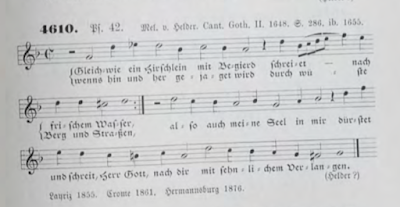
Here is my translation of the praise hymn, “Gleichwie ein Hirschlein mit Begierd” (Bartholomäus Helder, d. 1635), based on Psalm XLII (Sicut cervus), as it appears in Ev.-Luth. Gesangbuch (Wisc. Synod) #82. The appointed melody is “Es ist das Heil uns kommen her,” but Layriz indicates the “proper melody” from the Gotha Cantional II (1648), p. 286, and may have been written by Helder, which I therefore also include here from Zahn.


AS pants the hart with great desire
For water-brooks reviving,
When in the chase he starts to tire,
Through hills and byways striving,
So also doth my soul in me
Both thirst and groan, Lord God, for Thee,
With deep and heartfelt longing.

2 O Lord my God and Confidence,
When wilt Thou grant me ever
To look upon Thy countenance
So full of grace and favor?
Behold my grief and misery,
Defend me from the enemy,
From shame my soul deliver!

3 Both day and night I weep at heart
While proudly foes  aggrieve me,
But God again will joy impart,
And nevermore will leave me
So with His flock to church I'll go
And praises on His name bestow:
This is my highest gladness.

4 Why art thou cast down, O my soul?
Or what can discontent thee?
Hope thou in God, His name extol;
Thou need’st not thus torment thee.
God will assist thee graciously
This shalt thou witness visibly.
I’ll praise my God forever.

Translation © 2022 Matthew Carver.

GERMAN
Gleichwie ein Hirschlein mit Begierd
schreiet nach frischem Wasser,
wenn's hin und her gejaget wird
durch wüste Berg und Straßen:
also auch meine Seel in mir
dürstet und schreit, Herr Gott nach dir,
mit sehnlichem Verlangen.

2 Ach, Herr mein Gott und Zuversicht,
wann wird's einmal geschehen,
daß ich dein gnädig Angesicht
mög schauen und ansehen?
Sieh an mein Elend, Angst und Noth,
laß mich nicht sein der Feinde Spott;
Errette meine Seele.

3 Der Feinde Trotzen kränket mich
zu Tag und Nacht im Herzen;
Gott wird mich aber lassen nicht,
mich wiederum ergötzen.
Ich will in seiner Kirch und Gmein
hingehn und lobn den Namen sein:
das ist mein höchste Freude.

4 Was magst du denn betrUuuben dich,
mein allerliebste Seele?
Trau Gott, dem herren inniglich;
was darfst du dich selbst quälen?
Er wird dir helfen gnädiglich,
du wirst's erfinden sichtbarlich:
ich werd ihm ewig danken.


14 January 2018

Dein armer Hauf, Herr, tut klagen

Here is my translation of the hymn / paraphrse of Psalm 10, “Dein armer Hauf, Herr tut klagen” (M. Stiefel, 1524/5). One of the lesser known hymns composed in the earliest period of Lutheran hymnody, its focus on the papacy excluded it from more general use and it was in turn omitted from later important hymnals such as Bapst (1545), arguably the culmination of Luther’s hymnodic project during his lifetime. Its meter, furthermore, does not follow the bar-form with its repetition, but rather uses the meter of the popular Latin hymn Pange lingua gloriosi. Nevertheless, for the sake of its history and provenance (it was included in the early Wittenberg Chorgesangbuch and hymnal for the laity) I haved decided to include it here. The melody is first, that of Pange lingua, and secondly, a new, proper melody by J. Walter, both being here reproduced from Zahn vol. 2, 3681–3682a (Stiefel's other hymn to be included in the earliest Lutheran hymnals was indeed based on Pange lingua). For further information, see Robin Leaver, The Whole Church Sings (Eerdmans, 2017).


LORD, Thy little flock is sighing
’Neath the Antichrist’s great might,
Who by cunning arts is trying
To conceal Thy Word from sight,
Which in these last days, forth flying,
Threatens his destruction quite.

2 For Thine advent we are yearning,
Lord, why dost Thou tarry long?
Wilt Thou not be soon returning
To release us from his wrong?
What wild beasts, art Thou discerning
Mightily comprise his throng!

3 He by haughty passions prodded,
Sends Thy servants to the flame,
Bids his works by all be lauded,
Cloaks his deeds in fairest name,
Yea, as right is he applauded
When God’s honor he would claim.

4 His own passions he doth cherish,
Yea, o’er God gives them more praise,
Makes indulgences to flourish,
Sets at naught the Maker’s grace,
And God’s Word, which souls doth nourish,
He blasphemes in countless ways.

5 He o’erflows with curse and scolding,
When a man his will disdains,
Not regarding nor beholding
If it honors or profanes,
Sin and shame as nothing holding,
Yea, e’en God he keeps in chains.

6 He above, all others under,
So he boasteth as a god,
Heeds not, Lord, Thy works of wonder,
Nor Thy might, nor vengeful rod;
Freely says, “Tear them asunder!
My opponents pay in blood!”

7 “There is none that may defy me,
God is mine, one heart we share:
Would some person seek to try me,
My great scholars soon are there!
Caesar will his sword supply me,
And defend St. Peter’s Chair!”

8 Such a man has earth seen never
Who did ban and curse as he;
Whose vast greed, through sly endeavor,
Brings all men to poverty;
While his tongue oppresses ever
Consciences that else were free.

9 He the teacher’s title carries—
Death, the art he’s mastered most:
Blows against his Church he parries
With his Ban and battle-host;
Those who question him, he buries:
Pow’r upholds his throne and boast.

10 Those who do what he’s forbidden,
Lionlike he seeks with care,
Lest some soul from him be hidden
That would dare his reach impair;
Soon that man is overridden,
And made captive in his snare.

11 So the poor man is restrainèd
By the papal ban and blast,
Or the prince’s sword ordainèd,
Burning stake, or bondage fast—
By no arts can grace be gainèd,
Then is favor’s moment past.

12 “Let us still our war be waging,”
Says hell’s vicar boastfully,
“God is with us in our raging,
Shields us from calamity;
All in which we are engaging
Shall succeed most happily.”

13 Lord, arise! Our hearts are longing,
That we may Thy judgment see!
Break his boasting, cease his wronging,
Reigning, speaking blasphemy:
“All the world, to me be thronging!
Even God resists not me.”

14 Lord, what vile abominations!
Strike and slay him with Thy sword,
Who withstands the strength of nations;
He deserves no less, O Lord!
Still Thy flock awaits with patience,
Till hellfire is his reward.

15 Now, e’en as his grasp is failing,
He puts out his largest horn,
Which he holds as most availing,
Half-spurred, on his horse is borne,
Yet his pow’r no wise curtailing:
To him still what pow’r is sworn!

16 Praise the Lord! The time’s fulfillèd,
God Himself will shepherd be!
Now ye papists shall be stillèd,
Who seduced men wickedly;
God has heard our pray’r, and willèd
That ye shall His sentence see.

17 Pope, thy pride will leave thee broken,
God will hear our plaintive cry,
Soon shall end what thou hast spoken
On all lands beneath the sky;
We see clearly ev’ry token;
This no Christian can deny.

18 God, most worthy and most glorious!
All my senses Thee extol;
When I leave this life laborious,
Keep me, Lord, in body_and soul,
Till I dwell with Thee, victorious,
Where eternal ages roll.

Translation © 2018 Matthew Carver.

GERMAN

1. Dein armer Hauf, Herr, tut klagen
großen Zwang vom Widerchrist,
der sein Bosheit hat verschlagen
wohl unter dem Wort mit List,
welchs in diesen letzten Tagen
seins Greuels Verstörung ist.

2 Dein Zukunft wir hoch begehren,
ach, wo bleibst du, Herr, so long?
Willt du uns denn nicht gewehren
und abwenden unsern Drang?
Sieh doch, wie als Wolf und Bären
die gewalt’g Rott an ihm hang.

3 Wenn er Hohmut treibt mit Toben,
brennen muß dein armer Knecht,
seinen Anschlag muß man loben,
was er tut, ist alles shclecht;
das heißt gut, so diesem Buben
muß weichen dein Göttlich Recht.

4 Seins Herzenschrein er fast preiset
über Gott mit voller Gwalt,
uns sein Gnad und Ablaß weiset,
daß dein Gnad hat kein Gestalt;
Gotts Wort, das die Seelen speiset,
verlästert er manichfalt.

5 Aus geußt er Fluchen und Schelten,
wo er fühlet Widerstand,
Acht nicht und gedenket selten,
ob da sei Ehr oder Schand;
Sünd und Schand muß hie nicht gelten,
er faßt auch Gott in sein Band.

6 Hoch will er sein und besonder,
da ist eitel Übermut,
dein Recht, Herr, und deine Wunder
sieht er nicht, noch deine Rut;
Er spricht frei, “Der muß erunder,
wer mich haßt, es kost sein Blut!”

7 “Niemand ist der mich absetzet,
Gott is mein und ich sein Buhl;
So mich jemand hie verletzet,
weck ich auf mein hohe Schul,
bald sein Schwert der Kaiser wetzet,
beschirmet Sankt Peters Stuhl.”

8 Auf Erden kein Mensch erhöret
ist, der also bann’ und schelt’,
sein Geiz durch Betrug betöret
die Menschen all um ihr Geld,
ach und weh! sein Zung zustöret
gut Gwissen in aller Welt.

9 Er will als ein Lehrer sitzen,
Würgen ist sein größte Witz,
seinen Kirchhof muß beschützen
Bannes Kraft und Heeres Spitz,
Wer ihn straft, den tut er schmitzen,
ohn Gwalt sein Stuhl hat kein Stutz.

10 Darum sieht er auf mit Sorgen
als ein Löw in seiner Hühl,
Daß ihm keiner bleib verborgen
der ihm setzen will ein Ziel;
wer solchs tut, der muß erworgen,
ihn bringt sein Netz in das Spiel.

11 Also muß der Arm verderben
durch des Bapstes Bann und Blitz,
von dem Schwert muß er do sterben,
Gefängnis, Leiden und Hitz,
gar kein Gnad mag er erwerben,
da hilft kein Kunst oder Witz.

12 “Laßt uns fechten, laß uns streiten,”
spricht der Widerchristlich Hirt,
“Hie ist Gott auf unser Seiten,
kein Unglück uns immer rührt,
unser Sach zu allen Zeiten
mit Freuden wird ausgeführt.”

13 Herr, steh auf! Uns tut verlangen,
laß herbrechen dein Gericht!
daß zubrochen werd das Prangen,
das mit Lästern hirscht und spricht,
“All Welt muß wohl an mir hangen,
Gott selbst mir nicht widerficht.”

14 Es muß den Greuel erstechen
und ertöten, Herr, dein Schwert;
Menschen Hand mag ihn nicht brechen,
er ist kleiner Straf nicht wert,
ewig Pein die muß solchs rechen,
denn wird der arm Hauf gewährt.

15 Es ist seiner Gwalt abbrochen
itzund schon das größte Horn,
noch mit einem tut er pochen,
den Hengst reit mit einem Sporn,
hat die Welt an sich geflochten,
die Gwalt ist ihm noch geschworn.

16 Lob sei Gott, die Zeit ist kommen,
er will selber sein der Hirt!
Ihr Papisten mußt erstummen,
die ihr habt die Welt verführt:
Gott hat unser Bitt vernommen,
sein Urteil euch scheiden wird.

17 Eur Stolz, der macht euch zu Schanden,
Gott wird hören unser Klag,
Bald auf Erden in den Landen
wird sich enden all Vortrag,
alle Zeichen sind vorhanden,
kein Christen das leugnen mag

18 Gott, mit allen meinen Sinnen,
ich dein Lob und Ehr hier treib.
So ich scheiden soll von hinnen,
bewahr mir, Herr, Seel und Leib,
daß ich mög den Sieg gewinnen
und ewiglich bei dir bleib.