Showing posts with label gotha cantional. Show all posts

22 August 2023

Haben wir das Gute empfangen

Here is my adaptation of the funeral responsory, “Haben wir das Gute empfangen,” in ELGB #464, with Latin source, “Si bona suscepimus,” ELGB #465. The German text from Luther’s version of Job 1:21; 2:10, based on the Latin original, was used with a setting by Bartholomäus Gesius in 1605 and the song included thus the Gotha Cantional 1648, etc., from which it came into the Buffalo Synod Hymnal. The Common Service Book provides a brief form from the KJV rendering of Job, omitting the text “Naked came I . . .” The musical edition includes an adaptation of Gesius’ melody (dated 1605 here) for this abbreviated text. Here, then, I provide a text slightly altered to follow the German more closely and to allow some semblance of the Gesius melody, whose setting professional musicians may certainly try their hand at adapting better, and will no doubt be more successful.


R. IF we have received good  at the hand of the LORD,
why should we not also suffer evil?
The LORD hath given,  the LORD hath taken away.
As it hath pleased the Lord,  so is it done.
Blessed be the name of the
LORD
V. Naked came I out of my mother’s womb,  naked shall I return thither.

The LORD hath given, the LORD hath taken away, &c.

Translation adapted from the Bible, the Authorized Verson (King James) and Douay-Rheims.

COMMON SERVICE BOOK:
Shall we receive good at the hand of the Lord,
and shall we not receive evil?
The Lord gave, and the Lord hath taken away.
Blessed be the name of the Lord.
The Lord gave, and the Lord hath taken away.


GERMAN
Haben wir das Gute empfangen
aus der Hand des Herrn,
warum sollten wir auch das Böse nicht leiden?
Der Herr hat es gegeben,
der Herr hat es genommen;
wie es dem Herrn gefället, so ist es geschehn,
der Name des Herrn sie gelobet.
Ich bin nackend von meiner Mutter Leibe geboren,
nackend müs ich wieder hinfahren.

2 Der Herr hat es gegeben, etc.


LATIN
Si bona suscepimus de manu Dei,
mala quare non Suscipiamus?
Dominus dedit, Dominus abstulit,
sicut Deo placuit, ita factum est.
Sit nomen Domin benedictum.
Nudus egressus sum de utero matirs meae,
et nudus revertar illue.

2 Dominus dedit, etc.

06 July 2023

Lobet den Herrn alle

Here is my translation of the festal choir piece, “Lobet den Herrn alle” (ad. Heinrich Schütz, st. 1, d. 1672; Joseph Clauder, d. 1653, sts. 2–4), in ELGB #250, where it is appointed for days of Apostles and other feasts, and no melody is given. The first stanza, slightly altered, is from Schütz’s Symphoniae Sacrae, 1647, and is based on Psalm 117. Stanzas 2–4 are found with it in the Gotha Cantional 1646 (1651) with both a Latin text and a new, simple 4-voice setting, and in Gsb 1683, no. 143, p. 198f., and 1691, no. 116, p. 112, with no Latin and without music, where it is appointed for Holy Trinity. The Gotha Cantional indicates music by (?Orfeo) Vecchi, and text by Joseph Clauder, though it is unclear whether the latter is responsible for both Latin and German. I also include from Zahn a later melody taken from Witt 1715.


O PRAISE the Lord God, all ye,
O praise Him, all ye heathen,
O praise Him, all ye,
O praise Him, all ye nations:
His grace and truth are changeless,
Lasting ever, ever and evermore,
Ever and evermore.

2 Declare His wonders glorious
With shouts and songs victorious
With anthems painless,
With lips and hearts all stainless:
His grace and truth are changeless,
Lasting ever, ever and evermore,
Ever and evermore.

3 Glad songs to God be given,
Sun, moon, and stars of heaven,
In every nation,
In every nation,
The earth and all creation:
His grace and truth are changeless,
Lasting ever, ever and evermore,
Ever and evermore.

4 O Holy! Holy! Holy!
Our Triune God is Holy!
His praise resoundeth,
And every land surroundeth:
His grace and truth are changeless,
Lasting ever, ever and evermore,
Ever and evermore.

Translation © 2023 Matthew Carver.

GERMAN
Lobet den Herren alle,
lobet Ihn alle Heiden,
preiset Ihn alle,
preiset Ihn alle,
preiset Ihn alle Volker:
Denn seine Gnad' und Wahrheit
bleibet immer, immer und ewiglich,
immer und ewiglich.

2 Erzählt sein Wunder alle
mit Jauchzen und mit Schalle
ohn' alle Schmerzen,
mit reinem Mund und Herzen:
denn seine Gnad' und Wahrheit
bleibet immer, immer und ewiglich,
immer und ewiglich.

3 Singt fröhlich Gott dem Herren,
Sonn', Mond und alle Sternen,
Himmel und Erden,
Himmel und Erden,
und was darauf thut werden:
denn seine Gnad und Wahrheit
bleibet immer, immer und ewiglich,
immer und ewiglich.
4 Wie Heilig! Heilig! Heilig!
ist unser Gott Drei-Einig!
Sein Lob für allen,
Sein Lob für allen,
in allem Land thut schallen:
denn seine Gnad' und Wahrheit
bleibet immer, immer und ewiglich,
immer und ewiglich.

 LATIN

Gens cuncta voce crebra
Deum tuum celebra,
Laudant et omnes,
Laudant et omnes,
hunc usque nationes.
Nam fides ejus bonitasque,
durat saecla per omnia, saecla per omnia.


2 Narrare quisquis ejus
miracla surge laetus,
Totus que gaude,
Totus que gaude,
animo labioque plaude!
Nam fides ejus bonitasque,
durat saecla per omnia, saecla per omnia.


3 Huic cantitate prompte,
Sol, luna, sidus omne,
caelum solumque,
caelum solumque,
Et quaeque fert utrumque.
Nam fides ejus bonitasque,
durat saecla per omnia, saecla per omnia.


4 Sanctus Jehovah, Sanctus
Sanctus manet Triunus
Honore cujus,
Honore cujus,
claret stupetque mundus.
Nam fides ejus bonitasque,
durat saecla per omnia, saecla per omnia.

04 July 2023

Send uns, Herr Christ, die Engel dein

Here is my translation of the Michaelmas hymn, “Send uns, Herr Christ, die Engel dein” (Bartholomäus Helder, d. 1635), in ELGB #237, appearing in the Gotha Cantional 1646 (1651), no. 112, with a four-voice setting by Helder. I include this setting as given in Schöberlein’s Schatz II, p. 835.


LORD Christ, to us Thine angels send,
That they may e’er Thy flock defend,
And most of all, at Thy command,
The evil one’s attacks withstand.

2 Against those ruses be our stay
Which devil, world, and flesh would play;
To us a mighty Fortress be
Against all force and tyranny.

3 What blessed fortune is their gain
Who such protection here obtain,
By Michael saved, that warlord dread,
Who trampled down the dragon’s head!

4 May He precede us in the fray,
That we may safely walk Thy way
Till with the angel’s company
We dwell in heav’n eternally.

Translation © 2023 Matthew Carver.

GERMAN
Send uns, Herr Christ! die Engel Dein,
daß sie stets um Dein Häuflein sein,
nach Dein'm Befehl auch allermeist
Wacht halten widern bösen Geist.

2 Bewahre uns fürm Bösen Spiel,
so Teufl, Welt und Fleisch machen will,
sei uns ein starker Schutz dabei
widr all Gewalt und Tyrannei.

3 O glückselig sind alle die,
so diesen Schutz erlangen hie,
die der Großfürst Michael rett't,
der dem Drachen sein'n Kopf zertritt.

4 Der streit' für uns und geh' voran,
das wir treffen die rechte Bahn,
bis wir ewig den Engeln rein
im Himmel zugesellet sein.

14 June 2023

Coelos ascendit hodie, Alleluia

Here is my translation of the Ascension hymn/pia cantio, “Coelos ascendit hodie, Alleluia” (Anon., 15th c.) and its fairly close German rendering, “Gen Himmel aufgefahren ist” (asc. Melchior Franck) in ELGB #158/159, originally from Vulpius’ Gsb 1609, with melody by Melchior Franck. It was include in the Gotha Cantional, Niedling’s Handbüchlein, Freylinghausen 1704, etc. A partial translation by F. W. Herzberger made in 1912 was included in the Selah Song Book / Sela Gesangbuch 1924. The most widespread translation is J. M. Neale’s “Today Above the Sky He Soared,” which is full and good. However, following some of the Latin lines, I have given some consideration to beginning with an accentual pattern / - - / rather than pure iambs ( - / - /). I give the melody from Vopelius (for the Latin) and from the Gotha Cantional (for the German text), which are almost identical.


HEAV’Nward this day by high ascent
Alleluia!
Jesus the King of glory went
Alleluia!

2 Sitting on God the Father’s right
Alleluia!
Heaven and earth He rules with might.
Alleluia!

3 Now is fulfilled what was foretold
Alleluia!
By father David’s psalms of old.
Alleluia!

4 Now doth the Lord, our God alone:
Alleluia!
Sit with the Lord on heaven’s throne.
Alleluia!

5 Now on this mighty triumph sing:
Alleluia!
BLESS WE THE LORD, our heav’nly King.
Alleluia!

6 Praised be the Holy Trinity:
Alleluia!
THANKS BE TO GOD eternally!
Alleluia!

Translation © 2023 Matthew Carver.

SELA GESANGBUCH 1924 (from the German):
1 In triumph He went heavenward
Hallelujah!
King of all glory, Christ our Lord.
Hallelujah!

2 He sitteth now at God’s right hand.
Hallelujah!
To rule over heaven, sea, and land.
Hallelujah!

3 Fulfilled is what was prophesied:
Hallelujah!
Of Christ the Redeemer crucified.
Hallelujah!

5 Now let all men with joy proclaim
Hallelujah!
The glorious might of His great name.
Hallelujah!


LATIN
1 Coelos ascendit hodie,
Hallelujah,
Jesus Christus Rex gloriae,
Hallelujah.

2 Sedet ad Patris dexteram,
Hallelujah,
Gubernans coelum et terram,
Hallelujah.

3 Jam finem habent omnia,
Hallelujah,
patris Davidis carmina,
Hallelujah.

4 Jam Dominus cum Domino,
Hallelujah,
sedet in Dei solio,
Hallelujah.

5 In hoc triumpho maximo, [Ascensionis Domino]
Hallelujah,
Benedicamus Domino,
Hallelujah.

6 Laudetur sancta Trinitas,
Hallelujah,
Deo dicamus gratias,
Hallelujah.


GERMAN
Gen Himmel aufgefahren ist,
Hallelujah!
der König der Ehren Jesus Christ,
Hallelujah!

2 Er sitzt zur Rechten Gottes Hand,
Hallelujah!
herrscht über Himmel und alle land,
Hallelujah!

3 Nun ist erfüllt, was geschrieben ist,
Hallelujah!
in Psalmen von dem Herren Christ,
Hallelujah!

4 Nun setzt beim Herren Davids Herr,
Hallelujah!
wie zu ihm hat gesagt der Herr,
Hallelujah!

5 Drum jauchzen wir mit größem Schall'n
Hallelujah!
dem Herren Christ zu Wohlgefall'n,
Hallelujah!

6 Wir loben die heilig' Dreifaltigkeit,
Hallelujah!
von nun an bis in Ewigkeit.
Hallelujah!

22 May 2023

Der Engel zu Maria kömmt

Here is my translation of the Annunciation hymn, “Der Engel zu Maria kömmt” (Bartholomäus Helder, d. 1635), in ELGB #85, on Luke 1:26–38, first appearing in the Gotha Cantional 1646 (1651), from which it was included in the Buffalo Synod hymnal. The appointed melody is not given, suggesting the original cantional melody was used, while Fischer indicates “Vom Himmel hoch.”


TO Mary comes the Angel bright,
And brings her tidings of delight:
She shall conceive a Child and bear
Christ Jesus, God and heaven’s Heir.

2 In wonder Mary hears the word,
Told by the Angel from the Lord:
This shall the Holy Ghost in her
Perform in manner new and pure.

3 Lord Jesus Christ, who for our good
Didst take on Thee our flesh and blood,
Grant us partakers here to be
Of such great benefits from Thee.

4 Save us from sin and death and hell,
Before us every danger quell,
Help us by Thy humanity,
That we may ever live with Thee.

Translation © 2023 Matthew Carver.

GERMAN
Der Engel zu Maria kömmt,
und ihr die fröhlich Botschaft bringt:
sie soll empfahen und gebar'n
Jesum den wahren Gott und Herrn.

2 Maria des verwundert sich,
der Engel giebt ihr den Bericht,
das solch's in ihr der Heilig' Geist
verrichten werd' auf sonder Weis'.

3 Herr Jesu, der Du uns zu gut
hast angenommen Fleisch und Blut,
ach hilf! daß wir theilhaftig sein
der theuren großen Wohlthat Dein.

4 Errett' uns von Sünd, Höll und Tod,
erhalt' uns fest in aller Noth:
Hilf durch die zarte Menschheit Dein,
daß wir mög'n ewig bei Dir sein.

21 May 2023

Maria kömmt zur Reinigung

Here is my translation of the Purification/Presentation hymn, “Maria kömmt zur Reinigung” (Ludwig Helmbold, d. 1614), in ELGB #83. Fischer has no note, and it does not appear in Helmbold’s Schöne geistliche Lieder, but in Dreissig Geistliche Lieder (1609) with Joachim à Burck’s settings of Helmbold’s texts for the feasts of the church year; further, in the Gotha Cantional 1646 (1651), of which the Buffalo hymnal makes so much use. If this is the source, the Buffalo hymnal omits the 5th stanza and suggests two more common melodies in place of à Burck’s: “Wo Gott zum Haus” and “Vom Himmel hoch.”


NOW to her cleansing Mary goes,
Whose bearing no sin-blemish knows;
Whose Son Himself, completely pure,
Shall cleanse the world and be our Cure.

2 Within the Temple He is shown,
Who pleases God, yea, He alone,—
The Virgin’s Son by ancient plan,
Without addition of a man.

3 As He is offered to the Lord;
His Mother doth two doves afford,
Yet not His ransom-price to make,
For He must suffer for our sake.

4 God readies Him a Savior here
For Adam’s children far and near,
A Light for those in night who dwell,
The glory of His Israel.

5 Who Him receives as Simeon
In peace and joy departs thereon
From this world to God’s kingdom blest:
God grant us that eternal rest!

Translation © 2023 Matthew Carver.

GERMAN
Maria kömmt zur Reinigung,
die doch geboren hat ohn' Sünd
ein'n Sohn, der an Ihm selbst rein ist,
und alle Welt von Sünden wäscht.

2 Im Tempel wird Er dargestellt,
ist alleine, so Gott gefällt,
der erstgeborne Weibes-Sohn,
dazu kein Mann nichts hat gethan.

3 Er wird dem Herrn geheiliget,
die Mutter ein Paar Tauben giebt,
macht aber Ihn damit nicht los,
denn Er für uns selbst leiden muß.

4 Zum Heiland hat Ihn Gott bereitt
den Menschen-Kindern weit und breit,
zum Licht der Heiden klar und hell,
und Preis des Volkes Israel.

[5 Wer Ihn aufnimmt wie Simeon,
der fährt mit Fried und Freud davon
aus dieser Welt in Gottes Reich,
das werd an uns wahr ewiglich.]

19 May 2023

Herr Gott, nun schleuß den Himmel auf”

 Here is my translation of the Purification / Dying hymn, “Herr Gott, nun schleuß den Himmel auf” (Tobias Kiel, d. 1627), ELGB #79, first appearing with setting for 5 voices by Michael Altenburg in his Christlicher, lieblicher und andechtiger, newer Kirchen und Hauß Gesänge (Erfurt, 1620), later in the Gotha Cantional 1646 (1651). Bach incorporates it into BWV 1092 and BWV 617. Since the translation by Catherine Winkworth does not quite follow the meter, but also omits some internal rhyme, I have undertaken a completely new translation. Several settings with melodies and variants often based on Altenburg’s exist. I include here a 4-part setting by Zahn.


LORD God, let heaven open wide,
My little day soon closes;
My course is run, I’m satisfied,
My soul in joy reposes;
Grief was I given,
And much have striven;
Now softly send
Rest without end!
Let earthly things be taken,
To bliss let me awaken!

2 Lord, as Thou hast commanded me,
I have embraced My Savior
In arms of faith, and look to Thee,
Who art my Hope forever.
I’ll stand securely;
To gladness surely
I soon shall go
From tears and woe.
Let earthly things be taken,
To bliss let me awaken!

3 Lord, let me go like Simeon
To Thee in peace and favor;
Commit my soul to Christ Thy Son,
Who will preserve me ever,
And guide me rightly
And crown me brightly
With glory’s ray;
I go my way!
Let earthly things be taken,
To bliss let me awaken!

Translation © 2023 Matthew Carver.

WINKWORTH 1868
Lord God, now open wide Thy heaven,
My parting hour is near;
My course is run, enough I've striven
Enough I've suffered here;
Weary and sad
My soul is glad
That she may lay her down to rest;
Now all on earth I can resign,
But only let Thy heaven be mine.

2 As Thou, Lord, hast commanded me,
Have I with perfect faith
Embraced my Saviour, and to Thee
I calmly look in death;
With willing heart
I hence depart,
I hope to stand before Thy face:
Yes, all on earth I can resign,
If but Thy heaven at last be mine.

3 Then let me go like Simeon
In peace with Thee to dwell,
For I commend me to Thy Son,
And He will guard me well,
And guide me straight
To the golden gate;
And in this hope I calmly die;
Yes, all on earth I can resign,
If but Thy heaven may now be mine.


GERMAN

Herr Gott! nun schleuß den Himmel auf,
mein Zeit zum End sich neiget;
ich hab vollendet meinen Lauf,
des sich mein Seel sehr freuet,
hab gnug gelitten,
mich müd gestritten,
schick mich fein zu zur ew'gen Ruh.
Las fahren, was auf Erden,
will lieber selig werden.

2 Wie Dir mir Herr befohlen hast,
hab ich mit wahrem Glauben,
mein lieben Heiland aufgefaßt
in mein Arm, Dich zu schauen.
Hoff zu bestehen, will frisch eingehen
ausm Thränenthal
in Freudensaal.
Laß fahren, was auf Erden,
will lieber selig werden.

3 Laß mich nur Herr, wie Simeon
in Frieden zu Dir fahren,
befehl mich Christo Deinem Sohn,
der wird mich wohl bewahren,
wird mich recht führen
im Himmel zieren
mit Ehr und Cron,
fahr drauf davon.
Laß fahren, was auf Erden,
will lieber selig werden.

13 May 2023

O trautes, liebes Jesulein

Here is my translation of the New Year hymn “O trautes, liebes Jesulein” (Bartholomäus Helder, d. 1635), in ELGB #59, early appearing in the Gotha Cantional from 1646 (1651) with setting for four voices. Since the Buffalo hymnal has no melody indication, it may be assumed that cantional music was used. Fischer indicates the melody “Vom Himmel hoch da komm ich her.”


WE greet Thee, dearest Jesus, now,
O God and Man, our Brother Thou!
Thy love and faithfulness it was
That brought Thee down from heav’n to us.

2 Thou takest on our flesh and blood
Yet without sin, for all our good;
Thou com’st a poor Man and oppressed,
That we may be rich men and blest.

3 Teach us Thy benefits to love
Which Thou hast brought from heav’n above;
Our body let Thy manger be,
Our heart, a chamber fit for Thee.

4 Help us in need, the foe restrain,
And save us from the world’s disdain,
Till safe with Thee in heav’nly joy,
No evils more may us annoy.

Translation © 2023 Matthew Carver.

GERMAN
O trautes, liebes Jesulein!
o Gott und Mensch! o Brüderlein!
das Du vom Himmel kommen bist,
Dein Lieb' und Treu' die Ursach ist.

2 Nimmst an Dich unser Fleisch und Blut,
doch ohne Sünd', uns all'n zu Gut,
kommst zu uns arm und elend ein,
auf daß wir reich und selig sein.

3 Lehr' uns Dein Wohlthat hab'n in Acht,
die Du vom Himmel hast gebracht,
laß unsern Leib Dein Kripplein sein,
und unser Herz Dein Kämmerlein.

4 Steh bei in Noth, dem Teufel weh'r,
auch der Welt Bosheit von uns kehr;,
bis wir bei Dir in ew'ger Freud'
Bewahret sein für allem Leid.

12 May 2023

Mein Gott der wahres Gottes Sohn

Here is my translation of the Christmas carol, “Mein Gott der wahres Gottes Sohn” (Eckhard Leichner, d. 1690), from ELGB#42, another interesting selection by the Buffalo Synod hymnal from the Gotha Cantional (from at least 1646) with music for 3 voices by Johann Hermann Schein. I give the form of the melody from Kümmerle’s reproduction of König 1715 and the complex one from Freylinghausen 1745. Again, no melody is indicated in the Buffalo Synod hymnal, suggesting a copy of the Gotha Cantional or of its contents was present among the congregations.


MY God, the Father’s only Son
For me had such affection,
He left His high celestial throne
By His own free election
And in a servant’s station
He bore our sin, our souls to bless,
And won for us the righteousness
By which we have salvation.

2 Behold, the Maker of all things
Now in this manger lieth,
Looks lowlier far than earthly kings,
And eyes of man defieth,
Yet brings us highest glory.
He makes us rich by poverty,
That we may like the angels be.
What greater gift implore ye?

3 Oh, dearest Jesus, Savior mine,
Let me in truth possess Thee,—
Yea, let me evermore be Thine
And blush not to confess Thee!
Thou art my Joy, my Savior!
From death and sin Thou sett’st me free:
Then in both joy and misery
I’ll thank Thee now and ever!

Translation © 2023 Matthew Carver.

GERMAN
Mein Gott der wahres Gottes Sohn
hat mich ja hoch geliebet,
daß er von seines Himmels Thron
sich in dies Elend giebet,
und wird ein Knecht auf Erden,
nimmt an sich unser Sünden-Leid,
erwirbet die Gerechtigkeit,
dadurch wir selig werden.

2 Sieh da, der Schöpfer aller Ding'
in dieser Krippen lieget,
zwar die Gestalt, so gar gering,
für aller Welt nichts tüget,
bringt uns doch hoch zu Ehren.
Sein' Armuth macht uns ewig reich,
Ihm selber und den Englen gleich.
Wer könnte mehr begehren?

3 Ach mein herzliebes Jesulein!
laß michs zu Herzen nehmen,
ja laß mich ganz Dein eigen sein
und Deiner gar nicht schämen.
Du bist mein Heil und Freude,
machst mich vom Tod und Sünden frei,
das ich dort ewig dankbar sey,
auch hier in Lieb und leide.

02 February 2023

Lasset uns den Herren lieben

Here is my translation of the hymn “Lasset uns den Herren lieben” (Anon., 1729?), from Ev.-Luth. Gsb #487, a hymn on brotherly love of unknown authorship. Fischer does not mention it. The clean, concise style eschewing the unusual reminds of a Schmolck or Neumeister. Its first appearance known to the translator is the Gotha hymnal of 1729 and the prayerbook associated with it, both printed by Reyher. Here it has the title: “Firmly bound love of God and brother. 1 John 4:19–21” (hence suitable for Trinity I) and falls between two Schmolck hymns with explicit authorship, while the present hymn conspicuously lacks ascription. After this it appears in Hessia-Hamburg 1734 (with mel.: “Gott des Himmels), Silesia 1749, Breslau/Burg 1745ff., Regensburg Sing-Schule 1770, etc. Its inclusion in Breslau explains that ascription in the Gsb für Gemeinden des Ev.-Luth. Bekenntnisses, no. 403 (in 4 sts.). The appointed melody is almost universally “Herr, ich habe mißgehandelt.”


LET us love the Lord of heaven,
Whose love first to us was shown
And who in great love was driven,
For our sake to give His Son;
Thus we must, His mercies seeing,
Give Him all our heart and being.

2 This should be our fitting pleasure,
Since we have from God far more
Than our mind can ever measure
Of His love’s unfathomed store,
Yet few deeds can be detected
Whereby words are well reflected.

3 Who to love his Maker claimeth,
Yet his brother doth despise,
Yea, afflicteth and defameth,
Nor will help in Christian wise
Carry any burden pressing—
What of love is he confessing?

4 If he sees his brother ever,
Yet withholds all love and grace,
While conversely he can never
See His God and Maker’s face,
How, since he doth see his brother,
Can he love the unseen Father?

5 Who loves God, who all created,
Let him so with actions prove,
Which is thereby demonstrated,
That he doth his brother love;
For the Lord acclaims this labor:
Lov’st thou God? Then love thy neighbor.

Translation © 2023 Matthew Carver.

GERMAN
Lasset uns den Herren lieben,
denn er hat uns erst geliebt;
Liebe hat ihn angetrieben,
daß er seinen Sohn uns giebt:
unser Herz und alles Leben
sind wir schuldig ihm zu geben.

2 Billig ist es, dies zu leisten,
da Gott ungleich mehr gethan,
wie die Zahl der allermeisten
dieses auch erkennen kann:
gleichwohl sieht man wenig Thaten,
ihren Worten gleich gerathen.

3 Denn wer Gott vermeint zu lieben,
und doch seinen Bruder haßt,
sich nicht scheut, ihn zu betrüben,
und ihm auch die schwerste Last
nicht mag christlich helfen tragen:
was kann der von Liebe sagen?

4 Seinen Bruder sieht er immer,
liebet ihn gleichwohl doch nicht;
dahingegen sieht er nimmer
seines Schöpfers Angesicht:
Sollte wohl dem Unsichtbaren
wahre Liebe widerfahren?

5 Welcher Gott zu lieben meinet,
der erweis es in der That,
so denn aus der Lieb erscheinet
die er zu dem Bruder hat.
Denn dies ist ein Spruch des Höchsten:
Liebst du Gott, lieb auch den Nächsten.

26 August 2022

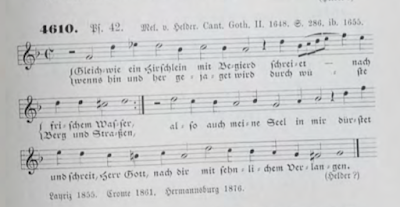
Gleichwie ein Hirschlein mit Begierd

Here is my translation of the praise hymn, “Gleichwie ein Hirschlein mit Begierd” (Bartholomäus Helder, d. 1635), based on Psalm XLII (Sicut cervus), as it appears in Ev.-Luth. Gesangbuch (Wisc. Synod) #82. The appointed melody is “Es ist das Heil uns kommen her,” but Layriz indicates the “proper melody” from the Gotha Cantional II (1648), p. 286, and may have been written by Helder, which I therefore also include here from Zahn.


AS pants the hart with great desire
For water-brooks reviving,
When in the chase he starts to tire,
Through hills and byways striving,
So also doth my soul in me
Both thirst and groan, Lord God, for Thee,
With deep and heartfelt longing.

2 O Lord my God and Confidence,
When wilt Thou grant me ever
To look upon Thy countenance
So full of grace and favor?
Behold my grief and misery,
Defend me from the enemy,
From shame my soul deliver!

3 Both day and night I weep at heart
While proudly foes  aggrieve me,
But God again will joy impart,
And nevermore will leave me
So with His flock to church I'll go
And praises on His name bestow:
This is my highest gladness.

4 Why art thou cast down, O my soul?
Or what can discontent thee?
Hope thou in God, His name extol;
Thou need’st not thus torment thee.
God will assist thee graciously
This shalt thou witness visibly.
I’ll praise my God forever.

Translation © 2022 Matthew Carver.

GERMAN
Gleichwie ein Hirschlein mit Begierd
schreiet nach frischem Wasser,
wenn's hin und her gejaget wird
durch wüste Berg und Straßen:
also auch meine Seel in mir
dürstet und schreit, Herr Gott nach dir,
mit sehnlichem Verlangen.

2 Ach, Herr mein Gott und Zuversicht,
wann wird's einmal geschehen,
daß ich dein gnädig Angesicht
mög schauen und ansehen?
Sieh an mein Elend, Angst und Noth,
laß mich nicht sein der Feinde Spott;
Errette meine Seele.

3 Der Feinde Trotzen kränket mich
zu Tag und Nacht im Herzen;
Gott wird mich aber lassen nicht,
mich wiederum ergötzen.
Ich will in seiner Kirch und Gmein
hingehn und lobn den Namen sein:
das ist mein höchste Freude.

4 Was magst du denn betrUuuben dich,
mein allerliebste Seele?
Trau Gott, dem herren inniglich;
was darfst du dich selbst quälen?
Er wird dir helfen gnädiglich,
du wirst's erfinden sichtbarlich:
ich werd ihm ewig danken.