Showing posts with label Layriz. Show all posts

26 August 2022

Gleichwie ein Hirschlein mit Begierd

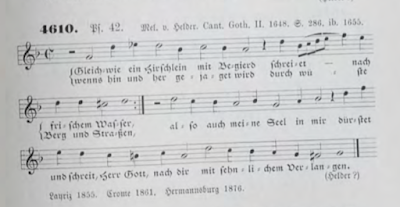
Here is my translation of the praise hymn, “Gleichwie ein Hirschlein mit Begierd” (Bartholomäus Helder, d. 1635), based on Psalm XLII (Sicut cervus), as it appears in Ev.-Luth. Gesangbuch (Wisc. Synod) #82. The appointed melody is “Es ist das Heil uns kommen her,” but Layriz indicates the “proper melody” from the Gotha Cantional II (1648), p. 286, and may have been written by Helder, which I therefore also include here from Zahn.


AS pants the hart with great desire
For water-brooks reviving,
When in the chase he starts to tire,
Through hills and byways striving,
So also doth my soul in me
Both thirst and groan, Lord God, for Thee,
With deep and heartfelt longing.

2 O Lord my God and Confidence,
When wilt Thou grant me ever
To look upon Thy countenance
So full of grace and favor?
Behold my grief and misery,
Defend me from the enemy,
From shame my soul deliver!

3 Both day and night I weep at heart
While proudly foes  aggrieve me,
But God again will joy impart,
And nevermore will leave me
So with His flock to church I'll go
And praises on His name bestow:
This is my highest gladness.

4 Why art thou cast down, O my soul?
Or what can discontent thee?
Hope thou in God, His name extol;
Thou need’st not thus torment thee.
God will assist thee graciously
This shalt thou witness visibly.
I’ll praise my God forever.

Translation © 2022 Matthew Carver.

GERMAN
Gleichwie ein Hirschlein mit Begierd
schreiet nach frischem Wasser,
wenn's hin und her gejaget wird
durch wüste Berg und Straßen:
also auch meine Seel in mir
dürstet und schreit, Herr Gott nach dir,
mit sehnlichem Verlangen.

2 Ach, Herr mein Gott und Zuversicht,
wann wird's einmal geschehen,
daß ich dein gnädig Angesicht
mög schauen und ansehen?
Sieh an mein Elend, Angst und Noth,
laß mich nicht sein der Feinde Spott;
Errette meine Seele.

3 Der Feinde Trotzen kränket mich
zu Tag und Nacht im Herzen;
Gott wird mich aber lassen nicht,
mich wiederum ergötzen.
Ich will in seiner Kirch und Gmein
hingehn und lobn den Namen sein:
das ist mein höchste Freude.

4 Was magst du denn betrUuuben dich,
mein allerliebste Seele?
Trau Gott, dem herren inniglich;
was darfst du dich selbst quälen?
Er wird dir helfen gnädiglich,
du wirst's erfinden sichtbarlich:
ich werd ihm ewig danken.


20 July 2022

Ach Du allerhöchste Freude

Here is my translation of the Communion hymn “Ach du allerhöchste Freude” (G. Weber, 1648) as found, i.a., in the Buffalo Synod hymnal #326. Two melodies are provided: the original from Weber’s Lebensfrüchte, and that for “Sei gegrüßet, Jesu gütig” (Praxis pietatis 1676), the latter being indicated in Layriz’s Kern. Concerning the author, little has come down to us of the life of Georg Heinrich Weber; there is not complete certainty in distinguishing him and his works from an elder Georg Weber. Our author seems to have been a 17th century composer born in Dahlen, Misnia, who in 1648–49 published his multi-volume Wohlriechende Lebensfrüchte (Sweet-smelling Life-fruits) in Danzig and had it printed in Königsberg, and the next year is found studying in the latter city. Later works appear in Leipzig and Weißenfels, where he was a cantor. He is possibly the Georg Weber mentioned by Wetzel, Hymnopoeograph. III, 361, as a vicar and succentor at the Magdeburg Cathedral in the 17th c. (ADB)


AH, Thou Joy, all joys excelling,
Pleasant pasture, death dispelling,
Soul, my dying body thrilling,
Balm, my hollow heart upfilling
Treasure, for which longings stir me!
Come, content me, come assure me!

2 Come, my Lord, come forth to meet me,
Who am hither come to greet Thee
In the greatest work of wonder,
Far beyond my skill to ponder;
Thus I come and will not leave Thee!
Come, or I cannot receive Thee!

3 Come to meet me! Lord, come hither
Think how, pow’rless, else I wither!
Jesus Christ, Thyself prepare me,
Worthy make me here to share Thee,
Live within me as my Savior,
Let me live with Thee forever!

4 Thou hast here the banquet given,
Spread the board with food of heaven,
Sickly hearts hereto hast bidden,
Healest souls and sins deep-hidden;
To be meat and drink hast deignèd,
Though in manner unexplainèd.

5 I in faith behold this truly,
Groaning cry, with life imbue me!
Quicken Thou my soul so needy,
Give my torment healing speedy;
Oh, what heavy pains I suffer!
Food of life, Thy solace proffer!

6 Heal me, grant me grace and favor,
Jesus worthily to savor;
Lord, refresh me with Thy quickness,
Sink Thyself within my sickness,
Live in me! Make me, O Maker,
Of Thy death and blood partaker.

7 Jesus, be my heart, my sighing,
Now and in my hour of dying,
Jesus, as my life avail me
When distress and fear assail me;
My Protector, be Thou near me;
When I call upon Thee, hear me!

8 Lord, Thy holy body feed me,
On its strength to heaven lead me;
Let Thy blood my heart be stirring,
Wash it clean from sin and erring,
Dress me fittingly for heaven
When by death my heart is driven.

Translation © 2022 Matthew Carver.

GERMAN

Ach Du allerhöchste Freude,
meine Lust und Lebensweide,
meines todten Lebens Seele,
Trost in traurigr Herzenhöhle,
o Du Schatz, den ich begehre,
komm vergnüge, komm gewähre!

2 Komm, mein Herr, entgegen gehe
mir, der ich mich unterstehe,
zu dem allergrößten Werke,
welches Sinn und Seelen-Stärke
übertrifft, hinzu zu nahen,
komm, sonst kann ichs nicht empfahen.

3 Komm entgegen, Herr, betrachte,
wie ich kraftlos sonst verschmachte,
Jesu Christe, mich bereite
würdig Dich zu nehmen heute,
jetzund wollst du in mir schweben,
auch mit Dir ewig zu leben.

4 Du hast ja den Tische gedecket,
gesetzt drauf, was köstlich schmecket,
ladest dazu kranke Herzen,
heilest Sünd und Seelenschmerzen;
Herr, Dich selbst gibst Du zur Speise,
doch in unbekannter Weise.

5 Dies im Glauben ich erblicke,
rufe seufzend, Herr, erquicke,
Herr, erquick mein arme Seele,
hindre, daß ich mich nicht quäle,
großen Schmerzen ich erleide,
lindre den, Du Lebensweide.

6 Heile mich, laß Gnad erlangen,
Jesum würdig zu empfangen,
labe mich, Herr, speis und tränke,
in mich Kranken Dich versenke,
senke Dich, ich will genießen,
Deinen Tod, Dein Blutvergießen.

7 Jesu, sei im Herz und Munde
jetzt und in der Todestunde,
Jesu Christe sei mein Leben,
wenn mich Angst und Furcht umgeben,
Jesu, Schutzherr, steh und wehre,
wenn ich Dich anruf, erhöre.

8 Herr, Dein heilger Leib mich speise,
stärke mich zur Himmelsreise,
Herr, Dein Blut mein Herz auch rühre,
wasch es rein von Sünd, und führe
mich zum Vater schön geschmücket,
wenn der Tod das Herz abdrücket.


13 July 2022

Siehe! wie dahin stirbt der Gerechte

Below is my translation of the choral piece “Siehe! wie dahin stirbt der Gerechte” (J. Gallus, d. 1591), drawn from Isaiah 57:1 and Psalm 72:17 and 76:2. The well-known SSAB setting for choir appears in Layriz, Kern IV, p. 102 (without attribution) as a choral treatment of the Responsory Ecce quomodo traditionally chanted on Good Friday:


Monatsschrift für Gottesdienst und kirchliche Kunst (MGkK) 1913 refers to two editions of Gallus, a Latin, and a 2nd, German edition. Both are given in Lützel’s Chorgesangbuch, no. 41, pp. 124–128. Note that the German text is different from that given above. (Both the Latin and German are included in Grabau’s hymnal for the Buffalo Synod, 2nd ed., nos. 120–121.)


LOOK ye, how the righteous man doth perish,
And no man the fact will cherish, (x2)

Godly men are snatched away,
And none will consider aye!
From the vile world of sin now severed
By death he’s delivered (x2)

His name will live always and will vanish never. (x2)
In peace beneath the earth he’s planted,

And in Zion will his dwelling be granted.

His name will live always and will vanish never. (x2)

 Tr. M. Carver, 2022.

GERMAN

Siehe! wie dahin stirbt der Gerechte,
und niemand ist ders bedächte. (x2)
Fromme werden hingerafft
und niemand ist ders betracht!
von dem sündlichen Tun und Wesen
ist er nun genesen:

Sein Name wird bleiben und gar nicht verwesen. (x2)
Im Friede ruhet er in der Erden,
und in Zion wird sein Wohnung ihm werden.
Sein Name wird bleiben und gar nicht verwesen. (x2)


LUTHER BIBEL (for comparison)

Aber der Gerechte kombt umb

und niemand ist, der es zu Hertzen nehme,

Und heilige Leute werden auffgerafft,

und niemand achtet drauff.

Denn die Gerechten werden weggerafft

fur dem Unglück,

und die richtig fur sich gewandelt haben,

komen zum Friede, und rugen in iren Kamern.

V. Zu Salem ist sein Gezelt und seine Wonunge zu Zion.

12 July 2022

Sei gegrüßt, Jesu, du einiger Trost

Here is my translation of “Sei gegrüßt, Jesu, du einiger Trost,” the German rendering and adaptation of O Crux Ave (the 9th stanza, perhaps a late addition, of the Latin hymn “Vexilla Regis Prodeunt”), included by Kunrad Michael von Nordhausen (1560–?) in a collection of hymns for the year, later in the Buffalo Synod hymnal, ELGB #117. Here, von Nordhausen has attempted to align the stanza more closely with Lutheran sensibilities (but cf. the version included in TLH, as st. 6, i.a.) by directing attention from the cross to the Crucified. His adaptation includes the Doxology in German as well. In making this notable adaptation, he follows earlier Lutheran Latin tradition, in which the Latin text “O Crux” was changed to “Christe,”and prayer is asked that Christians may have their righteousness increased, and sinners be given pardon—as seen in Lossius’ Psalmodia (1579, fol. 31a, e.g.):


   This may be compared with the current wording (since Pope Urban VIII’s revisions in 1629) of the Roman version: “
O Crux ave, spes unica, / hoc Passionis tempore! / piis adauge gratiam, / reisque dele crimina.” Much of the sense is preserved here in the prayer to increase grace for the godly and to blot out crimes for sinners.

   While we have a few translations of the original in English, the differences in the first stanza and the doxology seem substantial or interesting enough to warrant this present post. The melody for the German was adapted from the original chant, the German form of which is seen above (from Liber Hymnorum, Emmanuel Press, 2016). A version with the music may be seen in Layriz's Kern IV, p. 101, in his suggested Good Friday service (on which Friedrich Lochner largely bases his). Note that, in keeping with von Nordhausen’s free rendering of the meter, the traditional neumes of the chant are broken as needed:


O Christ, our only comfort, hail!
In this Thine hour of great travail:
Give to the faithful steadfastness,
To sinners poor, Thy righteousness. (or: "Poor sinners with Thy mercy bless.")
   
O God, Thou Holy Trinity,
The Church, redeemed by th’ agony
Borne on the Cross, doth Thee adore!
Save us, Lord God, for evermore. Amen.

Tr. st. 1, M. Carver, 2022.

GERMAN

Sei gegrüßt Jesu, Du einiger Trost,
in dieser Zeit Deines Leidens groß,
gieb den Frommen Beständigkeit,
und den armen Sündern Gerechtigkeit. (var. Barmherzigkeit.)

O Gott, Du heilige Dreifaltigkeit,
Dich lobet alle Christenheit,
erlöst durch des Creuzes Bitterkeit,
mach uns selig Herr Gott in Ewigkeit. Amen.

TLH (tr. J. M. Neale)

O Cross, our one reliance, hail!
So may thy power with us avail
To give new virtue to the saint
And pardon to the penitent.

To Thee, eternal Three in One,
Let homage meet by all be done,
Whom by the cross Thou dost restore,
Preserve, and govern evermore.

12 December 2011

O Vater der Barmherzigkeit (Kyrie for Christmastide)

Here I repost, in advance of the proper date, my translation of the Christmastide Kyrie trope, “O Vater der Barmherzigkeit,” from a German rendering of the beautiful Kyrie Magnae Deus Potentiae; here with words by Peter Herbert (Kirchengeseng 1566; see Kirch. 1580 p. 150). It should be sung on Sundays of Christmastide.

The 2-phrase version represents the form found in Layriz' Choralbuch, where it is appointed as an optional Kyrie for Christmas. The original has three stanzas to each Person (per the ninefold Kyrie use accepted in Lutheranism); Layriz' has two, with the 2nd stanza being entirely new, and the whole shorter, including the kyrie addresses, and all in all much more fitting for public worship. In the German below, the original 2nd and 3rd stanzas are labeled "b" and "c" resp., while the newer closing stanzas from Layriz are labeled "b-c.


2-PHRASE VERSION (Layriz):

O FATHER, God of mercies great,
Our hearts to Thee we elevate,
Praying Thee, Thy grace bestow
On rich and poor below.
:: O Father God of matchless might,
We beg Thee to attend our plight:
In Thy mercies inifinite,
Kyrieleison!

CHRIST the Savior of the earth
Thy children save by heav’nly birth,
That they in Thee / May flourish ceaselessly.
:: Hear us, Christ, our Helper sure,
Made man and born of Mary pure,
To be our Cure: / Christe eleison!

O HOLY GHOST, true God, we pray,
Regard Thy people’s needs today;
By Thy grace make bright and fair
The hearts of those who err.
:: O Holy Ghost, grant us the pow’r
To love Thee truly every hour,
And in Thy good virtue flow’r,
Kyrieleison!

Translation © Matthew Carver, 2010.

3-PHRASE VERSION (Boh. Brethren):
O FATHER, God of mercies great,
Our hearts to Thee we elevate,
Praying Thee, Thy grace bestow
On rich and poor below.
:: All those who seek Thee heartily,
Will find such grace and help from Thee,
That they ever may fulfill
Thy gracious, holy will.
:: Give them the truth for which they long,
And pardon for all sin and wrong,
In Thy holy house as one,
Until our life on earth is done.

CHRIST the Savior of the earth
Thy children save by heav’nly birth,
That they in Thee / May flourish ceaselessly.
:: As on earth Thy yoke they bear,
Oh, suffer not the devil’s snare
To cast them down / And steal the victor’s crown.
:: Through the shedding of Thy blood
Assist them here to know Thy good,
And worship Thee / For all eternity.

O HOLY GHOST, true God, we pray,
Regard Thy people’s needs today;
By Thy grace make bright and fair
All the hearts of those who err.
:: O come, Thou promised Comforter,
Thy heav’nly priesthood to confer,
That we may to Thee upraise
Fitting offerings of praise.
:: Oh, let us all by faith be giv’n
The blest inheritance of heav’n,
That we may Thy name adore
With our praises evermore.

Translation © Matthew Carver, 2010.

GERMAN
1a. O Vater der Barmherzigkeit,
wir bitten dich mit Innigkeit
du wollest dich erbarmen
der Schwachen und Armen.
1b. Die sich herzlich zu dir kehren
Gnad und Hilf von dir begehren,
aufdaß sie deinen Willen
stets mögen erfüllen.
1c. Hilf, daß sie die Wahrheit finden,
zur Vergebung aller Sünden,
in heiliger Gemeinschaft-
en denn ihr Bilgerschaft.
[1b-c. O Vater, allmächtiger Gott!
zu dir schreien wir in der Not:
Durch dein groß Barmherzigkeit
erbarm dich über uns!]

2a. Christe, aller Welt Heiland,
hilf allen die dich han erkannt,
daß sie in dir / zunehmen für und für
2b. Laß sie nicht kraftlos werden,
unter deinem Joch auf Erden,
aus deim Gesetz / fallen ins Teufels Netz.
2c. Hilf durch dein Blut vergiessen,
daß sie dein hie wohl geniessen,
und benedeit / dich loben allezeit.
[2b-c. O Christ! wollst uns erhören,
für uns bist du Mensch geboren
von Maria, / erbarm dich über uns!]

3a. O Heiliger Geist, wahrer Gott,
sieh heut an der gläubigen Not
und erleucht durch deine Güt
der irrenden Gemüt.
3b. O komm du verheissner Tröster,
und mach uns geistliche Priester,
daß wir dich unsern Schöpfer,
preisen mit Dankopfer.
3c. O hilf, daß wir durchs Glaubens Kraft,
erlangen die himmlisch Erbschaft,
und deinen edlen Namen.
ewig loben Amen.
[3b-c. O Heilger Geist, wollst uns geben,
dich allzeit– herzlich lieben
und nach deim Willen streben,
erbarm dich über uns.]

18 February 2011

Ich weiß, daß mein Erlöser lebt (ob ich schon…)

Here is my translation of the hymn “Ich weiß, daß mein Erlöser lebt” (L. Helmbold, 1573?), a meditation on Job 19, appointed for consolation of the dying and comprising an acrostic in the German on John William, Duke of Saxony (1530–1573), which I have attempted to preserve in the same spelling (exchanging I and J) at the expense of a slavish faithfulness to the structure of the lyric. In the original it is spelt IOHANS WILH / ELMHERTZOG / ZUSACHSSEN; that is in modern spelling, Johannes Willhelm zu Sachsen. The melody is provided here from Layriz’ Kern… Here is a midi version (uploaded 18 Feb. 2011).


I KNOW that my Redeemer lives,—
On earth though I by error
Have earned my death, yet terror
And every foe is crushed that strives,
None has the pow’r to hurt me.
Such is God’s wondrous mercy,
Who for my sake forsook His Son
In fiery wrath—O wonder!
Less worth to Him was heaven’s throne. (x2)
Heart, on this marvel ponder! (x2)

Earth He shall bid my form disclose,
Live in the flesh shall make me,
My foes no more shall shake me
Hell, death, and devil—which oppose
Eternal glad salvation,—
Retreat before His Passion.
That trampled serpent loud may bray,
Zeal aids him not, he knoweth;
O Lord, receive my soul, I pray, (x2)
Grace, grace with Thee o’erfloweth. (x2)

Zeal yet I have for Thee, my Might;
Undone I shall be never;
Stay with the children ever,
And let them, by Thy Word of light
Clear faith in Thee be given,
Hearts lifted up to heaven,
Salvation finding at life’s end,
Saints with the saints united,
Eternal praises to extend, (x2)
New-eyed, in Thee delighted. (x2)

Translation © Matthew Carver, 2011.

GERMAN
Ich weiß, daß mein Erlöser lebt,
Ob ich schon hie auf Erden
Hab Sünd gethand und sterbe.
All meine Feinde sind erlegt,
Nicht einter kann mir schaden.
So groß ist Gottes Gnade,
Welcher mir seinen lieben Sohn,
Jesum Christ, hat geschenket.
Liebers war nichts in seinem Thron;
Hieran mein Herz gedenket.

Er wird hernach mich aus der Erd
Leiblich wieder erwecken;
Mich soll kein Feind mehr schrecken;
Hell, Teufel, Tod, oder was mehr
Entgegen ist der Freuden,
Räumt er auf mit seim Leiden.
Trotz, daß ihm etwas widerbell,
Zutreten ist die Schlange.
O Herr, mein Seel ich dir Befehl,
Gnad ist bei dir die Menge.

Zu dir hab ich mein Zuversicht,
Und werde nicht betrogen;
Sei bei den Unerzognen,
Auf daß sie, durch dein Wort erleucht,
Christen werden und bleiben,
Himmlische Güter lieben,
Selig vollenden diese Zeit,
Sammt den, so deinen Namen
Erkennen und in Ewigkeit
Neu dich anschauen. Amen.

03 December 2010

Gloria (Spangenberg 1545)

I realize this is ill-timed, since the Church omits the Gloria during Advent, but perhaps this will be a good setting to think about using when the Gloria returns, especially for Christmas. This is the way the ELHB set the alternate Gloria in excelsis in the back of the hymnal (#568). It is adapted from the Spangenberg Cantional (1545) setting, which is represented in Layriz' Choralbuch (liturgy, part 10). One departure you will note is that the "et in terra" ("and on earth") here begins on A rather than on D. It uses the words of the Common Service, with one exception: In the Domine addresses (line 6), it says "O Lord God, Thou Lamb…" which we are used to singing without "Thou." This could be easily be harmonized by slurring A-G on "God" and omitting "Thou." Another change from the ELHB which might be advisable (and familiar) is to amend the rubric, so that we have the celebrant sing the Gloria in excelsis "Glory be to God…", and the congregation and choir respond beginning with the Laudamus Te, "We praise Thee."

07 May 2009

Hilf Gott, wie ist der Menschen Noth

Here is my translation of the old hymn "Hilf Gott, wie ist der Menschen Noth" (P. Speratus, 1524). This lesser known hymn is somewhat complex in structure in comparison with hymns of the latter centuries. It boasts of two internal rhymes in lines 1 and 3 which all match, making a sum of four syllables sharing the same rhyme, (stanza 1: God - broad; body - flawed) besides the end rhymes (grim - dim). It is essentially a paraphrase of Psalm 2, with much the same spirit as Luther's paraphrase of Psalm 46. It is especially fit for Reminiscere. Ludecus appoints it for Septuagesima, Invocavit, Reminiscere, Oculi, Lætare, and Trinity XX. The melody is the proper as found in Babst (1545) and Layriz' Kern... (Thanks to Sean Daenzer).


Another melody, here as it is given in the Nurnberg hymnal (1580):
1. Oh, God, man’s ruin is so broad and grim!
Who can its limits measure?
His body dead, his thinking flawed and dim;
His ignorance his pleasure.
His heart and mind / Are bound and blind,
His members all infected,
And ever misdirected;
No good he knows, / Much less he does,
As God commands; / Stiff-necked, he stands
Fighting God’s good pleasure blindly:
O Lord and God, from this sorrow save us kindly!

2. No rest he finds on earth; this quest of his
Can garner no salvation.
Oppressed by sin’s great weight, hell’s guest he is;
God, end his tribulation!
We all cry out / In pain and doubt
To Thee of greatest merit,
Thou canst lift up our spirit
And grant Thy grace, / Ere death we face—
Our common fate, / Then ’tis too late,
Thy good favor for to cherish;
O Lord and God, do not leave us thus to perish.

3. Oh how irate Thou wast, Thy brow, how dark,
When here Thy Word lay hidden!
Yet now will men not heed, avow or mark
Thy voice as Thou hast bidden,—
But fling it back! / Though churches lack
Not ears enough to hear it:
Thy plaint is that none fear it:
Far better ‘twere / If none did hear,
Than that they heard / And spurned the Word:
Oh what bitter castigation!
O Lord and God, make in us Thy new creation.

4. Oh shun us not, but through Thy Son grant grace,
On Whom Thy pleasure stayeth,—
The One who righteously hath run our race,
Who all our debt repayeth:
That we, set free / From misery,
And sprinkled by our Savior,
May ever find Thy favor:
Let anger go, / To judge be slow;
Our guilt efface, / And grant us grace:
We confess our errors! Take us,
O Lord and God, and Thy very children make us.

5. Because Thou hast with scarce a pause restored
Thy word to earth, to bless us,
Heal us anew whom Satan’s jaws have gored,
And of Thy love possess us;
All hangs on Thee, / This much we see;
Our own attempts are futile:
Thy wrath on us were brutal.
Behold us not, / Nor what we’ve wrought,
But in their place / Thy Word of grace:
Therefore He in flesh did hail us;
O Lord and God, let His saving death avail us.

6. O ye, His people, joyful be, and know
Ye are not thrust from heaven.
But see that ye not wantonly forego
This treasure He hath given.
It is His Word: / There stand assured;
This naught shall ever alter,
His might and wealth ne’er falter:
Who hath but Him / Shall all be giv’n ;
Do thou but trust, / Leave doubt in dust,
Hope in Him who rules the ages,
O Lord and God, ever let us sing Thy praises!

Translation © Matthew Carver, 2009.

GERMAN
1. Hilf Gott, wie ist der Menschen Noth so groß:
wer kann es alls erzählen!
Ganz todt liegt er, ohn allen Rath, weislos;
er kennt auch nicht sein Elend.
Herz, Muth und Sinn / ist gar dahin,
verderbt mit allen Kräften,
weiß nicht, wo ers soll heften;
kennt nicht das Gut, / noch minder thut,
was Gott gefällt / hat sich gestellt
wider allen Gottes Willen:
o Herre Gott, hilf uns diesen jammer stillen.

2. Nicht Rast findt er auf Erd; wie fast er sucht,
kein Macht will ihn doch retten.
Sein Last ihn als der Höllen Gast verflucht
ach Gott, hilf ihm aus Nöthen!
Wir rufen all aus diesem Qual
zu dir dem höchsten Gute:
du kannst uns geben Muthe
zu deiner Gnad, eh kommt der Tod,
der alls hin nimmt; da nicht mehr ziemt,
deiner Gnaden Huld erwerben.
o Herre Gott, laß uns nicht alsó verderben.

3. Ach, wie war nun dein Zoren hie so grimm,
da dein Wort lagn verborgen!
Nun sie wieder geben zu früh ihr Stimm;
denn niemand will ihr sorgen!* (achten)
man hört sie wohl, die Kirch ist voll;
noch wil sich niemand maßen:
der Zorn ist noch so große!
Viel besser wär gehört nimmer,
denn so man hört und nicht nach fährt:
ach, es ist ein grausam Strafe!
O Herre Gott, mach uns wieder neu erschaffen.

4. Sieh nun durch deinen lieben Sohn auf uns,
in dem dein Wohlgefallen;
der schon für uns hat gnug gethan, umsonst,
hat reichlich wollen zahlen,
daß wir gefreit von allem Leid
deinr Gnaden möchten gnießen;
sein Blut sollt uns entsprießen.
Laß Zoren nach, richt nicht so jach;* (schnell)
vergiß der Schuld, gieb uns dein Huld:
wir erkennen doch die Sünde.
O Herre Gott, nimm uns an für deine Kinder.

5. Dieweil du hast so kurzer Eil dein Wort
wieder gesandt auf Erden:
uns heil, von neu durchs Teufels Pfeil ermordt;
gieb, daß wir frömmer werden.
Es liegt an dir, das kennen wir;
mit uns ists gar verloren:
wir stehn in deinem Zoren.
Nicht sieh uns an, noch unser Thun;
sieh an dein Wort der Gnaden Hort:
darum ist es Mensch geworden.
O Herre Gott, für uns laß es sein gestorben.

6. Freu dich mit großer Zuversicht, sein Volk:
er wird dich nicht verschmähen.
Nur sieh, wie du nicht gar vernichten sollt
den Schatz, den er hat geben.
Es ist sein Wort: darauf steh hart;
es mag uns nicht ausweichen,
sein Kraft ist also reiche:
wem ers beschert, da wirds gemehrt;
nur glaub daran, laß Zweifel stan,
hoff in den, der ist dort oben.
O Herre Gott, von uns sei dir ewig Lobe!


JOHN WEDDERBURN’s “Translation” (Really just a translation of Psalm 2; Normalized spelling):
1. What is the cause, O God omnipotent,
That all nations commoved are so sore?
The kings and the people with one consent,
Resist Thee, Thy power and Thy glory. (gloire)
That strive again Thy law aye more and more,
And contrare Christ Thy Son whom Thou hast sent
To save all men that will on Him depend.

2. They will not be reformed from their sin,
But will remain blinded in ignorance,
And will not thole to lock Thy law within,
But cast it away with great grievance:
Thy counsel they refuse and governance,
And following their own heart’s conceit,
Every man draws a sundry gate.

3. But Thou, O God, in heaven into Thy ring,
Thou makest all their counsels every one,
What they intend, that shall they never bring
To final end; for Thy wisdom alone
Their pregnant wits shall scorn, and anon,
In Thy great ire, Thou shalt them sore reprove,
And from Thy face Thou shalt them quite remove.

4. For God hath set a captain stark and wight,
Christ His own Son, God and man natural,
On Mount Zion to rule it just and right,
That is to say, His Church universal,
To teach His Father’s Word celestial:
His godly will and pleasure for to show,
Instructing all the world into His law.

5. God said to Him, “Thou art my Son and heir,
I Thee begat, forever and this day,
Thy death purchased victory preclair,
Since from the dead Thou ris’t, to ring for aye,
My chosen in Thee shall not come to decay,
Who truly trusts in Thy godly name,
Shall never die eternally I plane.

6. My Son, I will Thee give all nations
In heritage, and put them in Thy cure: (care)
To rule them with Thy ministrations,
And prove them with the Cross at Thy pleasure,
To purge their fleshly lust, and make them pure,
And for to raise their minds spiritual,
To praise Thy name now and perpetual.

7. Herefore Kings and Rulers now beware,
Advert till God’s Word and discipline.
Receive His Son, above all things prefer
His godly Word, and keep well His doctrine:
Learn Him to dread, and trust in till Him sine,
Which is the true worship and righteousness,
That God requires of mankind more and less.

8. Receive therefore His sweet correction,
That He no more with you offended be;
Before your eyes with true affection,
And in your heart ye have Him idently.
Obey His law, for when grieved is He,
Then who dare His just judgment abide
Blessed are they, which on Him do confide.