Showing posts with label Spangenberg. Show all posts

06 June 2023

Heut triumphiert mit Freud und Wonn

Here is my translation of the Easter hymn, “Heut triumphiert mit Freud und Wonn” (Anon., 16th c.), in ELGB #139. Fischer has no entry in his lexicon. It appears, i.a., in Stenger’s Christlich-neuverm. u. gebess. Gsb (1663), immediately following our previous hymn, “Der Heiligen Leben,” thus in the same order as the Buffalo Synod hymnal (with the same false attribution to Johann Spangenberg for the latter hymn). Our hymn has no attribution, but has the character of an early festival hymn or carol. The melody is more widespread, e.g., assigned to other texts in the old Ohio hymnal, GGELB #96. and in Hymns Ancient and Modern #205.
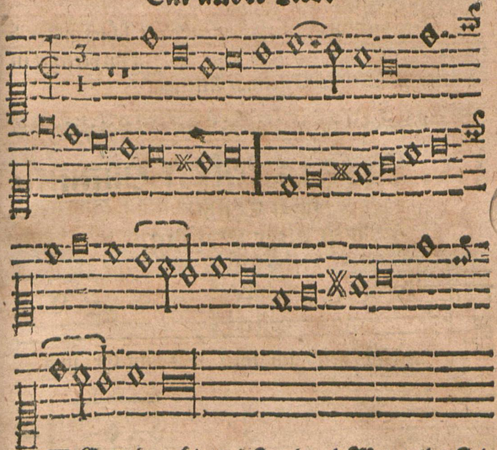


TODAY the Prince of Peace, God’s Son,
Christ Jesus, hath the vict’ry won (x2)
Praise Him with joy on heaven’s throne!
Alleluia! (x3)

2 The Man who on the cross was heaved,
And with all shame and pain aggrieved, (x2)
All might and rule hath now received.
Alleluia! (x3)

3 The Lord who in the tomb once lay
Is risen from the dead this day, (x2)
O’er him no foe has pow’r or sway.
Alleluia! (x3)

4 Now rage the devil, death, and hell,
God’s Son with us shall ever dwell, (x2)
The Champion He of Israel.
Alleluia! (x3)

5 Rejoice, dear Christians, gladly sing,
Oh, leap for joy! Your sorrowing (x2)
Is turned to bliss by Christ the King.
Alleluia! (x3)

Translation © 2023 Matthew Carver.

GERMAN
Heut triumphiert mit Freud und Wonn
der Friede-fürst, Christ, Gottes Sohn,
der Friede-Fürst, Christ, Gottes Sohn,
preist und lobt Ihn ins Himmels Thron.
Hallelujah, Hallelujah, Hallelujah!

2 Der Mann, der an dem Creuze hing,
groß Schmach und Marter da empfing,
ist jetzt ein Herr übr alle Ding,
Hallelujah, Hallelujah, Hallelujah!

3 Der Herr, der in dem Grabe lag,
ist auferstanden diesen Tag,
Kein Feind Ihm was anhaben mag,
Hallelujah, Hallelujah, Hallelujah!

4 Es zürnen Teufel oder Höll,
Gotts Sohn ist worden unser G'sell,
der Held von dem Haus Israel,

Hallelujah, Hallelujah, Hallelujah!

5 Freu dich, du werthe Christenheit,
hüpfe und spring, dein Jammr und Leid,
ist nun verkehrt in Seligkeit.
Hallelujah, Hallelujah, Hallelujah!

05 May 2023

Gott durch deine Güte

Here is my translation of the Advent and Trinity hymn, “Gott durch deine Güte” (Johann Spangenberg, d. 1550), from the Buffalo Synod hymnal (Ev.-luth. Gesang-Buch, 2nd, expanded ed.) #3, originally found in Alte und Newe Geistl. Lieder u. Lobgesenge (Erfurt, 1544) with title: “A hymn of praise of the Holy Trinity to be sung after the sermon.” J. C. Olearius calls it “the old Thuringian Advent hymn,” and according to Wetzel, Hymnopoeia, it is the titles in the Erfurt Gsb 1628: “A beautiful, brief Advent hymn and prayer to the Holy Trinity which is accustomed to be sung in some churches before the sermon.” It is sometimes categorized under Pentecost or Sunday hymns. Thus far Fischer. The appointed melody is “Gottes Sohn ist kommen.”


HELP, O God most Holy
These Thy people lowly
Who are warfare waging
’Gainst the devil raging;
Dying or yet living,
Still Thy help be giving!

2 Christ, all people’s Savior!
Keep them safely ever,
Man’s inventions spare them,
In Thy truth upbear them,
By Thy Word then bring them
To Thy Father’s kingdom.

3 Let the Spirit dress them,
Let His love possess them,
Drive from them all error,
Make them ever fairer;
Let them by Thy favor
Dwell with Thee forever.

Translation © 2023 Matthew Carver.

GERMAN
Gott durch Deine Güte,
wollst uns armen Leuten
Herz, Sinn und Gemüthe
für des Teufels Wüten
im Leben und im Tod
gnädiglich behüten.

2 Christe, der Welt Heiland,
über uns reck aus Dein' Hand,
b'hüt uns für der Menschen Tand,
Deine Lehr; mach uns bekannt
durch Dein göttliches Wort,
führ; uns in das Vaterland.

3 Des heilge Geistes Liebe
woll in uns bekleiden,
die Sünd von uns treiben,
seine Gnad einschreiben,
auf daß wir ewiglich
bei Dir mögen bleiben.

22 March 2013

Qui solis excellit jubar / Der heller leuchtet denn die Sonn

Here is my translation of “Qui solis excellit jubar” (G. Fabricius), a Reformation-period Latin hymn first appearing in the author’s De historia et meditatione mortis Christi et de usitatis Ecclesiae christianae festis ac temporibus, 1553, and afterwards in his Poemata Sacra, and was included in the Andernach Hymnal. A German cento by Spangenberg was appointed in the Nürnberg hymnal (766 Geistliche Psalmen) to be sung during Passiontide, as an alternate to one of a couple vernacular versions of Gregory's Passion hymn, “Rex Christe factor omnium” [O Christ our King, who all hast made]. The melody appointed by Spangenberg for his German rendering is “Conditor alme siderum.”


The Andernach Hymnal, however, had the following tune (use the alternate ending):


THE LIGHT whose brightness passes far
The beauty both of sun and star,
With stripes disfigured, hangs His head
Upon the cross, and God is dead.

2. The Lord who gives His creatures breath,
And life to those who lie in death,
With arms the crossbeam spanning wide,
Between the thieves is crucified.

3. So wracked with wounds and injured sore,
Our wounds and injury He bore:
He took the sins He had not done,
And thus our remedy He won.

4. The Lamb is lifted on the stock,
The Spotless for the spotted flock:
The worthy Victim who alone
With God the Father can atone.

5. O Christ, our true High Priest and Lord,
Upon the Cross’s altar poured,
Who, dying, didst death’s kingdom scour
And lay to waste his tyrant pow’r:

6. To Thee, Eternal God, we flee,
Our Seat of Mercy fair and free,
Oh, take the sins which here we own,
And cast them to oblivion.

7. By Thee grant us to overthrow
The devil, our salvation’s foe,
The flesh, to stumbling ever prone,
The world, with fruitless pleasures sown.

8. Reach forth Thy tortured arms to take
The pleas that we Thy mourners make,
And to our faithful pray’rs incline
Thy visage bloody and divine.

9. O Life and Hope and Strength, to Thee,
Redeemer, Savior, glory be,
With God the Father on His throne,
And Holy Spirit, God alone.

Amen.

Translation © 2013 Matthew Carver.

LATIN
1. Qui solis excellit jubar
Et astra pulchritudine,
Deformis, horridus, lacer
Pendet necatus in cruce.

2. Qui dat creatis spiritum,
Vitamque donat mortuis,
Extendit in ligno manus,
Inter latrones mortuus.

3. Nostro ille laesus scilicet,
Et vulneratus vulnere:
Peccata quae non fecerat,
Seruaret ut nos, pertulit.

4. Agnus levatur stipite,
Pro noxiis innoxius:
Haec sola grata pro reis
Deo parenti victima.

5. O Christe noster, in crucis
Oblatus ara, Pontifex:
Qui morte mortem permeans
Mortis tyrannum destruis.

6. Ad te perennis currimus
Thronum paratum gratiae.
Patrata nobis crimina
Oblivione contere.

7. Per te queamus vincere
Hostem salutis daemonem,
Et omne carnis lubricum,
Ac triste mundi gaudium.

8. Votis gementum porrige,
Distenta ligno brachia,
Preces et ad nostras caput
Tabo reclina lividum.

9. Tu vita, consolatio,
Robur, salus, redemptio,
Tibi, et Parenti, et Flamini
Sacro, canatur gloria.

GERMAN cento by SPANGENBERG
1. Der heller leuchtet denn die Sonn,
und übertrifft die Sterne schon,
der hänget an dem Kreuz hie tot,
greulich gegeisselt und verspott.

2. Der da die Toten auferweckt,
der haft am Holz hie ausgestreckt,
der allem Ding das Leben schenkt,
am Kreuz tot bei den Mördern hängt.

3. Der hängt am Kreuz verwundet sehr,
verletzt durch unsre Sünden schwer,
der trägt all unser Missethat,
der keine Sünd begangen hat.

4. Zu dem Thron deiner Gnaden wir,
demütig kommen nun zu dir,
und bitten dich durch deine Gnad,
Vergib uns unsre Missethat.

5. Gib, daß der Seelen Feind gedämpft,
der leidig Teufel überkämpft,
die eitel Freud auf dieser Erd,
des Fleisches Lust bezwungen werd.

6. Streck gnädig zu uns deine Arm,
und unsers Seufzens dich erbarm,
dein Blutig Haupt rab zu uns neig,
dich gnädig gegen uns erzeig.

7. Unser Leben und Trost du bist,
bei dir Stärk, Heil und Ablaß ist,
dir Vater, Sohn, Heiliger Geist,
werd ewig Lob und Ehr beweist.

24 March 2012

Dies ist der Tag / Haec est dies quam

Here is my translation of the antiphon-hymn “Dies ist der Tag” (tr. C. Spangenberg, †1604), itself a Germanicization of the Annunciation Antiphon Haec est dies quam, etc. Spangenberg’s text (as given by Wackernagel) represents a significant expansion of the original, much like a farce or trope. Note however the change in stanza , where probably for doctrinal reasons the poetic contrast of two "femina"s has been omitted. Spangenberg seems to have intended each syllable of the German to match one note of the original tune, much in the same way as the Bohemian Brethren adapted Gregorian melodies, but eliminated the difficulty of learning and singing melismas by turning them into syllabic phrases. I have mostly followed the German in dividing lines, but not having the exact version of the melody used by Spangenberg, I have chosen in some places to divide lines at more logical points following the Latin text. The melody I give here is transcribed for modern notation from a book (prob. an Antiphoner) printed in Augsburg ca. 1580, where the Antiphon appears for the Benedictus on the Feast (apparently in a variation of canticle tone VIII).


THIS IS the day,—
The holy, gracious and most blessed day,—
Which God hath made,
Before the world’s foundations were laid.

2. This day the good and merciful God did His creation prize,
In lovingkindness turning His godly eyes
Upon His poor people’s heaviness, anguish, and need,
And from death, devil, sin, and hell His people freed.

3. This day with might,
In human vesture, as right,
God’s only Son dispelled eternal death from hence,
Which Eve had ushered into this world by disobedience.

4. This day God the Father’s only Son a true Man was made,
Nor did what He e’er had been diminish or fade;
What He was not
Into His own self He brought.

5. Therefore, dear Christians, let us celebrate
In spirit and truth, and most rev’rent state,
With faith, love, and gladness great,
The Source of our Righteousness,
Grace, Redemption, and true Blessedness;
And, from our inmost heart giving God our thanks,
Sing to Him in united ranks:
“Praise, honor, and glory be to Thee, Lord God, forever.”

Translation © Matthew Carver, 2012.

GERMAN
1. Dies ist der Tag,
der gnadenreich heilig selige Tag,
den vor der Welt
Gott der Almächtiger Herr hat gemacht.

2. Heute hat der wohltätiger barmherziger Gott
mit sein Göttlichen Augen freundlich angesehn
seins elenden Volkes Beschwerung, Angst und Not
und vom Teufel, Tod, Sünd, Höll gnädiglich erlöst.

3. Heut hat mit Gwalt
in menschlicher Form und Gestalt
Gotts einiger Sohn den ewigen Tod verjagt,
den Eva durch ungehorsam in diese Welt hat gebracht.

4. Heutzutag ist Gottes des Vaters einiger Sohn Mensch worden:
was er war, das bleibt er ohn Ende,
immer und ewig,
was er nicht war nahm er in der Zeit an sich.

5. Darum, ihr lieben Christenleut,
bedenket ernstlich heut
im Geist und Wahrheit,
Glauben, Lieb und herzlicher Freud
unser Gerechtigkeit,
Gnad, Erlösung und Seligkeit Anfang,
und laßt uns von Herzen Gott sagen Dank,
allzugleich singen Gott in dieser Zeit:
“Lob, Ehr und Preis sei dir, Herr Gott, in Ewigkeit.”


LATIN
1. Haec est dies quam fecit Dominus.
2. Hodie Dominus afflictionem populi sui respexit et redemptionem misit.
3. Hodie mortem quam femina intulit femina fugavit.
4. Hodie Deus homo factus : id quod fuit permansit : et quod non erat assumpsit
5. Ergo exordium nostrae redemptionis devote recolamus : et exultemus dicentes: Gloria Tibi Domine.

06 July 2011

Nach dir, O Herr, verlanget mich (mein Gott auf den…)

Here is my translation of the hymn “Nach dir, O Herr, verlanget mich” (C. Spangenberg), a paraphrase of Ad te Domine (Ps. 25) from which the Introit for the Third Sunday after Holy Trinity is taken. Note that several paraphrases have a similar title, notably that of Paul Gerhardt. The melody is the proper here shown. Note (June 17, 2026): The original publication assigns the melody “Ach Gott vom Himmel” or “Wo Gott der Herr.”

FOR THEE, O Lord my God, I long,
I trust in Thee completely.
Confound me not for all my wrong,
Lest foes in triumph greet me.
For no man shall confounded be,
(This well I know) who waits on Thee.
Thy foes shall meet confusion.

2. Show me, O Lord, Thy righteous ways,
And in Thy path instruct me.
In Thy truth keep me all my days,
And to Thyself conduct me,
For Thou art very God indeed,
Who helpest me from every need,
Each day I wait upon Thee.

3. Now to remembrance call again
Thy mercies great and tender,
Which Thine eternally remain—
From sin be my defender—
Nor call to mind against Thy truth
The sins committed in my youth;
Forgive me my offenses.

4. O God of mercy, think on me
Because of Thy good favor,
Thou Lord wilt kind and clement be,
And make the sinner ever
Thy good and even way to wend,
And wretched people’s cause defend
And on the right path set them.

5. The way of God the Lord is grace,
With Him the truth is reigning;
He guards His cov’nant and His race,
His testament sustaining.
For Thy name’s sake, O God and Lord,
Thy mercy for my sin afford,
For it is great in measure!

6. Who fears the Lord? He shall not stray;
His way God shall be teaching.
His soul shall dwell, if he obey,
At ease in praise and preaching.
His offspring shall possess the land.
God’s mysteries are in the hand
And shown to those who fear Him.

7. Mine eyes are ever on the Lord,
Who from the net will save me.
Oh, be not far from me, my God,
Nor turn Thy back, nor leave me!
Have pity and turn to me soon,
For I am wretched and alone,
And great is my heart’s anguish.

8. Lord, bring me out of every need:
Behold what sorrows grieve me!
Forgive me of my sins with speed,
Lest they of life bereave me.
Behold, my foes the country fill,
And hate me with malicous will;
My soul keep safe before them!

9. From all distress deliver me,
Let me not be confounded;
I put my trust, O God, in Thee!
By right and truth well-grounded
I dwell secure. On Thee I wait.
Now out of all his troubles great
O God, redeem Thine Isr’el.

Translation © Matthew Carver, 2011.

GERMAN
1. Nach dir, O Herr, verlanget mich,
mein Gott, auf den ich traue.
Laß mich zuschanden werden nicht,
daß sich mein Feind nicht freue.
Denn keiner wird zuschanden gar,
der deiner harret das ist wahr,
wer dich veracht hat Schande.

2. Herr, zeig mir deine Wege gut,
und deine Steig mich lehre.
Halt mich in deiner Wahrheit gut,
und mich zu dir bekehre,
denn du bist ja der wahre Gott,
der mir stets hilft aus aller Noth,
täglich will ich dein harren.

3. Gedenk an dein Barmherzigkeit,
und an dein grosse Güte.
Die du gehabt von Ewigkeit,
für Sünden mich behüte,
gedenk auch nicht der Sünden mein,
die jung von mir begangen sein,
vergib die Übertretung.

4. O Barmherziger Gott, denk mein,
um deiner Güte willen,
denn du, Herr, bist gut, fromm und fein,
den Sünder führst so stille,
den aller besten Weg so schlecht,
und lattest die Elenden Recht,
und kehrest sie dem Steige.

5. Der Weg des HErrn ist eitel Güt,
darbei Wahrheit thut walten.
Denn er sein heilgen Bund behüt,
und die sein Zeugnis halten,
um deines Namens willen Gott,
sei gnädig meiner Missethat,
die da groß ist ohn massen.

6. Wer ist der, der den Herren fürcht,
dem wird er sein Weg weisen.
Sein Seel wird, so er nur gehorcht,
wohnen bei Gott mit Preisen,
sein Sam das Land besitzen wird,
Gottes Geheimnis den gebührt
zu wissen, die ihn fürchten.

7. Mein Augen sehn stet zu dem Herrn,
der wird mein Fuß fein ziehen
Wohl aus dem Netz, wollst ja nicht fern,
mein Gott, jetzt von mir fliehen,
sei gnädig mir, dich zu mir wend,
denni ch bin Einsam und Elend,
groß ist die Angst meins Herzens.

8. Herr, führ mich aus meinen Nöthen,
schau mein Jammer, Elende,
daß mich meine Sünd nicht töten,
vergib mir sie behende,
sieh, meiner Feind der sind so viel,
und hassen mich nur aus Mutwill,
mein Seel vor ihn bewahre.

9. Errette mich aus aller Noth,
daß ich nicht werd zuschanden,
denn auf dich trau ich, lieber Gott.
Recht und schlecht mich im Lande
behüten muß, denn ich harr dein,
ach Gott, erlös Israel fein,
aus allen seinen Nöten.

03 December 2010

Gloria (Spangenberg 1545)

I realize this is ill-timed, since the Church omits the Gloria during Advent, but perhaps this will be a good setting to think about using when the Gloria returns, especially for Christmas. This is the way the ELHB set the alternate Gloria in excelsis in the back of the hymnal (#568). It is adapted from the Spangenberg Cantional (1545) setting, which is represented in Layriz' Choralbuch (liturgy, part 10). One departure you will note is that the "et in terra" ("and on earth") here begins on A rather than on D. It uses the words of the Common Service, with one exception: In the Domine addresses (line 6), it says "O Lord God, Thou Lamb…" which we are used to singing without "Thou." This could be easily be harmonized by slurring A-G on "God" and omitting "Thou." Another change from the ELHB which might be advisable (and familiar) is to amend the rubric, so that we have the celebrant sing the Gloria in excelsis "Glory be to God…", and the congregation and choir respond beginning with the Laudamus Te, "We praise Thee."

09 September 2010

The Kyrie for Eastertide

Here is my translation of the Kyrie for Eastertide (or from Easter to Pentecost) traditionally sung in many German Lutheran churches, and in America before the switch to English, when the wide adoption of the Common Service (or lowest common denominator service) left American Lutheran churches only one basic threefold Kyrie to be sung for the whole church year. The music comes from Spangenberg's cantional. It can be found in Lochner with harmony by Riegel.


Kyrie, God, of all things Father and Creator: Eleison!
Christè, who true God and Man was born, and borest for us men God’s scorn: Eleison!
Kyrie, God, the Holy Ghost, one God with the Father and the Son: Eleison!
Kyrie, help us to keep the faith unswervingly, and adore only Thee, and Thy servants ever be: Eleison!

Translation © Matthew Carver, 2010.

GERMAN
Kyrie, Gott aller Welt Schöpfer und Vater, Eleison!
Christe, wahrer Gott und Mensch geborn, der du für unst trugst Gottes Zorn, Eleison!
Kyrie, Gott, Heiliger Geist, mit Vater und Sohn Ein Gott, Eleison!
Kyrie, hilf uns, daß wir in solchem Glauben rein, dich anbeten allein, und bleiben Diener dein, Eleison!