Showing posts with label cento. Show all posts

10 April 2024

Ach Herr, lehre mich bedenken

Here is my translation of the Death & Burial hymn, “Ach Herr, lehre mich bedenken” (Benjamin Schmolck, d. 1737) on Psalm 90:12, in GGELB #470 with melody assignment “Freu dich sehr, o meine Seele,” first appearing in the author’s Heilige Flammen (1706) with title “the best knowledge of all.” In Joseph Schaitberger’s Neu-vermehrter evangelischer Send-Brief, (1735), I find a special cento with 2 inserted stanzas, which I include below, with title “A beautiful death hymn” but no ascription.


TEACH me, Lord, aright to ponder
That my death will come one day.
Teach my sense to travel yonder
And life’s closing to survey;
Set my end before mine eye,
Rouse desire before I die,
And while yet my health attendeth,
To recall that death impendeth.

2 As at last a lamp must falter,
And the clock wind down some day,
So this truth no man can alter:
I must leave this house of clay
To be blest and buried cold;
’Tis concluded from of old:
As the heir of death, man dieth
Even as in life he lieth.

3 All our days, when first we’re carried
From the womb to daylight clear,
Till we die and so are buried,
Are one little step and sheer;
Ah, with every hour that flies,
Somewhat of our vigor dies!
Time’s procession swift and steady
Urges us to make us ready.

4 And who knows what day and hour-
One must find himself prepared?
’Tis beyond all mortals’ power,
Nor hath God the time declared.
Who his house will order well,
At what hour, which none can tell,
Leaves this world to joy supernal;
Others, to rebuke eternal.

5 My own body preaches daily
Of my own mortality!
When to slumber down I lay me,
My funereal sheet I see,
For my sleep doth signify
That repose in which I’ll lie;
Yea, the bed declares: “Prepare thee,
To the grave men thus will bear thee!

6 Therefore, O my God, remind me
That I never stand secure.
Lest the world to death should blind me,
Scribe my mind with letters sure:
Child of man, thou too must die;
So let earthly pleasure fly
Which may only serve to numb me
To the death that must befall me.

7 Let me not put off repenting
Till some illness seizes me,
But, my errors now resenting,
Own my sins continually,
Daily, while my body thrives,
That, when my last day arrives,
It will reconcilèd find me,
With no cherished sins to bind me.

8 Thou wilt grant a blessed ending;
God, to Thee all things I leave;
All that’s mine to Thee commending,
I implore Thee, me receive.
Let Thy Son’s dear blood avail
For my good! His name I hail,
Who from sin to heaven frees us:
Let my final word be Jesus!

SCHAITBERGER’S Form (1735)

1–3 (stanzas 1, 4, 5 above)

4 Ah, how gladly I will slumber,
Whensoe’er Thou thinkest best,
As with all the hallowed number.
Grant me, God, that blessed rest,
When the fearful hour is oe’r,
And Thy joys forevermore!
But must suff’ring yet betide me,
Tarry still, O Lord, beside me!

5 If like Thee I too must suffer,
Make it bearable for me,
And my back in patience offer
To the scourges, Lord, like Thee;
He who bade me bear the load
Will reduce it. Yes, my God
Can remove the weight that testeth,
For within His hands it resteth.

6 (stanza 8 above)

Translation © 2024 Matthew Carver.

GERMAN
Ach Herr, lehre mich bedenken,
daß ich einmal sterben muß.
Lehre mich die Sinnen lenken,
auf den letzten Lebensschluß.
Stelle mir mein Ende für
und erwecke die Begier,
mich bei noch gesunden Zeiten
auf das Grab wohl zu bereiten.
 
2 Endlich mu ein Licht verbrennen,
endlich läuft der Zeiger aus.
Also muß ich wohl bekennen,
daß ich dieses Leimenhaus
endlich auch gesegnen muß.
denn es ist der alte Schluß:
Menschen, als des Todes Erben
müssen auch im Tode sterben.
 
3 Wenn wir kaum geboren werden,
Ist vom ersten Lebenstritt
bis ins kühle Grab der Erden
nur ein kurzgemessner Schritt.
Ach, ein jeder Augenblick,
geht mit unsrer Kraft zurück.
Und wir sind in jedem Jahre
allzureif zur Totenbahre.
 
4 Und wer weiß in welcher Stunde
uns die letzte Stimme weckt.
Denn Gott hats mit seinem Munde
keinem Menschen noch entdeckt.
Wer sein Haus nun wohl bestellt,
geht mit Freuden aus der Welt,
da die Sicherheit hingegen
ewigs Sterben kann erregen.
 
5 Predigen doch meine Glieder
täglich von der Sterblichkeit.
Leg ich mich zur Ruhe nieder,
zeigt sich mir das Leichenkleid.
Denn der Schlaf stellt für und für
seinen Bruder, Tod, mir für.
Ja, das Bette will mir sagen:
So wird man ins Grab getragen.
 
6 Drum, mein Gott, lehr mich bedenken,
daß ich niemals sicher bin.
Will die Welt mich anders lenken,
ach, so schreib in meinen Sinn:
Du mußt sterben, Menschenkind!
daß mir alle Lust zerrinnt,
die mir sonst in eitlen Sachen,
kann den Tod geringe machen.
 
7 Laß mich nicht die Buße sparen,
bis die Krankheit mich ergreift.
Sondern bei gesunden Jahren,
ehe sich die Sünde häuft,
laß mich täglich Buße tun,
daß das allerletzte nun
mich befreit von aller Sünde
und mich dir versöhnet finde.
 
8 Nun, mein Gott, du wirst es machen,
daß ich fröhlich sterben kann.
Ich befehl dir meine Sachen,
nimm dich meiner Seelen an.
Deines Sohnes theures Blut
komme mir alsdann zu Gut,
daß mein letztes Wort auf Erden [S: Wann ich reis die Todesstrassen,]
Jesus! Jesus! möge werden. [S: kann ich mich auf dich verlassen.]


SCHAITBERGERS EINFÜGUNG

4 Ach wie gerne will ich sterben,
wann es doch nur selig ist.
Mein Gott! laß mich nicht verderben
in der letzten Todesfrist.
Ach wie wohl wird mir doch sein,
wann ich selig schlafe ein!
Muß ich aber hier noch leiden,
Herr, so stehe mir zur Seiten!
 
5 Soll es sein dir nachgelitten,
laß es nur erträglich sein.
Gib, daΩß ich nach deinen Sitten
mich geduldig geb darein.
Der die Last zu tragen gab,
wird sie wieder nehmen ab.
Gott kann lindern und auch wenden,
denn es steht in seinen Händen.


07 April 2024

Jesu, Ruhe meiner Seelen

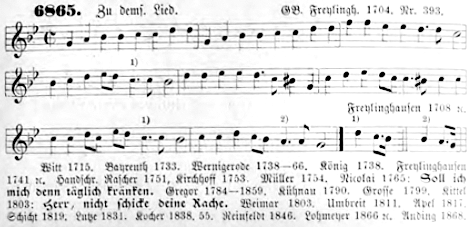
Here is my translation of the Cross & Comfort hymn, “Jesu, Ruhe meiner Seelen” (Ludwig Andreas Gotter, d. 1735), in GGELB #464 with melody assignment “Sollt es gleich bisweilen scheinen” using split stanzas in the form: 1a, 1b, 3b, 4a, 8a, 8b.; first appearing in 8 stanzas of 8 lines each in Gotha 1691, appendix, no. 11, later in 1699 ed. with author’s initials; then in Freylinghausen 1714 with mel. “Jesu, deine Liebesflamme” or “Folget mir, ruft uns das”; but in Hesse (Rambach) 1733 with split stanzas and mel. “Liebster Jesu, du wirst kommen. It must be distinguished from Gottschling’s “Jesu, Ruhe meiner Seelen, / Jesu du erquickest mich.” I include here a proper melody, of which Zahn notes that the irregular time is striking; below this, the two melodies designated in Freylinghausen.


JESUS, Rest and Consolation,
Be Thy rest my recreation
When by my own sins oppressed,
I can feel no peace or rest!
Thou art my delight forever,
And I count the highest favor
If my spirit may recline
In Thy blood and wounds divine.

2 Lord, Thy rest refreshment bringeth
When distress the spirit stingeth;
Yea, Thy rest is finest fare,
Food of joy beyond compare;
For in Thee, O pasture holy,
Joy is found by spirits lowly,
Peace and life upon them fall,
Yea, all things they joyful call.

3 Oh, what rest, what true elation;
Can be found in this creation?
Heartache, labor, toil, and strife
Is the time of mortal life;
In the world all bitter seemeth,
Tempest after tempest streameth,
Here we feel man’s peace and rest
As a weight upon the breast.

4 Yet Thy rest, O Lord, is pleasant
And when to my sense ’tis present,
All unrest and weights depart
From my sore afflicted heart.
When with Mary lowly kneeling
At Thy feet, I find all healing,
Perfect rest, salvation free,
And the better part in Thee.

5 When my sins and guilt afflict me
And with restless thoughts convict me,
Then to Jesus I make haste,
In His arms to be embraced.
Hell recoils at my Defender,
Who my mind doth peaceful render
And from conscience-pains secure
Gives me rest so sweet and pure.

6 If on earth I still must suffer,
And my back to scourges offer,
’Gainst the foe in darkness stand,
Anguish, grief on every hand,
Still I bear the torment searing
With a patient heart, unfearing,
For I bear (and own it oft)
Jesus’ gentle yoke and soft.

7 Thus I flee the world accursèd
For the One in comfort versèd,—
Jesus, who doth love my soul
And gives rest complete and whole.
In my heart I hold my Savior
Nor will let Him leave me ever,
Nor will He. He knoweth best
How to lead to perfect rest.

8 Come, then, Thou my Life undying
Leave me not in mis’ry lying,
Leave me not by pains oppressed
And the conscience’s unrest;
From the toils that here aggrieve me
In Thy cloven side receive me
And the rest for me prepare
In the life eternal there!

Translation © 2024 Matthew Carver.

GERMAN

Jesu, Ruhe meiner Seelen,
laß mich deine Ruh erwählen,
wenn die Missethat ihr Spiel
in der Unruh zeigen will;
denn du bleibest mein Ergötzen,
und ich werd mich selig schätzen,
wenn mein Geist in deinem Blut
und in deinen Wunden ruht.

2 Deine Ruhe bringet Gaben,
welche Seel und Herze laben,
deine Ruh ist meine Kost
und ein süßer Freudenmost;
und bei dir, du Seelenweide,
findet man gewünschte Freude,
Heil und Friede in dem Geist,
und was nur erfreulich heißt.

3 Ach was kann auf dieser Erden,
doch vor Ruh gefunden werden,
Arbeit, Schmerz und Herzeleid,
ist der Menschen Lebenszeit;
auf der Welt ist alles bitter,
und bei stetem Ungewitter,
wird der Menschen Ruh und Rast
eine Centner schwere Last.

4 Aber deine Ruh ist süße,
und so bald ich sie genieße,
weicht aus meinem trüben Sinn
Unruh, Last und Unmuth hin.
Ja, wenn ich in deinen Wunden
mit Maria Ruh gefunden,
hab ich dein erworben Heil
und den allerbesten Theil.

5 Wenn die Sünden mich vergiften
und im Herzen Unruh stiften,
eile ich nach Jesu zu,
und ergreife seine Ruh,
dorten kann ich Trotz der Höllen
mein Gemüth zufrieden stellen,
und vor die Gewissenspein
nehm ich süße Ruh herein.

6 Muß ich gleich auf Erden leiden,
und mit Tod und Teufel streiten,
muß ich gleich im Finstern stehn,
und nur Angst und Jammer sehn,
trag ich dennoch alle Schmerzen,
mit Gedult und frohen Herzen;
denn ich weiß, ich trage doch
meines Jesu sanftes Joch.

7 Nun, ich will die Welt verfluchen,
und hingegen Jesum suchen,
welchen meine Seele liebt,
weil er solche Ruhe giebt,
ich will ihn ins Herze fassen
und durchaus nicht von mir lassen,
weil er mir die süße Bahn
zu der Ruhe zeigen kann.

8 Also komme denn mein Leben,
laß mich nicht im Elend schweben,
laß mich nicht in steter Pein
und Gewissensunruh sein;
sondern führe meine Seele
hin in deine Seitenhöhle,
und bereite mir die Ruh
in dem ewgen Leben zu.

23 January 2024

O Herr, vor dem sich Erd und Himmel beuget

Here is my translation of the church dedication hymn, “O Herr, vor dem sich Erd und Himmel beuget” (Albert Knapp, d. 1864), in GGELB #144 with melody assignment “Herzliebster Jesu, was hast du verbrochen” and note: “From the Latin, 3rd c. AD or earlier.” Meant is the Latin hymn for church dedication, “Christe cunctorum Dominator alme,” composed probably in the 9th c. AD. This German paraphrase appears in Knapp’s Evangelischer Liederschatz (1837ff.), thence into various hymnals, e.g., Lübeck 1839, Schaffhausen 1867 (Ref.), Saxony 1883. Knapp’s stanza 1 includes ideas from Latin st. 1–2; other ideas of Latin st. 2 are also included in German st. 8. Stanza 4 combines Latin 5–6, the latter exorcised of devils, however. Stanza 6 combines ideas of Latin sts. 8–9. Common today in Anglophone countries is an abbreviated form of “Only-Begotten Son of God eternal,” a non-rhyming translation from the Latin by M. J. Blacker.


O LORD, adored by earth and heav’n supernal,
God’s Son, begotten ere all worlds eternal,
Graciously hear our grateful adoration
And supplication. (1–2)

2 Lord, to Thy service is this house appointed:
Here do Thine own, with Spirit’s joy anointed,
Eat of the Blood and Body that Thou gavest,
By which Thou savest. (3)

3 Here in Thy holy fount are debts erasèd,
Here all the damage of the soul effacèd,
Here babes to Thee, who death hast subjugated,
Are consecrated. (4)

4 Here wilt Thou heal the sick, the weary quicken,
Lighten the blind, give peace to those sin-stricken.
Here shall the heart stung by abundant sorrow
Fresh courage borrow. (5–6)

5 Here is the forecourt of the Lord immortal,
Here is His Holy Place, and heaven’s portal,
Which open stands to all who seek the Savior
And life forever. (7)

6 Though in the tempest all things else be flying,
Still stands the church, a rock the storm defying,
In Jesus’ shelter, hell’s  disdaining,
Safely remaining. (8–9)

7 Therefore rejoice we at this consecration,
Praying: Dear Lord, receive our supplication,
And on this church bestow in gracious favor
Thy blessing ever. (10)

8 Let nothing rob the joy of hearts elated,
Let this glad day be often celebrated,
Feed, Lord, Thy people oft the gives of heaven
Which here are given. (11)

9 Glory to Thee, O Father, be forever,
To Thee, God’s Son, to Thee, sweet Comfort-giver!
For endless ages, teach us, who confess Thee,
Further to bless Thee. (12)

Translation © 2024 Matthew Carver.

GERMAN

O Herr, vor dem sich Erd und Himmel beuget,
du, Gottes Sohn, von Ewigkeit gezeuget,
blick auf der Deinen Flehn und Dankeslieder
huldreich hernieder!

2 Dies Haus, o Herr, ist deinem Dienst geweihet;
Hier schmecken deine Gläubgen hocherfreuet
das Blut, den Leib, den du zu unserm Leben
dahingegeben.

3 Hier wird in deinem hellgen Wasserbade
die Schuld getilgt, geheilt der Seelenschade;
hier weihen wir, o Todesüberwinder,
dir unsre Kinder.

4 Hier finden Kranke Heilung, Kraft die Müden,
die Blinden Licht, die Sünder Seelenfrieden;
hier athmen freier bei des Lebens Schmerzen
die wunden Herzen.

5 Des Ewgen Vorhof ist an diesem Orte,
das Heiligthum des Herrn, des Himmels Pforte,
stets offen allen, die dem ewgen Leben
entgegenstreben.

6 Mag bei der Stürme Wüthen alles zittern,
die Kirche steht, ein Fels in Ungewittern,
und bleibet bei der Hölle wildstem Trutze
in Christi Schutze.

7 Drum freun wir uns der heilgen Tempelweihe,
und bitten: Herrz, Allgütiger, verleihe,
daß uns geleite dein mildreicher Segen
auf allen Wegen!

8 Nichts raube uns des Herzens fromme Freude;
oft kehre dieser Tag zurück; oft weide
dein Volk, o Herr, sich an dem Himmelsgaben,
die hier uns laben!

9 Lob und Anbetung töne dir, o Vater!
Dir, Gottes Sohn, dir, Tröster und Berather!
Lehr uns, dein Volk, durch alle Ewigkeiten
dein Lob ausbreiten!


LATIN (from Daniel, for reference)
1 Christe cunctorum Dominator alme,
Patris aeterni genitus ab ore,
Supplicum vota pariterque hymnum
Cerne benignus.

2 Cerne, quod puro Deus in honore
Plebs tua supplex resonet in aula
Annua cuius redeunt colenda
Tempora festa.

3 Haec domus rite tibi dedicata
Noscitur, in qua populus sacratum
Corpus assumit, bibit et beati
Sanguinis haustum.

4 Hic sacrosancti latices veternas
Diluunt culpas, perimuntque noxas
Chrismate vero genus ut creetur
Christicolarum.

5 Hic salus aegris, medicina fessis,
Lumen orbatis, veniaque nostris
Fertur offensis, timor adque moeror
Pellitur omnis.

6 Daemonis saeva perit hic rapina,
Pervicax monstrum pavet et retenta
Corpora linquens fugit in remotas
Ocyus umbras.

7 Hic locus nempe vocitatur aula
Regis immensi, vineaque caeli
Vitae quae sanctos patriam petentes
Accipit omnes.

8 Turbo quem nullus quatit, aut vagantes
Diruunt venti penetrantque nimbi;
Non tetris laedit piceus tenebris
Tartarus horrens.

9 Quaesumus ergo Deus ut sereno
Annuas vultu, famulos gubernans,
Qui tui summo celebrant amore
Gaudia templi.

10 Nulla nos vitae crucient molestas:
Sint dies laeti placidaeque noctes:
Nullus ex nobis pereunte mundo
Sentiat ignes.

11 Haec dies in qua tibi consecratam
Conspicis aram, tribuat perenne
Gaudium nobis, vigeatque longo
Tempore usu.

12 Gloriam summum resonet Parentem;
Gloria Natum, pariterque sanctum
Spiritum dulci moduletur hymno
Omne per aevum. Amen.

13 January 2024

Hier liegt mein Heiland in dem Garten (Es liegt mein Jesus auf der Erden)

Here is my translation of the Passion hymn, “Hier liegt mein Heiland in dem Garten” (Magdalena Sibylle, Duchess of Württemberg, d. 1712), in GGELB #72 with melody assignment “Erquicke mich, du Heil der Sünder” (= “Friend of the Weary, Oh, Refresh Us”) and omitting stanzas 1–4, thus beginning with “Es liegt mein Jesus auf der Erden.” The full form is rare in American hymnals; it is found, e.g., in the Wolga Gsb (Chicago, 1916). Fischer has no entry for it. Koch notes that this Passion hymn appears “in the Dresden Gsb for the Electoral Hofkapelle (1673) and Nuremberg 1677.” In the latter I find it with title “Of Christ’s Sweat of Agony in the Garden,” with a melody and bass, with cipher “P. H.” and curious (?) ascription “Stephan. Sass.” Koch also notes its inclusion in Hedinger’s Herzensklang (1700, 1705) with cipher MSHZW (Magdalena Sibylle Herzogin zu Württemberg). In Gotha 1729 it appears with a different ascription: ‘Sigism. Schererzius” (the theologian and hymnwriter Scherertz) and melody assignment: “Wer nur den lieben Gott läßt,” which melody necessitates splitting the last 2 notes of the last two lines. It is later found in the Augsburg Liederschatz (1749) with melody assignment “Hier ist die Ruhstatt,” Prussia 1751 (Burg) with proper ascription to Magdalena Sibylle, and Rambach’s Anthologie (1819).


HERE in the Garden lies my Savior
Upon His sweet and sacred face,
For all my sins and misbehavior
Weighed down by sorrow and disgrace;
Distress and agony unbounded
Have here His grieving soul surrounded.

2 He wails, He quails, He prays in sorrow,
He calls to His disciples dear:
Abide, and watch ye till the morrow;
Why give yourselves to slumber here,
When all men’s sins, which hell should merit,
Constrain my heart and mind and spirit?

3 Alas, my soul is sorely painèd,
Aggrieved to death with bitterness,
If only ye with Me remainèd,
To watch and pray in My distress!
Ye are like sheep, far lost and straying,
Your weary heads in slumber laying.

4 But I, your Shepherd, now am smitten,
And ye, My sheep of precious worth,
Shall scatter, as by anguish bitten,
Through fields of woe across this earth:
Oh, wake, and make your supplication,
That ye fall not into temptation!

5 My Jesus lies as though forsaken,
And “Father!” cries, “if it may be,
Then let this cup from Me be taken,
This cup of bitter agony—
Yet will I ever be obeying,
And never from Thy will be straying.

6 I see my Lord with death contending,
His sweat like many a glist’ning bead,
Great drops of blood thereby expending,
Which from His holy soul proceed.
His sweat flows from His grief appalling,
Like streams upon the earth is falling.

7 Alas! My sin, my foul misdoing,
My malice, my iniquity—
These, these, alas, have wrought my ruin,
Such that I scorned God’s love for me;
That I should die in death forever,
Perdition suff’ring, ceasing never.

8 Yet He, my faithful Savior, waketh,
And blots the record of my strife,
That else brings death and guilty maketh;
He writes me in the house of life:
He does this by His bitter grieving,
In soul a thousand stings receiving.

9 The anguish for my soul appointed,
The cup poured out for me to drink,
Hath here His holy limbs anointed
And made his soul in anguish sink;
For He, my soul’s deep wounds assumèd,
And bore the weight that had me doomèd.

10 What Adam by a tree receivèd,
The poison old, sin’s awful pow’r,
And what I’ve done—these have bereavèd
The Savior of His strength this hour;
Now for that fruit for which they groanèd,
My Jesus hath in sweat atonèd.

11 By this He quenched the burning fire
Of God the Father’s righteous wrath;
The hellish foe’s dominion dire
Was wrested by this anguish-bath,
And in this way to me was given
An everlasting home in heaven.

12 Lord Jesus, let Thy sweat that hour,
And death that Thou didst die for me
Protect me from transgression’s power
And save my soul from agony:
Thy sweat let be my balm, O Savior,
And in my soul be flowing ever!

Translation © 2024 Matthew Carver.

GERMAN
Hier liegt mein Heiland in dem Garten
auf seinem heilgen Angesicht,
belegt mit vielen Leidensarten,
für meiner Sünden schwere Pflicht;
Angst, Noth und alle Trauerwogen,
die haben seine Seel umzogen.

2 Er klagt, er zagt, er betet, trauret,
und rufet seinen Jüngern zu:
Ach! bleibet hier und wachend dauret,
was gehet ihr euch jetzt zur Ruh?
jetzt, da mir aller Menschen Sünden
Herz, Geister und die Seele binden.

3 Ach! meine Seel ist hoch betrübet,
betrübet an den bittern Tod;
bis an den Tod: Ach! daß ihr bliebet
mit mir zu wachen in der Noth!
Ihr seid ja wie verirrte Schaafe,
und übergebt euch doch dem Schlafe.

4 Ich, euer Hirt, werd jetzt geschlagen,
und euch, ihr Schafe meiner Heerd,
euch werd die Angst zerstreuet jagen
durch jedes Nothfeld dieser Erd:
Ach! wacht und im Gebete wallet,
daß ihr nicht in Anfechtung fallet.

5 Es liegt mein Jesus auf der Erden, [Er liegt, mein Jesus, …]
ruft: Vater! kann es möglich sein,
so laß von mir genommen werden
des schweren Kelches herbe Pein;
doch, den gehorsam zu erfüllen,
nach deinem, nicht nach meinem Willen.

6 Ich seh ihn mit dem Tode ringen
und matt im dicken Schweiße stehn,
des tropfen Blutestropfen bringen,
so aus der heilgen Seele gehn.
Sein Angstschweiß will nicht stille werden,
er läuft als Bäche zu der Erden.

7 Ach! meine Sünd, ach mein Verüben,
mein Unarth und erboßte Schuld,
die habens leider! so getrieben,
daß ich entsetzet Gottes Huld;
daß ich, im Tode zu Verderben,
sollt ewig, ewig, ewig sterben.

8 Mein treuer Heiland aber wachet
und tilget jene Handschrift aus,
die mich dem Tode zinsbar machet;
er schreibet mich ins Lebenshaus:
dies thut er durch die bittre Leiden,
die hier in Herz und Seele schneiden.

9 Die Noth, die mir war aufgesetzet,
der Kelch, der mir war eingeschenkt,
hat seinen heilgen Leib genetzet,
und seine Seel in Angst bekränkt,
weil er von mir der Seelen Schaden,
die schwere Last, auf sich geladen.

10 Was Adam dort am Baum empfangen,
das Gartengift, den Sündensaft,
und das, was ich darzu begangen,
ermattet hier meins Jesus Kraft:
was jen im Apfel dort genießen,
muß Jesus hier im Schweiße büßen.

11 Hierdurch hat er es Zornes Feuer
bei seinem Vater nun gedämpft,
die macht dem Höllenungeheuer
in seiner Angst ganz abgekämpft,
und also mir zum Seelenleben
ein immerfreie Schrift gegeben.

12 Herr Jesu, laß dein Angst, dein Schwitzen
und deinen drauf erfolgten Tod
mich für der Macht der Sünden schützen,
und reißen aus der Seelen Noth:
Laß deinen Schweiß, zum Trostgenießen,
sich stets in meiner Seele gießen.

11 March 2023

Höret ihr Eltern Christus spricht”

Here is my translation of the Domestic Estate (Child-rearing) hymn, “Höret ihr Eltern Christus spricht” (Ludwig Helmbold, d. 1598), from Ev.-luth. Gsb #554, first found in the author’s Crepundia Sacra (1596), later included in Erfurt 1648, Cantica Sacra (1655) with title: “On the Fourth Commandment for 4 voices by Joachim Burck,” Gotha 1660, Wittenberg 1672, etc. The Wisconsin Hymnal has a slightly revised form with the first line “Ihr Eltern, hört was Christus spricht.” William M. Czamanske’s 3-stanza cento translation (stanzas 1, 4, 5a, 6b, as published) from 1938, which appears in The Lutheran Hymnal 630, also in Ev. Luth. Hymnary 186, etc., is held in copyright by Concordia Publishing House. Rather than seek to obtain permission for those lines, I have opted simply to translate the whole thing, though by no means wish to discount or disregard Czamanske’s fine translation. The appointed melody is “Wo Gott zum Haus nicht gibt sein Gunst.”


GIVE ear, ye parents, Christ doth say:
Let children not be kept away,
But to My open arms draw near
That I may bless whom I hold dear.

2 The heav’nly kingdom’s also theirs;
What thing on earth with this compares?
The world’s pomp, glory, and delight
Are ended soon and fled from sight.

3 That kingdom never suffers loss
To which Christ Jesus carries us
By doctrine true,—th’ eternal Word,—
By which salvation is conferred.

4 Obey Him, then, let them be brought,
That from their youth they may be taught
In church and school most carefully
How God in faith should honored be.

5 If them ye love with true intent,
Let them to Jesus’ arms be sent,
Who stops them, thou their foe must deem,
However great his love may seem.

6 What good can wealth those children do
Whose hearts are not well ordered too?
Who lets them come at Jesus’ call
Does for them what is best of all.

Translation © 2023 Matthew Carver.

GERMAN
Ihr Eltern, hört, was Christus spricht: [Höret ihr Eltern,…]
den Kindlein sollt ihr wehren nicht,
daß sie sich meinen Armen nahn,
denn ich will segnend sie empfahn.

2 Auch ihrer ist das Himmelreich,
und was ist dem auf Erden gleich?
Mit aller Weltlust, Pracht und Ehr
hat's bald ein End und ist nicht mehr.

3 Das Himmelreich sich nie verliert,
darein uns Jesus Christus führt
durch seine Lehr, dies ewge Wort,
das uns macht selig hier und dort.

4 Gehorchet ihm, und bringt sie her,
daß man von Jugend auf sie lehr
in Kirchen und in Schulen wohl,
wie man Gott gläubig ehren soll.

5 Habt ihr sie lieb mit treuem Sinn,
so führet sie zu Jesu hin;
wer dies nicht thut, ist ihnen feind,
wie groß auch seine Liebe scheint.

6 Was hilft den Kindelein großes geld,
wenn nicht ihr Herz in gut bestellt?
Wer sie zu Gott recht führen läßt,
der thut für sie das Allerbest.

30 January 2023

Sieh wie lieblich und wie fein (suppl.)

Here is my supplemental translation of the hymn “Sieh wie lieblich und wie fein” (Michael Müller, d. 1704 / Johann Christian Nehring, d. 1736), a hymn on brotherly love appearing in Ev.-Luth. Gsb #484 in 12 stanzas, of which 4 stanzas are already translated by Frances Cox and found (in a much-altered form of the hymn from Bunsen’s hymnal, which also adds new stanzas) in Evangelical Lutheran Hymnary (1913) #397 for Trinity II. The present text goes further back to a less-abbreviated 12-stanza form popular in Moravian hymnals such as that of Zinzendorf (omitting sts. 2–3), ultimately derived from the 14-stanza Müller-Nehring hybrid from Freylinghausen 1704, the first four stanzas from Müller’s paraphrase of Psalm 133 in his Die Psalmen Davids . . .(Stuttgart, 1700); the remaining stanzas by Nehring, expanding on brotherly love, from a “Manuscript of spiritual poems,” as Wetzel attests. The appointed melody is “Nun komm der Heiden Heiland.”


GOOD and pleasant 'tis to see
Brethren dwell in unity,
When the law which Jesus taught,
Rules each word, and deed, and thought.

2 Like rich balm this love flows down,
Spilling from the head and crown,
Till its pow’r and grace revered
Fills the whole of Aaron’s beard.

3 Down upon His garment flows
Balm that joy and bliss bestows,
As the dew on Hermon white
And on Zion’s sacred height. 

4 God has promised, as we know,
This rich blessing to bestow,
Life on earth, with all its store,
Life in heav’n for evermore.

5 Oh, how is that love grown cold,
Not a spark may man behold,
On the earth, nor flame detect,
Such as may the heart affect.

6 Every man lives selfishly
With no sense of charity,
With no thought but for his own;
Whither is love’s duty gone?

7 O Lord Christ, the Father’s Son!
Look at last from heaven’s throne,
And the scattered flock attend,
Which no man has pow’r to mend.

8 Heav’nly Shepherd! to Thy way
Bring back all that go astray;
’Neath Thy favor and Thy light,
All Thy pasture-sheep unite.

9 Let Thy mighty unction spill,
Hearts of men with life to fill,
Pour it deep within our heart,
There Thy gladd’ning ray impart.

10 Bind together heart with heart,
Let no strife the union part;
With thine own Almighty hand
Knit the sacred brother-band.

11 Father, Son, and Spirit, we
Own one God in Persons Three;
Who His flock as one doth bind,
In His perfect love combined.

12 Oh, what joy and what delight
Can we lack in yonder light?
All that we desire in heav’n
To that host by God is giv’n.

13 All those hurt in former days
As with single mouth of praise
Shall God’s pow’r of love revere
When He makes them one fore’er.

14 Honor, praise, and majesty
To the Highest ever be,
Me He grant us unity,
Who is ever One in Three!

Sts. 1, 4, 8 tr. F. Cox, alt.
Sts. 2–3, 5–7, 9–14 Translation © 2023 Matthew Carver.


GERMAN

Sieh, wie lieblich und wie fein
ists wenn Brüder friedlich sein,
wenn ihr Thun einträchtig ist,
ohne Falschheit, Trug und List!

[2 Wie der edle Balsam fleußt,
und sich von dem Haupt ergeußt,
weil er von sehr guter Art,
in des Aarons ganzen Bart;

[3 Der herab fleußt in sein Kleid,
und erreget Lust und Freud,
wie befällt der Thau Hermon,
auch die Berge zu Zion.]

4 Diesen ja verheißt der Herr, [Denn daselbst…]
reichen Segen nach Begehr,
und das Leben in der Zeit,
und auch dort in Ewigkeit.

5 Aber ach, wie ist die Lieb
so erloschen, daß kein Trieb
mehr auf Erden wird gespürt,
der des Andern herze rührt!

6 Jedermann lebt für sich hin
in der Welt nach seinem Sinn,
denkt an keinen andern nicht,
wo bleibt da die Liebespflicht.

7 O Herr Jesu, Gottes Sohn,
schaue doch von deinem Thron,
schaue die Zerstreuung an,
die kein Mensche bessern kann!

8 Sammle, großer Menschenhirt,
Alles, was sich hat verirrt:
laß in deinem Gnadenschein
Alles ganz vereinigt sein.

9 Gieß den Balsam deiner Kraft,
der dem Herzen Leben schaft,
tief in unser Herz hinein,
strahl in uns den Freudenschein.

10 Bind zusammen Herz und Herz,
laß uns trennen keinen Schmerz,
knüpfe selbst durch deine Hand
das geheilgte Brüderband.

11 So, wie Vater, Sohn und Geist
drei und doch nur Eines heißt,
wird vereingt ganz und gar
deine ganze Liebesschaar.

12 Was für Freude, was für Lust
wird uns da nicht seyn bewußt!
Was sie wünschet und begehrt,
wird von Gott ihr selbst gewährt.

13 Alles, was bisher verwundt,
wird mit Lob aus Einem Mund
preisen Gottes Liebesmacht,
wenn er All's in Eins gebracht.

14 Kraft, Lob, Ehr und Herrlichkeit
sei dem Höchsten allezeit,
der wie er ist drei in Ein,
uns in ihm läßt Eines sein!

22 January 2023

Unverwandt auf Christum sehen

Here is my translation of the Jesus hymn, “Unverwandt auf Christum sehen” (Johann Andreas Rothe, d. 1758), Ev.-Luth. Gsb #471 in an “improved” cento of stanzas 1, 3, 4, 5, and 9. I have noted and used for my translation the original form of the lines, which first appears in the Moravian hymnal of 1735. In the ed. 1741, it appears in the section “Of movements in the church.” It was taken up into the Ebersdorf Gsb 1742 and appears in the aforesaid revised cento in later hymnals from the early 19th c., such as this one for children, which tends to erase certain peculiarities and increase conventional style and content in certain stanzas. The appointed melody in the Wisc. hymnal is “Werde munter, mein Gemüthe.”


WATCHING Christ and wand’ring never—
Thus the blessed road is fared!
For all those who trust their Savior,
Sure salvation is prepared:
In thy heart to see the Son,
And what He for all hath done,
And to trust the Father’s speaking—
Thus will having follow seeking.

[2 In the first attack already
Hath the soul a taste thereof;
Is our feeble foot unsteady,
Rails the flesh at faith and love—
Oh, at last the light will break
Through the dark, the shadows shake!
Let us only, sleep disdaining,
Fight the foe, the vict’ry gaining!]

3 Oh, that every soul might only
See how ceaseless is the gain
In that band of Christians lonely
Of Christ Jesus’ solder-train!
Not a moment passes there
But He breaketh every snare;
Parting from life’s pathway never,
Grace for grace we gain forever.

4 Surely yet no thing availeth
But what is by Jesus done;
If He from our vision faileth,
If to other goods we run,
Soon we shall be certain made
That our light is darkest shade,
That our help is desolation,
That our life is pure damnation.

5 Oh, that we were Jesus’ wholly,
Then no pow’r our souls could move,
Since the Savior never solely
Followed whither impulse drove!
For the mouth of stranger kissed,
For the hope by reason wished,
For conclusions truth-betraying,
We hereafter must be paying.

[6 Savior, if to vacillation
Or to erring thought we yield,
If we opt for some foundation
Which is not by Thee revealed,
If the soul conclusions reach
Which Thy sayings never teach,
If we follow nature’s forces,
Quickly help correct our courses.

7 Even though we have desisted
From our first opposing Thee,
Yet our peace to care is twisted
By our own sly fantasy;
Without Thee, our pow’rs within
Stir to detriment and sin;
Yet, Lord, by Thy gentle pressing,
They are used with greatest blessing.

8 Savior, who hast moved and won us
Only on Thyself to gaze,
And till now behind Thee drawn us,
Let it be so all our days!
Rule our thoughts from start to end,
Teach our foot the way to wend,
Without Thee let naught be stirring,
Keep us on the way unerring.]

9 Keep us in those bounds selected
By the wisdom of Thy love;
Other counsels, once inspected,
Poor and unavailing prove.
For a new creation may
Prosper only on this way
To extol Thy name, O Savior,
And with joy behold Thy favor.

[10 Thou who freedom hast provided
To our race, once slaves to death,
And our little vessel guided
To this hav’n of simple faith.
Moor us here and make us fast,
Keep us steady to the last,
Our devout desire bestowing
In Thy Spirit’s gentle blowing.]

Translation © 2023 Matthew Carver.

GERMAN

Unverwandt auf Christum sehen,
bleibt der Weg zur Seligkeit;
allen, welche zu ihm flehen,
ist gewisses Heil bereitt:
siehet man im Herzen an,
was er für die Welt gethan,
und man glaubt daran mit Beugen; [gläubet man des Vaters Zeugen:]
so bekommt man es zu eigen.

*2 Bei dem allerersten Ringen
hat die Seele schon Genuß;
will uns gleich das Fleisch verdringen,
wanket unser schwacher Fuß;
wenn nur endlich noch das Licht
durch die Finsternissen bricht,
wenn wir nur den Feind bekriegen
und nicht ruhen, bis wir siegen.

3 Wenn doch alle Seelen wüßten,
wie es dem so wohl ergeht, [daß man unaufhörlich nimmt,]
welcher in der Zahl der Christen, [wenn man in die…]
wahrer Glieder Jesu, steht! [wahrer Streiter Jesu, kömmt!]
da geht man in seinem Glück [da vergeht kein Augenblick;]
immer fort, und nie zurück; [es zerfähret jeder Strick;]
man ist auf dem Lebenspfade,
und nimmt immer Gnad um Gnade.

4 Aber freilich kann nichts taugen,
als nur das, was Christus thut:
lassen wir ihn aus den Augen,
finden wir was anders gut;
so erfahren wir gewiß,
unser Licht sei Finsternis,
unser Helfen sei Verderben,
unser Leben lauter Sterben.

5 Wären wir doch völlig seine,
regte sich doch deine Kraft, [rührte uns doch keine…]
da der Heiland nicht alleine,
was sie wirkete, geschafft!
Jesu, richte unsern Sinn [vor geküßten fremden Mund,]
lediglich auf dich nur hin, [vor den selbst-erwählten Grund,]
so lebts Herz in deiner Wahrheit, [vor des ungelernte Schließen,]
und das Auge wird voll Klarheit. [haben wir hernach zu büßen.]

*6 Heiland! wenn wir hier verfehlen,
wenn wir was nicht recht gefaßt,
wenn wir einen Grund erwählen,
den du nicht gegeben hast,
wenn die Seele Schlüsse macht,
da du nicht daran gedacht;
ist es nur Naturgemächte:
o so hilf uns bald zurechte.

*7 Haben wir gleich aufgehöret,
weiter wider dich zu sein;
unsre Ruh wird doch gestöret,
wenn was eignes schleichet ein:
unsre Kräfte regen sich,
uns zum Nachtheil ohne dich;
aber, Herr! auf dein Bewegen,
braucht man sie mit vollem Segen.

*8 Heiland! der du uns bewogen
nur allein auf dich zu sehn,
und bisher dir nachgezogen,
laß es unverwandt geschehn!
Gieb Begriffe, Grund und Schluß,
richte ganz allein den Fuß,
ohne dich sei ja nichts rege,
und erhalt uns auf dem Wege!

9 Bring uns völlig in die Schranken,
die dein Liebesrath gesetzt;
weder Worte noch Gedanken [weder Vorsatz…]
werden sonst für gut geschätzt: [werde sonsten gut…]
einen neue Kreatur
kann allein auf dieser Spur,
deines Namens Ruhm erhöhen,
und in deine Freud eingehen.

*10 Der du uns gewesnen Sklaven
dieses Freiheitsrecht geschenkt,
und zu diesem Einfaltshafen
unseres Schiffes Lauf gelenkt,
bind ein jedes also an,
daß es sich nicht regen kann;
laß bei deines Geistes wehen,
unsers Herzens Wunsch geschehen!


14 January 2023

Jesu, meiner Seele Leben / Meines Herzens . . .

Here is my translation if the Jesus hymn, “Jesu, meiner Seele Leben / Meines Herzens höchste Freud” (Christian Scriver, d. 1693), Ev.-Luth. Gsb #441 (in 12 stanzas). Fischer says the original form has 14 stanzas, though I have only been able to locate 13 in the earliest hymnals. His notes are as follows: Rambach reproduces the hymn from the Hamburg/Ratzeburg Gsb 1684, but notes that an earlier copy from circa 1660 must exist based on Scriver’s reference to such in Seelenschatz II (1675), with the adverb “schon längst,” and the interesting note that “its beginning and ending are “Jesu, meiner Seele Leben” (which might explain the 14th stanza as a repetition of the first). The last line of the unchanging refrain was changed in Freylinghausen 1704 to “Ich will keines andern sein.” In the Pennsylvania and Wisconsin hymnals, the 2nd stanza, “Deine Hand” is omitted, a form ultimately going back to Freylinghausen. Here the 2nd stanza, “Deine Güt…” is heavily altered as “Deine Huld…” so as to soften the imagery related to nursing. The earlier readings are in square brackets. The appointed melody is “Alle Menschen müssen sterben.”


JESUS, my true Life I own Thee,
Of my heart the highest Joy!
Make me Thine, as I have known Thee,
Here in life and there on high!
My own God—so I address Thee,
And before all men confess Thee:
I am Thine and Thou art mine,
Dearest Jesus, Friend divine!

[2 ’Twas Thy hand at first that made me,
And Thy mouth breathed life in me.
With Thy grace Thou didst o’erspread me,
Like a carpet sumptuously
For the shrine that was my dwelling;
Thus I say, all fear dispelling:
I am Thine and Thou art mine,
Dearest Jesus, Friend divine!]

3 ’Twas Thy goodness did enfold me
When the world my life received:
And Thy strength did then uphold me
When I to my mother cleaved,
Yea, Thy arms did then embrace me
When I came to Thee, to grace me;
I am Thine and Thou art mine,
Dearest Jesus, Friend divine!

4 When a child I wandered wildly,
Yet Thy mercy followed e’er,
And Thy Spirit’s impulse mildly
Made my heart and mind aware,
So that if I had e’er been straying,
Then I sought Thee, humbly praying:
I am Thine and Thou art mine,
Dearest Jesus, Friend divine!

5 Ah, how oft my adolescence
Lay within Thy hand of grace,
When of pious acquiescence
There was hardly yet a trace;
Oh, I would have long since perished,
Hadst Thou not my life so cherished!
I am Thine and Thou art mine,
Dearest Jesus, Friend divine!

6 Yes, as long as I’ve been living,
Thou hast led me by Thy light;
What I have is by Thy giving;
Thou hast steered my course aright;
All Thy grace each day unfettered
Hath my life sustained and bettered:
I am Thine and Thou art mine,
Dearest Jesus, Friend divine!

7 If I err, Thy love pursues me,
If I fall, it makes me stand.
If things trouble or confuse me,
It is my consoling hand.
If I’m poor, good things it yields me;
If I’m hated, then it shields me.
I am Thine and Thou art mine,
Dearest Jesus, Friend divine!

8 ’Tis my crown when others spurn me,
My defiance ’gainst the foe,
Teacher when some doubt would turn me,
Shelter from the hunter’s bow.
Nothing ever had I wanted,
But, if good, ’twas surely granted.
I am Thine and Thou art mine,
Dearest Jesus, Friend divine!

9 Torrents of Thy love so tender
In my heart have been distilled;
With the glimpse of heaven’s splendor
Is my mind with comfort filled
When by anguish it is harried.
By Thy help each cross is carried.
I am Thine and Thou art mine,
Dearest Jesus, Friend divine!

10 I have witness by Thy Spirit
What for me in heaven lies.
I know what I shall inherit
Whither I by death shall rise:
Up to Thee in joy, O Jesus,
Much though this the foe displeases!
I am Thine and Thou art mine,
Dearest Jesus, Friend divine!

11 Such a blessing is not founded
On my works, a shifting ground—
Balms by which my heart’s surrounded
I proclaim the world around:
That from Thy dear blood it springeth—
This alone my blessing bringeth.
I am Thine and Thou art mine,
Dearest Jesus, Friend divine!

12 Therefore living, yea, or dying,
I remain Thy property;
I give all, myself denying,
As my glory boast of Thee,
My Assurance and my Gladness,
And my Sweetness in all sadness:
I am Thine and Thou art mine,
Dearest Jesus, Friend divine!

13 Yet, O Lord, one last petition;
Do not cast this plea aside:
When my eyes have lost their vision
And no pow’rs in me abide
With my lips to speak or mutter,
Grant me with a sigh to utter:
I am Thine and Thou art mine,
Dearest Jesus, Friend divine!

Translation © 2023 Matthew Carver.

GERMAN
Jesu, meiner Seelen Leben,
meines Herzens höchste Freud,
dir will ich mich ganz ergeben
jetzo und in Ewigkeit.
Meinen Gott will ich dich nennen, [Meinen Schatz…]
und vor aller Welt bekennen,
daß ich dein bin, und du mein,
ich will keines andern sein. [Allerliebstes Jesulein!]

*2 Deine Hand hat me bereitet
Dein Mund blies mir Odem ein
Deine Gnad ward ausgebreitet
Wie ein Teppich ob dem Schrein,
Welcher mich hat erst verschlossen:
darum sag ich unverdrossen:
Ich bin dein und du bist mein,
Allerliebstes Jesulein!

3 Deine Huld hat mich umfangen, [Deine Güt…]
eh die Mutter mich gebar; [Als mich erst die Welt empfing]
dein Erbarmen mich empfangen, [Dir bin ich schon angehangen]
als ich kaum geboren war. [Als ich an den Brüsten hing.]
Frühe bist du mir begegnet, [Dein Schoß hat mich angenommen]
hast mich als ein Kind gesegnet. [Wann ich nur bin zu dir kommen]
Ich bin dein, und du bist mein;
ich will keines andern sein. [Allerliebstes Jesulein!]

4 Auf der Kindheit wilden Wegen
folgte mir stets deine Güt,
deines Geistes Trieb und Regen
regte mir oft das Gemüth,
so ich etwa fehlgetreten; […ausgetreten]
daß ich wieder käm mit Beten.
Ich bin dein, und du bist mein,
ich will keines andern sein. [Allerliebstes Jesulein!]

5 Ach wie oft hat meine Jugend
deine Gnadenhand gefaßt, […regiert]
wenn die Frömmigkeit und Tugend [wenn von…]
war in meinem sinn verhaßt, [mich die böse Welt verführt]
ach, ich wäre längst gestorben [Ausser dir wär ich verdorben]
außer dir und längst verdorben. [und in Sünden hingestorben]
Ich bin dein, und du bist mein,
ich will keines andern sein. [Allerliebstes Jesulein!]

6 Ja, in meinem ganzen Leben
hat mich stets dein Licht geführt;
du hast, was ich hab, gegeben,
du hast meinen Lauf regiert;
deine Güt, die täglich währet
hat mich immerdar ernähret.
Ich bin dein und du bist mein,
ich will keines andern sein. [Allerliebstes Jesulein!]

7 Irr ich, sucht mich deine Liebe,
fall ich, hilfet sie mir auf.
Ist es, daß ich mich betrübe,
tröst sie mich in meinem Lauf.
Bin ich arm, sie giebt mir Güter.
haßt man mich, sie ist mein Hüter.
Ich bin dein und du bist mein,
ich will keines andern sein. [Allerliebstes Jesulein!]

8 Schmäht man mich, ist sie mein Ehre, […sie ist…]
trotzt man mich, ist sie mein Trutz.
zweifle ich, sie giebt mir Lehre: […sie ist die Lehre;]
jagt man mich, sie ist mein Schutz. […ist sie mein Schutz.]
Niemals hab ich was begehret, [Niemal…] /[Hat der Satan mein…]
war es gut, ich bins [wards] gewähret. /[Sie hat seinem Grimm…]
Ich bin dein und du bist mein,
ich will keines andern sein. [Allerliebstes Jesulein!]

9 Deiner Liebe Süßigkeiten
sind in mein Herz eingeflößt,
durch den Blick der Herrlichkeiten
deines Himmels wird getröst
mein Gemüth in seinem Zagen. […seinen Zagen,]
alles Kruez hilfst du mir tragen.
Du bist mein und ich bin dein,
ich will keines andern sein. [Allerliebstes Jesulein!]

10 Dein Geist zeiget mir das Erbe,
das im Himmel beigelegt.
Ich weiß, wenn ich heute sterbe,
wo man meine Seel hinträgt:
zu dir, Jesu, in die Freude:
trotz, daß mich was von dir scheide!
Ich bin dein und du bist mein
ich will keines andern sein. [Allerliebstes Jesulein!]

11 Dieses Alles ist gegründet
nicht auf meiner Werke Grund:
dieses, was mein Herz empfindet,
thu ich allen Menschen kund;
daß es kommt aus deinem Blute,
das allein kommt mir zu gute,
Ich bin dein und du bist mein,
ich will keines andern sein. [Allerliebstes Jesulein!]

12 Drum, ich sterbe, oder lebe,
bleib ich doch dein Eigenthum;
dir allein ich mich ergebe,
du bist meiner Seele Ruhm,
meine Zuversicht und Freude,
meine Süßigkeit im Leide.
Ich bin dein und du bist mein,
ich will keines andern sein. [Allerliebstes Jesulein!]

13 Höre, Jesu, noch ein Flehen,
schlag mir diese Bitt nicht ab:
Wenn mein Augen nicht mehr sehen,
wenn ich keine Kraft mehr hab, [und…]
mit dem Mund was vorzutragen,
laß mich seufzend doch noch sagen: [laß mich doch zuletzt…]
Ich bein dein und du bist mein,
ich will keines andern sein. [Allerliebstes Jesulein!]


08 January 2023

Schau, lieber Gott, wie meine Feind & Laß, Vater, deinen guten Geist.

Here is my translation of the sanctification (Christian warfare) hymn “Schau, lieber Gott, wie meine Feind” (David Denicke, d. 1680), which is included in Ev.-Luth. Gsb #426 as a cento of the last 4 stanzas (after Rambach’s precedent) beginning “Laß, Vater, deinen guten Geist.” According to Fischer, the first 8 stanzas appear in the New Ordentlich Gsb (Braunschweig, 1648). It was revised and expanded by Georg Heine of Halle, according to Grischow-Kirchner’s Nachricht, and in such form published in his Christ erbauliche Lieder (1693). Rambach published the last 4 stanzas alone (with slightly altered first line). I take my text from Crüger’s Praxis, ed. 1674, which has the title: “Against the three spiritual enemies.” A quote of stanza 7 in Moller’s festival sermons from 1671 begins “Laß, Jesu, deinen guten Geist” and emphasizes the 4 Last Things referenced at the end. of the stanza. The appointed melody is universally “Herr, wie du willst.”


BEHOLD, O God, how all my foes
With whom I am embroilèd
So craftily around me close
To see me crushed and spoilèd!
Unless Thy grace upholds me, Lord,
The devil, flesh, and worldly horde
In sin can swiftly plunge me.

2 The devil may by guile begin
At first to draw me sweetly;
Then, when my hand hath done the sin,
He numbs the heart completely;
With fraud and violence he drives
From sin to sin, till one arrives
At last in hell’s dominion.

3 The worldly brood, as well we know,
Too easily provoketh
The lust of eyes and flesh, and so
The pride of life it stoketh;
But when the wrath of God descends,
They scatter to the farthest ends,
And all their friendship ceaseth.

4 And yet my flesh and blood will not
Release their hold so lightly
On things which only harm have brought;
The world they hate not rightly;
They to its passing pleasures run,
Therefore they would not have me shun
The net and snare of Satan.

5 Now I, poor wretch, must e’er contend
With all these foes that hound me,
Who every moment me offend,
At every turn surround me:
The devil is my vicious foe,
The world no peace would let me know,
My flesh to sin incites me.

6 O faithful God, to Thee I flee!
My pow’rs can best them never;
Help, Father, in this misery
For Jesus’ sake, my Savior;
Empow’r me by the Holy Ghost,
The guile and works of all their host
At last to leave in ruins.

7 Dear Father, let Thy Spirit fill
My heart and mind, and rule me,
That I may always do Thy will
Nor let deceptions fool me;
That evil I may ever fight
And never to the left or right,
Lord, from Thy way may wander.

8 Though evil passion tempteth me
Oft while I yet am living,
Let me resist it instantly,
Thy help all swiftly giving,
And let me nevermore forget
The hour of death that cometh yet,
The Judgment, hell, and heaven.

9 Lord, let me ever keep in mind
These Last Things I’ll be meeting,
And so my feeble heart unbind
From all sin’s pleasure fleeting,
That, serving Thee, I run my course,
Without all fear, nor yet by force,
In Thy obedience willing.

10 God, Father, let me richly know
Thy faithfulness and power!
O Jesus Christ, Thy strength bestow
To overcome each hour-.
Help, Holy Ghost, in this campaign,
That I may ever vict’ry gain
Yea, vict’ry after vict’ry!

Translation © 2023 Matthew Carver.

GERMAN
*Schau, lieber Gott, wie meine Feind,
damit ich stets muß kämpfen,
so listig und so mächtig seind,
daß sie mich leichtlich dämpfen!
Herr, wo mich deine Gnad nicht hält,
so kann der Teufel, Fleisch und Welt
mich leicht in Sünde stürzen.

2 Der Satanas mit seiner List
im anfang gar süß locket
drauf wenn die Sünd begangen ist
das Herze er verstocket :
er treibt mit Trug und mit Gewalt
von einer Sünd zur andern bald
und endlich in die Hölle

3 Der Welt Art ist auch wohl bewußt
wie die kann Anlaß geben
zu Augenlust und Fleischeslust
zu hoffärtigem leben.
Wenn aber Gottes Zorn angeht
ein jeder da zurücke steht,
die Freundschaft hat eine Ende.
    
4 Und dennoch will mein Fleisch und Blut
von dem ungerne lassen
was ihm so grossen Schaden thut
es will die Welt nicht hassen:
die kurze Freud gefällt ihm wohl
drum wills nicht, daß ich meiden soll
des Teufels Netz und Stricke.

5 Nun muß ich armer immerfort
mit diesen Feinden streiten :
sie ängsten mich an allem Ort
und seyn mir stets zu Seiten,
der Satan setzt mir hefftig zu
der Welt läß t mir gar keine Ruh
mein Fleisch zur Sünde mich reizet.

6 Zu dir flieh ich, o treuer Gott,
ich weiß sie nicht zu stillen:
hilf, Vater , hilf in dieser Noth
um Jesu Christi Willen
verlieh mir deines Geistes Stärke
daß meiner Feinde List und Werke
dadurch zerstöret werde.

7 (1) Laß, Vater, deinen guten Geist [Laß diesen…]
mich innerlich regieren,
daß ich allzeit thu, was du heißt,
und mich nicht laß verführen,
daß ich dem Argen widersteh
und nicht von deinem Weg abgeh
zur Rechten oder Linken.

8 (2) Ob böse Lust noch mannigfalt
mich anficht, weil ich lebe,
so hilf, daß ich ihr alsobald
im Anfang widerstrebe,
und daß ich ja vergesse nicht
die Todesstunde, das Gericht,
den Himmel und die Hölle.

9 (3) Gieb, daß ich denke jederzeit
an diese letzten Dinge
und dadurch alle Sündenfreud
aus meinem Herzen bringe,
damit ich mög mien Lebenlang
dir dienen ohne Furcht und Zwang
in willigem Gehorsam.

10 (4) Gott Vater, deine Kraft und Treu
laß reichlich mich empfinden.
O Jesu Christe, steh mir bei,
daß ich könn überwinden.
Hilf, heilger Geist, in diesem Krieg,
daß ich da immer einen Sieg
erhalte nach dem andern.

08 November 2022

O Vaterherz, o Licht, o Leben

Here is my translation of the hymn “O Vaterherz, O Licht, O Leben” (Carl Heinrich von Bogatzky, d. 1774) on the surrender of the heart to God. In Ev.-Luth. Gesangbuch #294 it appears in a cento of eight stanzas, ommitting 5–7, and is located in the category “Holy Sacraments,” suggesting its use as a Confirmation hymn. Fischer notes that the hymn, which appears first in the Cöthen hymnal of 1736 (I take my stanzas 5-7 from the 1768 edition), later appears in his home devotional Tägliches Hausbuch (1748) with only the first three stanzas. It was written while Bogatzky was staying at the house of Count Erdmann Heinrich Henkel zu Pötzig after a 3-month cure in Karlsbad’s baths for physical and spiritual recuperation. He himself said about the hymn “I had a special refreshment in it. The close presence of my Savior was very close and comforting to me. I saw Him as my Adviser and Leader, and although subjects do not very often like when their supervisors are always around them, attending to their every action, it was on the contrary very welcome and comforting to me that my Savior should be always with me and looking at me, and I sincerely asked Him always to pay close attention to me and let me not take one step alone. And all that was in my heart I put into this hymn, which, as it was uplifting to me, also later served to awaken others. . .” The appointed melody is “Wie wohl ist mir, o Freund der Seelen.”


THOU Father’s Heart, Thou Light of heaven,
Life, Shepherd true, Immanuel!
Into Thy hands I have been given,
My soul doth in Thy shelter dwell;
I would no more be self-directed;
To fathers sons should be subjected;
So make Thy presence to me known,
In every step I take, precede me,
(Oh, as I pray, Lord Jesus, heed me!)
I would not take one step alone.

2 I’m but a feeble child and brittle,
Bereft of wisdom, strength, and speed;
Therefore in matters great or little,
Be Thou my wisdom and my deed.
Of me Thou wilt not be ashamèd,
By me Thou as my all art namèd,
And Thou Thyself my all wouldst be;
Thus to all things be Thou attending,
Be Thou beginning, middle, ending;
Then naught but blessings comes to me.

3 Thou, guiding, keepest me from sliding,
Thy Word no treach’rous way doth know;
Thou speakest, with Thy eye me guiding,
Thy face before me e’er shall go;
Thy mercy, pity, and great favor
Shall hold me and embrace me ever;
Oh, that I may but childlike be,
In all things trustingly implore Thee,
And at Thy signal ne’er ignore Thee,
Each day new faithfulness may see!

4 Oh, that I may a glimpse be granted
Of all Thy wisdom, truth, and grace,
That in the faith more firmly planted,
At peace, I may Thee love and praise;
Leave all to Thy wise will and pleasure,
To keep the order, goal and measure;
For if I lead I lose the sight.
With what will serve Thee best content me,
From selfish purposes prevent me;
Whatever Thou ordain’st is right!

[5 What meadow’s best alone Thou knowest,
Thou knowest what may hurt or kill,
So let Thy sheep go where Thou goest,
Avoiding what would nourish ill.
Oh, let me cease from Thee to wander,
Nor come to ruin here or yonder,
For poison often seems most fair!
Oh, keep my soul yet firm, unyielding,
And guard me, rod and crozier wielding,
And me in all temptation spare.

6 Lord, ever move me by Thy guiding,
To watch and wrestle, pray and sigh.
Thy Word let, in my heart abiding,
With Life and Spirit me supply;
Forever let Thy call implore me
To walk with fear and as before Thee,
And self-examine faithfully:
My inner life be Thou increasing,
That I may bear Thee fruit unceasing,
In nothing lax nor slothful be.

7 Oh, that I had not vainly wasted
My time and pow’r, and Thee ignored!
Oh, that I had to heaven hasted!
My Champion, gird Thou on Thy sword,
And break through every hindrance surely,
Yea, henceforth let me step securely
According as Thy Word directs,
In all my words and works oh, let me
Look only to Thy Spirit’s leading,
And not what my own will expects.]

8 Oh! make me faithful, firm, unstirring,
Enabled e’er to follow Thee.
Alone Thy will, Thy will unerring,
My bound’ry, course, and pathway be.
Let me no self-advantage ponder,
Yea, let me be of nothing fonder,
Than that Thy holy name be blest;
On earth be that my sole endeavor—
Oh! Let it be deflected never,
For I’m Thy property possessed.

9 Let me in Thee give honor duly
To Love, Thy Father throned in heav’n;
Let Thy good Spirit show me truly
How Thou by Him to me art giv’n.
Oh, let Thy love be manifested,
Work in me longing uncontested
To proffer Thee pure love in turn,
My heart and senses wholly winning,
That henceforth, all my own beginning
I in Thy love and praise discern.

10 I long to live for Thee, Lord, only,
My Master and my Bridegroom still,
Whate’er refuse to own Thee wholly,
Whate’er is counter to Thy will,
Rebuke it in my conscience quickly;
Let blood and water flood me thickly,
And all impurity remove,
Make my great wish Thy adoration,
And all Thy lowly flock’s salvation
In one pure Spirit, faith, and love.

11 Thus praising, loving, in the stillness,
I childlike rest upon Thy knee;
The Sheep are sated from Thy fullness,
The Bride from every care is free;
Her only care in life is wholly
To please Thyself, her Bridegroom, solely;
She decks herself and waits for Thee.
Far, far from hence, oh, draw me sweetly!
What Thou art not dissolve completely,
Pure Radiance of eternity!

Translation © 2022 Matthew Carver.

GERMAN

O Vaterherz, o Licht, o Leben,
o treuer Hirt, Immanuel!
Dir bin ich einmal übergeben;
dir, dir gehöret meine Seel.
Ich will mich nicht mehr selber führen;
der Vater soll das Kind regieren;
so geh nun mit mir aus und ein,
und leite mich nach allen Tritten;
ich geh,(ach hör, o Herr, mein Bitten!)
für mich nicht einen Schritt allein.

2 Was kann dein schwaches Kind vollbringen?
Ich weiß mir gar in keinem Rath;
drum sei in groß und kleinen Dingen
mir immer selber Rath und That.
Du willst dich meiner gar nicht schämen:
ich mag dich ja zu Allem nehmen;
du willst mir selber Alles sein:
so sollst du denn in allen Sachen
den Anfang und das Ende machen;
dann stellt sich lauter Segen ein.

3 Du leitest mich, ich kann nicht gleiten,
dein Wort muß ewig feste stehn:
du sprichst, dein Auge soll mich leiten;
dein Angesicht soll vor mir gehn;
ja deine Güte und Erbarmen
soll mich umfangen und unarmen.
O daß ich nur recht kindlich sei,
bei allem gläubig zu dir flehe
und stets auf deinen Wink nur sehe,
so spür ich täglich neue Treu.

4 O daß ich auch in Kleinsten merke
auf deine Weisheit, Güt und Treu,
damit ich mich im Glauben stärke,
dich lieb und lob und ruhig sei,
und deine Weisheit lasse walten,
stets Orbnung, Maaß und Ziel zu halten;
denn lauf ich vor, da lauf ich an.
Drum mach im Besten mich gelassen,
nichts ohne dich mir anzumaßen:
was du mir thust, ist wohlgethan.

[5 Due weißt allein die besten Weiden,
auch das, was an mir Schaden übt,
drum laß dein Schäflein alles meiden,
was ihm nicht gute Nahrung gibt.
Ach, daß ich nicht mehr von dir irre,
noch zur Zerstreuung mich verliere,
auch nicht im allerbesten Schein!
Ach, halte meine Seele feste,
hab acht auf mich aufs allerbeste,
und halte der Versuchung ein.

6 Du wollst ohn Unterlaß mich treiben
zum Wachen, Ringen, Flehn und Schrein.
Laß mir dein Wort im Herzen bleiben,
und in mir Geist und Leben sein;
laß deinen Zuruf stets erschallen,
mit Furcht, und als vor dir zu wallen,
laß mich stets eingekehret sein:
vermehr in mir dein innres Leben,
dir unaufhörlich Frucht zu geben,
und laß nichts lau noch träges ein.

7 O daß ich mich in nichts verweilte,
was mir hat Zeit und Kraft verzehrt!
O daß ich stets zum Himmel eilte!
Mein Held, umgürte du dein Schwert,
und brich durch alle Hindernisse,
ja, laß nach deinem Wort die Füße
hinfort gewisse Tritte thun,
laß mich in allen Wort und Werken,
auf deines Geistes Trieb nur merken,
und nicht im eignen Willen mein.]

8 Ach! mach einmal mich treu und stille,
daß ich dir immer folgen kann.
Nur dein, nur dein vollkommner Wille
sei hier mein Schranken, Lauf und Bahn.
Laß mich nichts mehr für mich verlangen,
ja laß mir nichts am Herzen hangen,
als deines heilgen Namens Ruhm;
der sei allein mein Ziel auf Erden:
ach! laß mir's nie verrücket werden;
denn ich bin ja dein Eingenthum.

9 Laß mich in dir den Vater preisen,
wie er die Liebe selber ist;
laß deinen Geist mir klärlich weisen,
wir du von ihm geschenkt mir bist.
Ach, offenbare deine Liebe
und wirke doch die heißen Triebe
der reinen Gegenlieb in mir;
durchbringe dadurch Herz und Sinnen,
daß ich hinfort mein ganz Beginnen
in deiner Lieb und Lob nur spür.

10 Ich sehne mich, nur dir zu leben,
der du mein Herr und Bräutigam bist.
Was dir sich nicht will ganz ergeben,
und was nicht deines Willens ist,
das strafe bald in dem Gewissen;
laß Blut und Wasser auf mich fließen
und tilge was nicht lauter heißt.
Laß nur dein Lob zur Lust mir werden,
und dann das Heil der armen Heerden
mit einer reinen Lieb im Geist.

11 So lob und lieb ich in der Stille
und ruh als Kind in deinem Schooß.
Das Schäflein trinkt aus deiner Fülle,
die Braut steht aller Sorgen bloß;
sie sorget nur allein in allen
dir, ihrem Bräut'gam zu gefallen:
sie schmückt und hält sich dir bereit.
Ach zeuch mich, zeuch mich weit von hinnen;
was du nicht bist, laß ganz zerrinnen,
o reiner Glanz der Ewigkeit.

04 November 2022

Komm, mein Herz, zu deiner Taufe

Here is my translation of the Baptism-Renewal hymn “Komm, mein Herz, zu deiner Taufe” (Ernst Gottlieb Woltersdorf, d. 1761), found in a cento in Ev.-Luth. Gesangbuch #282. Its original form (in no less than 18 stanzas) is found in the posthumous Sämtliche Neue Lieder oder Evangelische Psalmen (Schleusingen, 1768) with the mel. “Werde munter mein Gemüthe,” and title: “The Blessed Renewal of the Baptismal Covenant.” It is divided into  VI distinct sections with subtitles for each. It also appears, without sections or subtitles, in Caspar Kretz’s Erbauliches Communion-Buch (1757) with the melody “Der am Kreuz ist meine Liebe.” - The cento in the Wisc. hymnal evinces several revisions of lines mostly referring to Satan, blood, etc., and thus no doubt is traced back to an “enlightened” reviser. The cento also omits stanzas 3, 5, 6, 8, and 9 (revising the first part of st. 7 for the whole Trinity), further omits stanzas 11–15, and heavily reworks 17, substituting for the last two lines those of st 18, which it otherwise omits (thus the cento may be described as consisting of sts 1, 2, 4, 7–9*, 10, 16, 17–18* In my translation I follow the original readings, but below I also provide a cento version with the Trinitarian stanza 7 and revised final stanza approximating that in the Wisc. Hymnal.


I. Encouragement of the heart to seek again the lost Baptismal grace, and to restore the broken covenant.

COME, my heart, in thought recalling
Thy baptismal birth today,
That the old man, drowning, falling,
To the new man may give way—
New in righteousness of God,
In the robes of Jesus’ blood,
Cause of all thy pow’rs’ renewing,
All thy thoughts and all thy doing.

2 Lo, all grace and all salvation
And all blessedness behold
In the full regeneration
Which the blood and font unfold!
Heart and mouth, with joy retrace
Thy baptismal pledge of grace,
Stolen by the foe accursèd—
Be it now in heart rehearsèd!

II. Come then! I renounce anew the devil, the world, and my wicked heart.

3 I renounce thee, wicked devil!
Whom the Lord hath bid me flee,
There’s no doubt but thou art evil,
And hast ever wounded me;
I renounce, reject, deplore
Both today and evermore
All thy works, thy ways, thy being,
Ever from their traces fleeing.

4 I renounce all things whatever
Which the world esteems and loves:
From its works myself I sever,
Since of them God disapproves;
I will not their love requite,
But from Sodom take my flight.
Though they threaten or adjure me,
To their crowd they shall not lure me.

5 I renounce what lies inside me,
Heart and flesh, my closest foe;
Though it many pains provide me,
I will ne’er its friendship know;
Nay, I’ll closely all discern
Whereof it may think or yearn,
That in no false, fair endeavor
It may prosper with me ever.

III. I joyfully pledge the Triune God anew faith, love, and obedience.

6 But to whom shall I commend me?
Who is worthy of my soul?
To whose service shall I bend me?
Who desires my good in whole?
Who does good, nor shall defraud?
O my soul, thy good is God!
If to Him thou wilt surrender,
Thou wilt see eternal splendor.

7 Oh, to Thee then I surrender,
God, the Father of mankind,
Heart and soul and life I tender,
Seek what pleases but Thy mind.
Unto Thee in faith I cling,
Honor Thee o’er everything,
I will love, fear, and adore Thee,
Joyful to do service for Thee.

8 So I pledge to Thee sincerely,
O Lord Jesus, Lamb of God,
Not to live so cavalierely,
But to follow on Thy road,
Bridegroom! and no other way
But in suff’ring firm to stay.
Trust Thy merit for salvation,
Build upon no strange foundation.

9 Thee I pledge with hearty gladness,
Holy Ghost! Thy house to be:
To avoid what gives Thee sadness,
For Thy help to call on Thee.
I would hearken to Thee, Lord,
Walk according to Thy Word,
Well attend to Thy directing,
All invented works rejecting.

IV. Accordingly, I grasp again my lost Baptismal grace. I take it and say with fearless faith: “God, Thou art my God!”

10 Thou Thyself to me dost offer,
Mighty God, to be my own;
Unto me Thy blessing proffer,
In my heart resume Thy throne!
Thy good will the cov’nant wrought
Ere my heart thereon had thought;
Faithfully Thou, Lord, dost will it,
And wilt certainly fulfill it.

11 Thou art gracious to me, Father,
Therefore I may rest secure;
Though great need and want may bother,
Thou Thy riches dost assure;
Yea, I am Thy darling son,
And free access here am shown;
Thou wilt care for, keep, and spare me,
And a place in heav’n prepare me.

12 Slaughtered Lamb, I now possess Thee
In Thy blood eternally;
My great Good I must confess Thee,
Thou dost wrap me up in Thee,
Lamb of sacrifice adored,
Brother, Bridegroom, holy Lord!
Thou wilt help whene’er I stumble,
Lest the blood-wrought cov’nant crumble.

13 Spirit gracious, Helper blessed,
Thou my pledge, my seal, my ring!
Is my needy heart oppressèd?
Needful help Thy hand doth bring;
Thine anointing teacheth me,
Thou delight’st me thoroughly,
Chastenest my soul and leadest,
And for me Thyself Thou pleadest.

V. But because by my own powers I cannot promise or keep anything, nor earn anything with works, therefore, O God, give me Thy power and grace!

14 Now, God, let my hands be taken,
And Thy hand to mine commend;
Let the cov’nant stand unshaken,
Ever thriving till the end;
Oaths and pledges without Thee
Are a guiling fantasy;
But by Jesus’ suff’ring sour
For the fall, I have the power.

15 Let me daily find Thy favor,
I’m a servant profitless,
Sin is all I offer ever,
Jesus’ blood my righteousness;
I deserve but wrath and curse,
Yet I plead this single verse:
Let the cov’nant, Lord, be thriving,
Thus my song of grace reviving!

VI. An exhortation and intercession for Christians who have broken the covenant.

16 All who have the cov’nant broken,
Come, O come, who faint and pine!
For the Lord Himself hath spoken:
“Turn again, for I am thine.”
Bow to Him in penitence,
Grasp again great confidence!
If to Him yourselves ye fetter,
Ye will find all things made better.

17 But whoever keeps asunder,
Clinging to the leaven old,
Still doth on his own way blunder,
Unbelieving, brazen, cold,—
Doth forever cursed remain,
Since he seeks it not again,
But disdains the cov’nant blessed,
Which he first by grace possessèd.

18 Jesus, Ark of wondrous commerce,
Where salvation’s cov’nant lies,
Mediator of the promise
Of o’erflowing grace’s prize:
Is thy soul not grieved to see
Christians from salvation flee?
Oh, convert Thy flocks offended,
Lest in fire Thy flood be ended.

Translation © 2022 Matthew Carver.

CENTO

COME, my heart, in thought recalling
Thy baptismal birth today,
That the old man, drowning, falling,
To the new man may give way—
New in righteousness of God,
In the robes of Jesus’ blood,
Cause of all thy pow’rs renewing,
All thy thoughts and all thy doing.

2 Lo, all grace and all salvation
And all blessedness behold
In the full regeneration
Which the blood and font unfold!
Heart and mouth, with joy retrace
Thy baptismal pledge of grace,
Stolen by the foe accursèd—
Be it now in heart rehearsèd!

3 (4) I renounce all things whatever
Which the world esteems and loves:
From its works myself I sever,
Since of them God disapproves;
I will not their love requite,
But from Sodom take my flight.
Though they threaten or adjure me,
To their crowd they shall not lure me.

4 (7*) Oh, to Thee then I surrender,
Father, Son, and Holy Ghost—
Heart and soul and life I tender,
Seek what pleases Thee the most.
Unto Thee in faith I cling,
Honor Thee o’er everything,
I will love, fear, and adore Thee,
Joyful to do service for Thee.

5 (10) Thou Thyself to me dost offer,
Mighty God, to be my own;
Unto me Thy blessing proffer,
In my heart resume Thy throne!
Thy good will the cov’nant wrought
Ere my heart thereon had thought;
Faithfully Thou, Lord, dost will it,
And wilt certainly fulfill it.

6 (16*) All who have the cov’nant broken,
Come, O come, who faint and pine!
For the Lord Himself hath spoken:
“Turn again, for I am thine.”
Bow to Him in penitence,
Grasp again great confidence!
If to Him yourselves ye fetter,
Ye will find all things made better.

7 (17*) But if ye shall keep asunder,
Clinging to the leaven old,
Still upon your own way blunder,
Unbelieving, brazen, cold,—
Then to curse ye change your grace,
From Life’s Book yourselves erase.
Lord, convert Thy flocks offended,
Lest in fire Thy flood be ended!

Translation © 2022 Matthew Carver.

GERMAN

I. Aufmunterung des Herzens, die verlorne Taufgnade wieder zu suchen, und den gebrochenen Bund wieder aufzurichten.

Komm, mein herz, zu deiner Taufe!
Tauche dich im Geist hinein,
daß zu deinem Christenlaufe […der alte Mensch ersaufe;]
du ein neuer Mensch mögst sein; [denn ich muß ein neuer sein;]
neu in der Gerechtigkeit,
die vor Gott dein Ehrenkleid, [in den Blutrock eingekleidt,*
neu in allen Seelenkräften,
in Gedanken und Geschäften.

*In Christi Blut und Gerechtigkeit (Is. 61:10).

2 Sieh, es liegt die ganze Gnade, [Sieh, da liegt…]
alles Heil und Seligkeit
in dem Geist- und Wasserbade [In dem Blut- und…]
deiner Taufe ausgebreit.
Öffne fröhlich Herz und Mund,
diesen theuren Gnadenbund, [Deiner Taufe…]
den die Welt dir weggestohlen, [Den die Satan…]
jetzt mit Ernst zu wiederholen.*

*Rev. 1:5.

II. Wohlan! ich entsage aufs neue dem Teufel, der Welt, und meinem bösen Herzen.

[3 Dir entsag ich, arger Teufel!
Den der Herr mich fliehen heißt,
Denn es ist durchaus kein Zweifel,
daß du mein Verderber seist.
Ich entsage ganz und gar,
Auf jetzt und auf immerdar
deinem Wesen, deinen Werken,
wo nur was davon zu merken.]

4 Ich entsage allen Sachen,
Die die Welt verehrt und liebt:
was sie macht, nicht mit zu machen,
weil es meinen Gott betrübt;
ihre freundschaft zu verschmähn,
ihrem Wesen fern zu stehn. [und aus Sodom auszugehn.]
Mag sie reizen, drohen, hassen, [Will sie…]
bleib sie doch von mir verlassen. [bleibt sie…]

[5 Ich entsage meinem Herzen,
meinem Fleisch, dem nächsten Feind;
kostets mir auch manche Schmerzen,
werd ich ihm doch niemals Freund;
nein, ich gebe eifrig Acht,
was es denkt, wornach es tracht;
daß es ferner bösen Tücke
ja bei keiner Reizung glücke.]

III. Ich ergebe mich aufs neue und mit Freuden dem dreyeinigen Gott, zum Glauben, Liebe und Gehorsam.

[6 Aber wem soll ich mich geben?
Wer ist meiner Seelen werth?
Wem soll ich zu Ehren leben?
Wer ist, der mein Heil begehrt?
Der mir lauter Gutes thut?
Gott, o Seele! ist dein Gut;
wirst du ihm dich anvertrauen,
sollst du ewge Freuden schauen.]

** (7–9) Dir will ich mich wiedergeben,
Vater, Sohn und heilger Geist!
Und mein ganzes Herz und Leben
sei ein neues, das dich preist!
Der hang ich im glauben an,
ehre dich vor Jedermann,
will dich loben fürchten, Lieben,
deinen Dienst mit Freuden üben.

[7 Nun so sei ich dir ergeben,
Gott, du Vater aller Welt!
Geist und Leib, und Herz und Leben,
suche nur, was dir gefällt.
Dir hang ich im GLauben an,
ehre dich vor jedermann,
will dich loben, fürchten, lieben,
deinen Dienst mit Freuden üben.]

[8 Ich ergebe mich von Herzen
dir, Herr Jesu! Gottes Lamm,
mit der Sünde nicht zu scherzen,
dir, dem Seelenbräutigam,
und sonst keinem nachzugehn,
auch im Leiden fest zu stehn;
nur auf dein Verdienst zu trauen,
sonst auf keinen Grund zu bauen.]

[9 Dir ergeb ich mich mit Freuden,
Heilger Geist! dein Haus zu sein:
was du strafest, gern zu meiden,
dich um Beistand anzuschrein.
Dir will ich geöffnet stehn
deinem Worte nachzugehn,
auf dein Treiben recht zu merken,
still zu sein von eignen Werken.]

IV. Nun ergreife ich wieder meine verlorde Taufgnade. Ich nehme sie, und sage mit freudigem Glauben: Gott, du bist mein Gott!

10 Aber du wollst auch nun wieder, […du sollst…]
großer Gott, mein eigen sein!
Sende Segen zu mir nieder, [senke dich zu mir hernieder]
kehre wider bei mir ein. [kehre gnädig…]
Du hast selbst den Bund gemacht,
eh mein Herz daran gedacht;
du wirst deinen Liebeswillen [drum wirst du ihn recht mit Willen]
überschwenglich treu erfüllen. […gut erfüllen.]

[11 Du, o Vater, bist mir gnädig,
daß ich sicher ruhen kann;
bin ich elend, arm und ledig,
füllst du mich mit Gütern n,
ja, ich bin dein liebes Kind,
das den Zugang offen findt.
Du willst sorgen, schützen, schonen,
dort soll ich im Erbe wohnen.

12 Du erwürgtes Lamm im Blute!
bist und bleibest ewig mein,
kommst mir ganz und gar zugute,
hüllest mich in dich hinein,
bist mein heilges Opferlamm,
Bruder, Herr und Bräutigam;
wenn ich strauchle, wirst du eilen,
und den Bund im Blute heilen.

13 Du, o selger Geist der Gnaden!
bist mein Siegel, Ring und Pfand.
Ist mein armes Herz beladen,
unterstützt mich deine Hand,
deine Salbung lehret mich,
du erfreust mich innerlich,
züchtigest und treibst die Seele,
betest selbst in meiner Höhle

V. Weil ich aber aus eignen Kräften nichts versprechen und halten, auch mit Werken nichts verdienen kann: so gieb mir, mein Gott, deine Kraft und Gnade!

14 Nun, mein Gott! da sind die Hände,
lege deine Hand hinein;
laß das Bündnis bis ans Ende
vest und immergrünend sein;
mein Versprechen ohne dich,
wahrlich das betrüget mich;
aber durch den Trost des Falles,
durch den Sohn, vermag ich alles.

15 Laß mich täglich Gnade finden:
ich bin ein unnützer Knecht,
finde nichts an mir als Sünden,
bin allein durchs Blut gerecht:
mein Verdienst ist Zorn und Fluch,
aber das ist mein Gesuch:
laß mir, Herr, den Bund gelingen;
so will ich von Gnaden singen.]

VI. Eine Ermahnung und Fürbitte für die bundbrüchige Christen.

16 Kommt, die ihr den Bund gebrochen,
stellt euch reuig wieder ein! […hungrig wieder ein,]
denn der Herr hat uns versprochen: […selbst gesprochen:]
"Kehre wieder, ich bin dein."
Beugt euch unter sein Gericht,
und faßt neue Zuversicht! [Faßet große…]
Wollt ihr euch mit ihm verbinden,
sollt ihr Alles wiederfinden.

17 Wollt ihr aber ferne bleiben, [Aber, wer entfernet bleibet]
auf dem alten Lager ruhn, […Hefen ruht]
nach wie vor eu'r Wesen treiben, […sein Wesen treibet]
Gott vergessen, Sünde thun: [heuchelt oder Greuel thut:]
ach! so kehrt ihr Gnad in Fluch, [der ist ewiglich verflucht,]
tilgt euch aus des lebens Buch.– [weil er das nicht wieder sucht,]
Herr, halt uns bei deiner Heerde, [und so schändlich kann vergessen,]
daß nicht Wasser Feuer werde! [was er schon einmal besessen.]

[18 Jesu! güldne Bundes-Lade,
die den Heilsbund in sich schließt;
Mittler der verheißnen Gnade,
die so reichlich überfließt:
Jammerts deine Seele nicht,
daß den Christen Heil gebricht?]
Herr, halt uns bei deiner Heerde, [Ach, bekehre deine H.]
daß nicht Wasser Feuer werde!