Showing posts with label Herr Jesu Christ wahr' Mensch und Gott. Show all posts

02 May 2026

Ich geh zu dem, der mich hat gsandt

Here is my translation of the hymn, “Ich geh zu dem, der mich hat gsandt (or, mich gesandt)” (N. Herman, 1561), from the author’s Sontags-Evangelia, for Cantate. Gesius 1605 assigns the


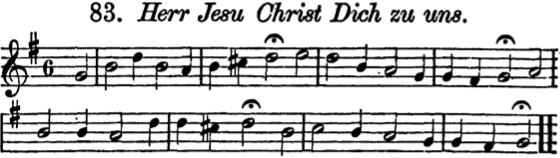
Mel.: Herr Jesu Christ, wahr Mensch und Gott.


“TO Him that sent Me now I go,

And none of you doth ask to know

Where that may be, but since I part,

With sorrow it hath filled your heart.


2 “’Tis for your good, I tell you true,

Else will the Comforter to you

Not come, whom I to you will send,

When here my earthly time shall end.


3 “He will the wicked world reprove,

Which will My Word not trust nor love,

For sin and all their wickedness,

For judgment and for righteousness.


4 “This is the world’s sin properly,

That it will not believe in Me,

But righteousness it doth despise,

Which in My work as Savior lies.


5 “The world for judgment chastens He

Because its prince by God’s decree

Is judged and sentenced and condemned,

And cannot harm My saints redeemed.


6 “I have yet many things to say,

But ye cannot them bear today.

My Spirit shall your teacher be,

And guide in truth and verity.


7 “My Word shall He explain to you,

And bring Me clearly into view,

And things to come to you will show

When it is time that ye should know.


8 “All that the Father hath is Mine,

One undivided wealth divine;

Of Mine, then, shall the Spirit take,

And show it to your for your sake.”


*9 Lord Jesus, faithful teachers send,

From all offenses them defend;

Help them to walk the pathway true

That so their flocks may follow too.


Translation © 2026 Matthew Carver.


GERMAN

Ich geh zu dem, der mich hat gsandt,

doch fragt mich unter euch niemand,

und weil ihr hört, das ich hingeh,

thuts euch in euren Herzen weh.


2 Wahrlich zum Besten euchs geschicht,

sonst kommt zu euch der Tröster nicht,

welchen ich zu euch senden werd,

wenn ich hingeh von dieser Erd.


3 Strafen wird er die bösen Welt,

welche mein Wort nit glaubt noch hält

um die Sünd, und ihre Bosheit,

ums Gricht und um die Grechtigkeit.


4 Das ist der Welt Sünd eigentlich,

das sie nit glauben will an mich,

veracht auch die Grechtigkeit,

die ihr durch mich ist zubereit.


5 Straft er die Welt auch ums Gericht,

denn der Welt Fürst, der Bösewicht,

ist gericht und verurtheilt nun,

kein Leid kann er den meinen thun.


6 Ich bet euch viel zu sagen mehr,

so ists zu tragen euch zu schwer,

mein Geist wird euer Lehrer sein,

und in der Wahrheit leiten fein.


7 Mein Wort wird er euch gar deutlich

lehren, und recht erklären mich,

auch wird er euch, was künftig ist,

verkünden zu der selben Frist.


8 Auch was der Vater hat, ist mein,

ungetheilt unser Güter sein,

drum wirds der Geist vom mein nehmen,

was er euch wird verkündigen.


*9 Gib uns treue Lehrer, Herr Christ,

und behüt sie für Ärgernis,

hilf, daß sie selbst brechen die Bahn,
damit ihr Völklein folgen kann.


14 February 2026

Wir gehn nun gen Jerusalem

Here is my translation of the hymn, “Wir gehn nun gen Jerusalem” (N. Herman, 1561), from the author’s Sonntags-Evangelia for Estomihi (Quinquagesima). Gesius 1605 appoints the

Mel.: Herr Jesu Christ, wahr Mensch und Gott.

TO Salem now our path is laid,
Christ to His dear apostles said;
What of the Son of Man of old
The prophets wrote, shall then unfold.

2 For He on earth must drink His cup,
To Gentiles be delivered up,
From them bear mock’ry and disdain,
And lastly in disgrace be slain.

3 Yet on the third day from the dead
He shall arise (mark what I’ve said).
This saying yet from them was hid,
And none therefrom could pry the lid.

4 And when to Jericho they came,
There asked a beggar blind, whose name
Was Bartimaeus, who it was:
They answered: Jesus comes to us!

5 Then he began to cry and moan:
Have mercy on me, David’s Son!
Some him rebuked and chastened sore,
But he a great deal cried the more.

6 Christ heard him cry before them all,
And them commanded him to call,
And to the man said: What wilt thou
That I should do unto thee now?

7 He said: Lord, that I might my sight
Receive, and see the shining light;
Help me the brightness of the day
To see, discern, and well survey.

8 To this the Lord Christ Jesus said:
Come, let thine eyes be openèd;
Henceforth thou shalt have sight, and see.
Thy faith hath helped and mended thee.

9 At once his eyes were bright and clear,
Their darkness all did disappear,
Then giving God the glory and praise,
He followed Christ and all His ways.

*10 Lord Jesus Christ, alas, our eyes
Oft blinded are by Satan’s lies.
In grace our minds with light amend,
From blindness body_and soul defend!

Translation © 2026 Matthew Carver.

GERMAN

Wir gehn nun gen Jerusalem,
sprach Jesus zun Apostelen;
Was die Propheten gschrieben han
vons Menschen Sohn, das wird ergahn.

2 Denn er muß hie auf dieser Erdn
den Heiden überantwort werdn,
und von ihn leiden Hohn und Spott,
auch letzlich ein schmählichen To.

3 Doch wird er wiedr am dritten Tag
vom Tod erstehn, merkt was ich sag,
die Red ihn gar verborgen was,
ihr keiner konnt versuchen das.

4 Als sie kamen bei Jericho,
da saß ein blinder Bettler do,
der fragt, wer da vorüber ging;
Jesus, ein Antwort er empfing.

5 Laut ruft er mit der Stimme sein,
Du Sohn Davids, erbarm dich mein!
Etlich darum ihn straften sehr,
er aber schreit je längr je mehr.

6 Da Jesus ihn so schreien hört,
hieß er, daß man ihn zu ihm führt,
und sprach zu ihm, Sag, was willt du
von mir haben, daß ich dir thu?

7 Er sprach: Herr, ich begehr sonst nicht
denn daß ich sehen mög das Licht,
hilf mir, daß ich des Tages Schein
erkennen mög, und sehen fein.

8 Der HErr Jesus antwort darauf:
Wohlan, so thu dein Augen auf,
forthin sollt du nun sehend sein,
dir hat gholfen der Glaube dein.

9 Alsbald wurden sein Augen klar,
ihr Finsternis verschwunden war,
drum preist er Gott und lobt ihn sehr,
folgt Christo nach und seiner Lehr.

*10 Unser Augen, Herr Jesu Christ,
verblendet oft des Teufels List.
Erleucht du uns durch deine Güt,
vor Blindheit Leib und Seel behüt.

04 October 2025

Ein Witfrau hat ein eingen Sohn

Here is my translation of the hymn “Ein Witfrau hat ein eingen Sohn” (N. Herman, 1561), from the author’s Sonntags-Evangelia for Trinity XVI, on the Gospel from Luke 7. 

For the tune, left unspecified by Herman, Gesius 1605 appoints the

Mel.: Herr Jesu Christ, wahr Mensch und Gott.
 

A WIDOW had an only son,
Who was her staff and joy alone,
Who in the flow’r of youth had died,
His mother’s heart was sorely tried.

2 With sorrow, mourning, and complaint
She to the grave in comp’ny went,
As through the gate was borne the bier,
Came Jesus with His foll’wers near.

3 He saw the mother of the dead
And to her in compassion said:
Oh, weep no more, but quiet be;
Thy son I will wake up for thee.

4 He came and touched the bier, and bade
The bearers no more move the lad,
And at that hour the dead arose
And saw that here his Master was.

5 Then there arose a conflict great,
The gate became too small and strait,
Then life would enter, death would flee,
And either would the stronger be.

6 But when Christ spoke a word of might,
Death must withdraw and take to flight;
The Lord called to the lad: Arise.
At once death must yield up its prize.

7 There was a Stronger at his side,
Who broke the bonds of death awide,
The lad upon the bier straightway
Sat up and lived again that day.

8 The lad began again to speak;
Christ gave him to his mother back,
And turned her tears and heartache sad
To bliss and joy, and she was glad.

9 At this great wonder came a fear
On those who followed at the bier,
They ever glorified their God
And praised His mercy far abroad.

10 We at the Last Day shall likewise
From death to heaven’s kingdom rise;
This joy and hope the Christian hath:
That Christ hath set them free from death.

11 Lord Christ, in mercy care for all
Poor widows and all orphans small,
In all their suffering and need,
Defend them, faithful God, with speed.

Translation © 2025 Matthew Carver.

GERMAN

Ein Witfrau hat ein eingen Sohn,
der was ihr Trost, ihr Freud und Wonn,
der starb in seiner besten Blüt,
sein Mutter ward herzlich betrübt.

2 Mit Jammer, Weh und Herzenleid,
gab sie zum Grab ihm das Geleit,
wie man zum Thor austrug die Paar,
kam Christus mist sein Jüngern dar.

3 Da er das Weib so weinen sach,
jammerts ihn sehr, und zu ihr sprach,
Hör auf zu weinen, und schweig still,
dein Sohn, ich dir aufwecken will.

4 Die Träger hieß er stille stahn,
ging zu der Paar und rührt sie an,
von stundan wurd der Tod gewahr,
daß sein Herr da verhanden war.

5 Es erhub sich ein groß Gedräng,
das Thor wollt werden gar zu eng,
der Tod wollt raus, das Leben nein,
ein jeder wollt der stärkste sein.

6 Da aber Christus sprach nur ein Wort,
da wich der Tod und mußt bald fort,
den Jüngling hieß der Herr aufstehn,
bald mußt der Tod ihn lassen gehn.

7 Es was ein stärker vor der Hand,
derselb zerriß des Todes Band,
der Jüngling sich bald auf der Paar
aufricht und wieder lebend war.

8 Zu reden auch fing an der Knab,
Christ, der Mutter ihn wieder gab,
da wurd ihr Weinen und Herzleid
verkehrt in eitel Wonn und Freud.

9 Des entsetzt sich die ganze Schar,
die nach gefolget hat der Paar,
und preisten Gott in Ewigkeit,
und rühmten sein Barmherzigkeit.

10 Am Jüngsten Tag werdn wir dergleich
vom Tod erweckt zum ewign Reich,
das ist der Christen Freu und Trost,
daß sie vom Tod Christ hat erlost.

11 Herr Christ, laß dir befohlen sein
alle Wittwen und Waisen klein,
wenn sie oft leiden Gwalt und Noth,
so bschutz du sie, o treuer Gott.

23 March 2025

Wenn ich gedenk, Herr Jesu Christ

My next new passion hymn translation is “Wenn ich gedenk, Herr Jesu Christ,” originally a lyric poem by Johann Leon (d. 1597) from his Trostbüchlein, as found in Wackernagel 4:514, no. 711 (Leon no. 73 “Trost”). It is found as a hymn as early as 1718 in the Auserlesenes und vollständiges Gsb Dresden, no. 213, set to the melody “Herr Jesu Christ, meins Lebens Licht,” with two final lines added to fill 7 stanzas, perhaps taken from or suggested by common epitaphs. Lochner quotes stanzas 1, 3–6 in his Passion-book to conclude his Devotion 17 (“Christ Begins to Be Sorrowful in the Garden of Gethsemane”). Here I give the full hymn with the omitted stanzas 2 and 7.

Mel.: O Jesu, du mein Bräutigam
 

WHEN I consider, Christ my Lord,
What anguish over Thee was poured,
  When unto death Thy soul was grieved,
  Thy sweat the form of blood received:

2 How Thou wast innocently bound,
Struck piteously with many_a wound,
  And how this toil for Thee I wrought,
  And Thee to such affliction brought:

3 Then all my bones are sore oppressed,
My heart recoils within my breast.
  Yet if I look to Thee, I see
  Thou didst it all in love for me;

4 On Thee Thou took’st my every sin,
God’s wrath and chast’ning and disdain,
  In death Thou gav’st Thyself for me,
  And poured Thy blood unstintingly.

5 Didst buy me by Thy wounds so red
From sin and death and hellish dread;
  It doth my conscience comfort bring,
  And comforts me, so that I sing:

6 My thanks and praise, O Christ, to Thee,
That Thou didst suffer death for me!
  Thy bitter death, Thy suff’ring pain,
  Alone my life and bliss remain.

7 My payment, Lord, Thou didst supply;
This is my creed, hereon I die.
  Awaken me to blessedness,
  That Thee I evermore may bless.

Translation © 2025 Matthew Carver.

GERMAN (LATER FORM)
Mel.: Herr Jesu Christ, meins Lebens Licht.

Wenn ich gedenk, Herr Jesu Christ,
wie groß dein Angst gewesen ist,
da dein Seel betrübt bis in Tod,
Dein Schweiß war(d) wie geliefert Blut,

2 Wie du gefangn unschuldiglich,
verwundt, zerschlagen jämmerlich,
ich aber dir solch Müh gemacht,
dich in solch Noth und Leiden bracht:

3 So erzittert all mein Gebein,
das Hertz erschrickt im Leibe mein.
Seh ich dich aber also an,
daß du solchs alles hast gethan

4 Aus Lieb mein Sünd auf dich gefaßt,
Gottes Zorn und Straf getragen hast,
in Tod für mich gegeben dich,
dein Blut vergossen mildiglich:

5 Und mich durch deine Wunden roth
erlöst von Sünden, Höll und Tod,
so wird mein arm Gewissen froh,
schöpf reichen Trost, und sing also:

6 Hab Lob und Dank, Herr Jesu CHrist,
daß du vor mich gestorben bist.
Dein bitter Tod, das Leiden dein
mein Heil und Leben ist allein.

7 Du hast, o Herr, bezahlt für mich,
das ist mein Glaub, darauf sterb ich.
Erweck mich auf zur Seligkeit,
daß ich dich lob in Ewigkeit.


GERMAN (ORIGINAL FORM)
Wenn ich gedenk, Herr Jesu CHrist,
wie groß deine Angst gewesen ist,
da dein Seel betrübt bis in Tod,
dein Schweiß ward wie geliefert Blut,
wie du gefangen unschüldiglich,
verwundt, zerschlagen jämmerlich,
ich aber dir solch Mühe gemacht,
dich in solch Noth und Leiden bracht:
so erzittern all meine Gebein,
das Hertz erschrickt im Leibe mein.

Sehe ich dich aber also an,
daß du solches alles hast gethan
aus Lieb, mein Sünd auf dich gefaßt,
Gottes Zorn und Straf getragen hast,
in Tod vor mich dargegeben dich,
dein Blut vergossen mildiglich,
und mich durch deine Wunden roth
erlöst von Sünden, Höll und Tod,
so wird mein arm Gewissen froh,
schöpf reichen Trost, und sprech also:
Hab Lob und Dank, Herr Jesu Christ,
daß du vor mich gestorben bist.
Dein bitter Tod, das Leiden dein
mein Heil und Leben ist allein.
Du hast, o Herr, bezahlt für mich,
das ist mein Glaub, darauf sterb ich.


19 February 2024

Christus, der wahre Gottes Sohn (supplement)

Here is my supplement to C. H. L. Schuette’s translation of the Baptism hymn, “Christus, der wahre Gottes Sohn” (N. Selnecker, d. 1592), in GGELB #239 with melody assignment “Herr Jesu Christ, dich zu uns wend” in 8 stanzas. It also appears in ELGB (Buffalo Synod), 2nd ed., #290 with melody assignment “Herr Jesu Christ wahr Mensch und Gott.” Fischer omits it. I find it first in Selencker’s Drei Predigten (1571) with title “The Sacrament of Holy Baptism” and melody assignment: “Von Himmel hoch,” and in his Psalter (1581) without melody assignment, and curiously the same year, in his Christliche Psalmen, Lieder und Kirchengesänge (1581) expanded to 14 stanzas (with 5 stanzas of scriptural narrative) and with melody “Christ der du bist der helle Tag”; later in Dresden Gsb 1656 and Crüger’s Praxis 1674, both with 8 stanzas and the latter melody. — Schuette’s 6 stanza translation occurs relatively unchanged in all the Ohio English hymnals. It is unclear why Schuette omitted two stanzas—perhaps to save space. Stanza 4 focuses on the fruit of Baptism: regeneration and eternal salvation, ideas overlapping with the previous sts. 2–3. Stanza 7 is partly subsumed by Schuette’s version of st. 6 (really a conflation of 6 and 7), so the original sense there has been restored here and a new stanza 6 has been substituted, restoring the lost idea of new obedience. Since stanza 7 earlier had substantial differences, I offer a translation of the earlier version, and in brackets that of the later text found in GGELB. An update of Schuette’s 6-stanza translation is found in ELH (1996) #248 with melody assignment “Deus tuorum militum.”


NOW Christ, the very Son of God,
On sinners sends another flood;
It is the water which the Lord
Has comprehended in the Word.

[*1 At Jordan He the Baptist nears,
Where clearly He to us appears
As our Redeemer, who His blood
Will shed for every mortal’s good.

*2 He is baptized: the Father’s Word
Speaks of His own essential Word:
My one begotten Son this is,
In whom is all My joy and bliss.

*3 He stands in manhood frail, which He
From sin and every blemish free
Took on Himself—My Son most dear:
Receive Him with respect and fear.

*4 Hear Him, all ye, both great and small,
Who fain would live in heaven’s hall.
Who hears Him not, doth lost remain
And God’s unyielding vengeance gain.

*5 The Lord Baptism establishèd
By His command and action wed,
To be in a church a water pure
In God’s own Word for mortals’ cure.]

2 This flood, to cleanse sin's leprosy,
Mere earthly water cannot be;
But water and God's gracious Word
Conjoined, this saving bath afford.

3 "Go ye," says Christ, "my Word proclaim,
Baptize the nations in God's name;
All who are baptized and believe
My full salvation shall receive."

4 In water is God’s mighty Word,
New birth is here on man conferred,
The living water full of grace
Brings him to heaven’s dwelling place.

5 God, Father, Son, and Holy Ghost,
To be baptized invites the host;
He will be present, though unseen, > There is He present, as He saith,
From all their sins to wash them clean. > And puts an end to sin and death.

6 To drown is now old Adam’s fate, [So too, by our repentance, must]
He dies with all his sinful weight; [The old man, with his sins and lust,]
By true repentance every day [Be daily drowned, and then arise]
He now must serve and follow aye. [A new man, righteous, pure, and wise.]

7 A new man now emerges thence, [A new man now we see arise,
Adorned with Jesus’ innocence, [Adorned before God’s holy eyes
In righteousness and purity [In innocence and righteousness;
He lives with God eternally. [Eternal life he doth possess.

8 That by the water and the Word
We're born again, we thank Thee, Lord!
In life and death Thine let us be,
And Thine in all eternity.

[** Lord Jesus, send the Holy Ghost,
That we to Thee may hearken most,
And newborn children ever be,
And come to heaven and to Thee.]

Translation 1–3, 5–[6], 8, C. H. L. Schuette, 1880, alt.
Translation sts. *1–•5, 4, 6–7, ** © 2024 Matthew Carver.


GERMAN

Christus der wahre Gottessohn
richt wiederum ein Sündfluth an,
welchs ist die Tauf und Seelenbad,
das er im Wort gefasset hat.

* Er kommt zum Täufer am Jordan,
da wird er uns gewiesen an,
als unser Heiland, der sein Blut,
vergiessen will uns alln zugut.

* Er wird getauft: Des Vaters Wort,
spricht von seim wesentlichen Wort:
Das ist mein eingeborner Sohn,
an dem mein Herz hat Freud und Wonn.

* Da steht er in der Menschheit zart,
die er ohn Sünd und Sündenart
hat gnommen an, mein lieber Sohn,
den ich euch will befohlen han.

* Den sollt ihr hören allzugleich,
die ihr begehrt das Himmelreich:
Wer ihn nicht hört, der bleibt verlorn,
unter dem strengen Gotteszorn.

* Die Tauf der Herr bestätigt hat
mit seim Befehl und mit der That,
das sie soll in der Kirche sein
in Gottes Wort ein Wasser rein.

2 Solch Tauf kann nicht schlecht Wasser sein,
sondern es ist der Gnadenschein,
mit Gottes Wort verbunden wohl,
darin die Sünd ersaufen soll.

3 Geht hin, spricht er, in alle Welt,
tauft alle Heiden ohn Entgeld,
wer nur gläubt und getaufet wird,
das ewig leben er erwirbt.

4 Gotts Wort und Kraft im Wasser ist,
der Mensch hie neu geboren ist:
Des Lebens Wasser gnadenreich
führt ihn ins ewig Himmelreich.

5 Gott Vater, Sohn, heiliger Geist,
zur Tauf uns alle kommen heißt,
da will er gegenwärtig sein,
die Sünd und den Tod treiben ein. [von Sünden uns abwaschen rein.]

6 Der alt Adam ersäufet wird, [Der alte Mensch…]
mit bösen Lüsten er abstirbt; [mit seinen…erstirbt;]
durch täglich Reu und wahre Buß [durch tägliche…]
er nun dienen und folgen muß [Er Gott nunmehro dienen…]

7 Ein neuer Mensch tritt jetzt herein,
in Christi Unschuld gzieret fein [vor Gott ist er gezieret…]
in Grechtigkeit und Reinigkeit […Unschuld und Gerechtigkeit]
lebt er vor Gott in Ewigkeit.

8 Von Sünden er erstanden ist,
Dank sei Dir, o Herr Jesu Christ!
Dir leben wir, Dir sterben wir,
Dein sind wir immer für und für.

* Herr Jesu, gib uns deinen Geist,
das wir dich hören allermeist,
und neugeborne Kinder sein,
und kommen in den Himmel dein.


04 May 2023

O Sündenmensch, bedenk dein Tod

Here is my translation of the Eternity hymn “O Sündenmensch, bedenk dein Tod” (Georg Philipp Harsdörfer, d. 1658), Ev.-luth. Gsb #692, originally published in the author’s Hertzbewegliche Sontags-Andachten nach den Evangelien (Nuremberg, 1649). The appointed melody is “Herr Jesu Christ, wahr Mensch und Gott.”


O MAN of sin, think on thy death,
Thy last distress, thy final breath;
By true repentance ready thee
To live for all eternity.

2 Though ye possess the whole wide world,
With highest honor and all gold,
A little time it gladdens thee,
And serves not for eternity.

3 Oh, dost thou not the echoes hear:
“Ye dead, for judgment now appear”?
The Last Day is not far from thee.
Then cometh dread eternity.

4 That God’s good grace may be enjoyed,
The heavy guilt of sin avoid,
That fights thy soul most angrily;
Free art thou in eternity.

5 Unnumbered are the starry host
And grains of sand upon the coast,
Yet they have measure and degree;
Not so is God’s eternity.

6 Oh, think and ponder undeterred:
Eternity! O thundrous word!
Time of no eons setteth free
The pure, untamed Eternity!

Translation © 2023 Matthew Carver.

GERMAN
O Sündenmensch, bedenk den Tod,
der letzten Stunde Angst und Noth!
Mach dich mit wahrer Buß bereit,
zu leben in der Ewigkeit.

2 Besitzet du die ganze Welt
mit höchster Ehr und allem Geld:
erfreut es dich ein kleine Zeit,
und dienet nicht zur Ewigkeit.

3 Erschallt in deinen Ohren nicht:
Ihr Todten kommet vor Gericht?
Ist doch der jüngste tag nicht weit,
dem folgen wird die Ewigkeit.

4 Wenn du begehrest Gottes Huld,
so meid der Sünden schwere Schuld,
die wider deine Seele streit:
so bist du frei in Ewigkeit.

5 Unzählig ist der Sterne Heer,
die Tropfen und der Sand am Meer:
doch haben sie Maaß, Ziel and Zeit,
ind gleichen nicht der Ewigkeit.

6 Besinn und denke fort und fort,
was Ewig! für ein Donnerwort.
Ach keiner Zeiten Zeit befreit
die Ewig-Ewig-Ewigkeit!

22 April 2023

Leb ich, so leb ich meinem Gott

Here is my translation of the death hymn, “Leb ich, so leb ich meinem Gott” (Anon., 16th c.?), in Ev.-luth. Gsb #661, based on Romans 14:8. Fischer has no entry for it. It is in fact originally a rhymed prayer for the dying found especially in early “art of dying” books and hymnals as a single stanza. I find it first in the Nuremberg Gsb 1590 (525 Geistliche Lieder…), and funeral orders, such as Seb. Wresovic’s Gloriae Christi sacrum (1594) and Johann Juglerus’ funeral sermon for Otto Henry, Elector Palatine (1604). Its early appearance in Nuremberg points to a possible connection with a Bohemian source. Later it appears in other art-of-dying manuals and hymnals, e.g., of Bernhard Albrecht (1666); Daniel Tanner (Regensburg, 1646), etc. It is especially reminiscent of lines by Johannes Leon, e.g., in “Ich hab mein Sach Gott heimgestellt,” and “Leb ich, O mein Herr Jesu Christ, so leb ich dir, mein Heyland bist” (Wackernagel IV, p. 512) and probably dates from his time, being included also in his posthumous Ejaculationes, das sind, Kurtze Hertzerweichende Klag (cf. ed. 1620). The appointed melody in the Wisconsin hymnal is “Herr Jesu Christ, wahr Mensch und Gott.”


NOW, if I live, I live to God,
And if I die, I fear no rod,
For I in Jesus Christ confide,
And trust that for my sins He died.

2 He that believes in Him, dies not
Nor shall dread judgment be his lot.
Therefore I die with willing heart;
In peace and joy I shall depart.

3 When at the Last Day God shall sound
His mighty trump, I’ll leave the ground
And joy in Christ eternally:
So grant it, Holy Trinity!

Translation © 2023 Matthew Carver.

GERMAN
Leb ich, so leb ich meinem Gott;
sterb ich, so hört auf all mein Noth;
ich glaub, das mein Herr Jesus Christ
für all meine Sünd gestorben ist.

2 Wer an ihn glaubt, der stirbet nicht,
und kommt auch nimmer ins Gericht.
Drum ich zu sterben willig bin,
absterben ist meine bester G'winn.

3 Wenn Gottes Posaun wird angehn
am jüngsten Tag, will ich aufstehn,
bei Christo sein in ewger Freud,
das helf die wahr Dreienigkeit!

Amen.


GERMAN VARIANTS
sterb ich, so hört auf all mein Noth.
Ich glaub, daß mein Herr Jesus Christ
für all mein Sünd gestorben ist.
Wer an ihn glaubet stirbet nicht, […glaubt, der stirbet nicht]
viel wenigr wird derselb gericht, [viel wenger…]
drum ich zum Sterben willig bin,
mit Fried und Freud ich fahr dahin. {or, Absterben ist vor mein Gewinn. Amen.}
Wann Gottes Posaun wird angehn,
am Jüngsten Tag will ich aufstehn,
[mein lieben Gott von Angesicht
ewig schauen, dran zweifl ich nicht,]
in aller Freud und Herrlichkeit,
das helf mir die Dreifaltigkeit. Amen.

30 September 2022

Hallelujah! Jesus lebt (supplement)

Here is my supplement to Emmanuel Cronenwett’s’ 1880 translation of the Easter hymn, “Hallelujah! Jesus lebt” (Benjamin Schmolck, 1731), “Hallelujah! Lo, He wakes! / Lives! O’er death and hell victorious”—not to be confused with the Borthwick translation of Garve’s hymn: “Hallelujah, Jesus lives / He is now the living One.” Neither should this be confused for the various versions or revisions by Danneil, Hiller, et al. Cronenwett omits stanza 4, which I attempt below (as well as altering lines 1 and 3 in his first stanza). His translation appears with a different alteration (by J. T. Mueller) of the first stanza in Selah Gesangbuch as “Hallelujah! Jesus Lives / Over death and hell victorious.” Here, curiously, stanza 4 is given in the German instead of 5 in the English cento. Miss Anna Warner, in Hymns of the Church Militant, p. 486, gives a translation “Hallelujah! Jesus lives! Life, immortal . . .” but it is not in the original meter. Though a newer melody was written which calls for a repetition of the last line, our present hymnal appoints “Jesus, meine Zuversicht.”


HALLELUJAH! Jesus lives!
O’er the foe and death victorious;
Earth, all trembling, passage gives
As the Hero rises glorious;
He who died on Golgotha,
Jesus lives, Hallelujah!

2 Hallelujah! See the tomb,
Ye who o'er His death are pining;
Dry your tears, to joy give room,
While the radiant sun is shining.
Hear the angels' Gloria;
Jesus lives, Hallelujah!

3 Hallelujah! Why seek ye
Yet among the dead the living?
Christ is ris'n in majesty!
Hence away with gloomy grieving,
Join with her of Magdala:
Jesus lives, Hallelujah!

4 Hallelujah! Here’s a word
To revive the soul like thunder!
Though life may no chance afford
On that tomb to look with wonder,
Yet faith sees it from afar:
Jesus lives! Hallelujah!

5 Hallelujah! then I cry;
Christ too will from death restore me,
Take me to His throne on high,
Whither He has gone before me.
Faith exults: Victoria!
Jesus lives, Hallelujah!

Translation sts. 1–3, 5, E. Cronenwett 1880, alt.
Translation st. 4 © 2022 Matthew Carver.


GERMAN

1 Hallelujah! Jesus lebt!
Tod und Teufel sind bezwungen,
Gruft und Kluft und Erde bebt,
da der Held hindurchgedrungen.
Geht nicht mehr nach Golgatha!
Jesus lebt, Hallelujah!

2 Hallelujah! seht das Grab,
die ihr weinen Tod beweinet;
wischet eure Thränen ab,
weil die helle Sonne scheinet.
Euer Heiland ist nicht da.
Jesus lebt, Hallelujah!

3 Hallelujah! suchet nicht
den Lebendigen bei Toten;
glaubet aber dem Bericht
der verklärten Osterboten,
diese wissen, was geschah;
Jesus lebt, Hallelujah!

4 Hallelujah! dieses Wort
soll mich wiederum beleben;
kann ich gleich nicht an den Ort
seines Grabes mich begeben;
gnug, daß es meine Glaube sah;
Jesus lebt, Hallelujah!

5 Hallelujah! er wird mir
Leben in dem Tode geben;
also sterb ich freudig hier,
Christi Tod ist nun mein Leben.
Nur getrost, ich glaube ja:
Jesus lebt, Hallelujah!


29 September 2022

Der du, Herr Jesu, Ruh und Rast

Here is my translation of the Passion hymn “Der du, Herr Jesu, Ruh und Rast” (Georg Werner, d. 1671), as found in Ev.-Luth. Gsb #183. Fitting for the end of Good Friday or on Holy Saturday, it originates in the author’s Hundert Psalmen Davids nach Evangelischen Kirchen Melodeyen zu singen (Königsberg, 1638). The appointed melody is “Herr Jesu Christ, wahr Mensch und Gott.”


LORD Jesus, our Redeemer blest,
Who in Thy tomb didst take Thy rest,
Grant that we all may rest in Thee
And let our life God-pleasing be.

2 All needful strength and courage, Lord,
Won by Thy blood, to us afford.
And bring us into heaven’s light
To God Thy Father’s glorious sight.

3 O Lamb of God, our thanks to Thee,
Who slaughtered wast upon the Tree;
May Thy dear pains for sinners prove
An entrance to the life above.

Translation © 2022 Matthew Carver.

GERMAN

Der du, Herr Jesu, Ruh und Rast
in deinem Grab gehalten hast:
gieb, daß wir in dir ruhen all,
und unser Leben dir gefall.

2 Verlieh, o Herr, uns Stärk und Muth,
die du erkauft mit deinem Blut;
und führ uns in des Himmels Licht
zu deines Vaters Angesicht.

3 Wir danken dir, o Gotteslamm,
getödtet an des Kreuzes Stamm;
laß ja uns Sündern deine Pein
ein Eingang in das Leben sein.

17 July 2010

Mit Todsgedanken geh ich um

Here is my translation of the hymn “Mit Todsgedanken geh ich um” (Nic. Hermann, †1561) a contemplation of mortality. Ludecus appoints the hymn for Trinity XVI. The melody is “Herr Jesu Christ, wahr Mensch und Gott.”


WITH thoughts of death I journey on,
He circles round me, dusk and dawn,
And tracks my step so constantly,
Each place I turn, his face I see.

2. His bow is raised, his arrow nocked,
His sights upon me trained and locked;
He bides the hour with sleepless eye
Till he shall let his arrow fly.

3. No time, I know, will he allot.
Prepared or no, it matters not.
For come he will, and speak a word,
And I must follow undeterred.

4. And so, my soul, make ready here;
Death may this very day appear
And take thee to the judgment seat
Where Christ the judge thy doom will mete.

5. Oh, be thou purged of every sin
And all thy guilt without, within,
By Jesus’ blood; Thy trespass own.
In Him is righteousness alone.

6. To leave thy burden do not fear,
For thou art but a stranger here
In this poor, fragile house of clay,
And thou must surely leave someday.

7. But know, the Shepherd of thy soul,
Thy Savior, will remake thee whole,
That e’en thy flesh, which here must fade,
Will, healed, arise, in life arrayed.

8. Then soul and body, both unriv’n,
Shall make one resident of heav’n,
And ever have God’s Son in sight
Upon His glorious throne of might.

9. There shalt thou be as Adam first,
Unsoiled by sin, thy stain reversed,
In righteousness and piety
As God created man to be.

10. Let this, o soul, thy joy afford:
We are redeemed by Christ our Lord;
Let go this life with will content,
And homeward make thy blest ascent.

Translation © Matthew Carver, 2010

GERMAN
1. Mit Todsgedanken geh ich um;
der Tod geht stets um mich herum,
und bleibt mir stündlich auf dem Fuß,
daß ich stets seiner warten muß.

2. Den Bogen hat er schon gespannt
und hält den Pfeil in seiner Hand,
er nimmt des Seigers immer wahr,
bis daß er ausläuft ganz und gar.

3. Ich weiß, er läßt mir keine Frist;
Ich sei woihl, oder nicht gerüstt,
kommt er, und spricht ein einzig Wort,
so muß ich auf und mit ihm fort.

4. Drum, meine Seele, sei bereit!
Vielleicht geschiehts, er kommt noch heut,
und fordert dich hin vors Gericht,
da Christus sitzt und Urtheil spricht.

5. Ach, reinge dich von aller Sünd
und was an dir sich strafbar findt,
durch Christi Blut mit Reu und Leid!
Bei ihm nur ist Gerechtigkeit.

6. Leg freudig ab des Leibes Last!
O Seele, du bist nur ein Gast
in diesem schwachen Erdenhaus,
aus dem du einmal mußt heraus.

7. Doch wisse, daß dein Seelenhirt’
und Heiland dich erneuern wird,
daß auch dein Leib, der hier verwest,
dann auferstehet und genest.

8. Da werden Seel und Leib zugleich
Einwohner sein im Himmelreich,
und ewig schauen Gottes Sohn
auf seiner Allmacht Ehrenthron.

9. Dort wirst du, wie im Anfang, sein,
von aller Sünde lauter, rein,
gerecht und fromm, wie Gott einst ließ
den Adam sein im Paradies.

10. Dies seis, o Seele, was dich tröstt:
Christ, unser Herr, hat uns erlöst;
gib willig nur dies Leben auf,
und flieh zu deinem Ursprung auf!